Faculdade da Saúde e Ecologia Humana, FASEH, Vespasiano, MG, Brazil.
Program in Global Surgery and Social Change, Harvard Medical School, Boston, MA, USA.
Vaccine. 2022 Apr 1;40(15):2292-2298. doi: 10.1016/j.vaccine.2022.02.076. Epub 2022 Mar 1.
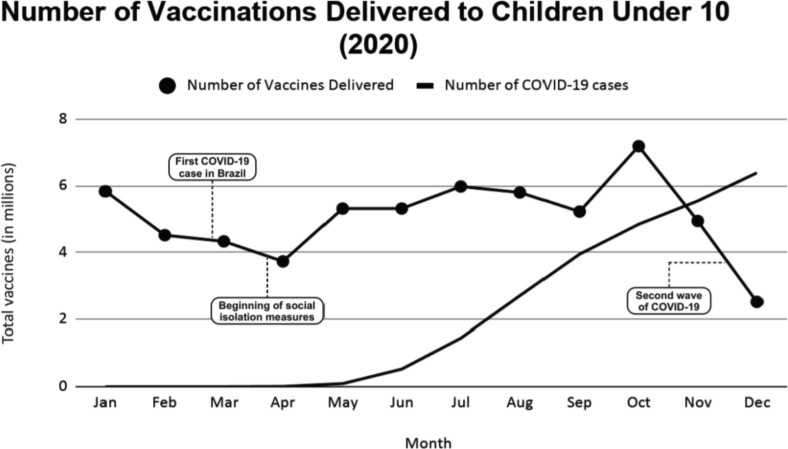
Childhood vaccination rates have decreased significantly during the COVID-19 pandemic. The Brazilian immunization program, Programa Nacional de Imunização (PNI), is a model effort, achieving immunization rates comparable to high-income countries. This study aimed to evaluate the impact of the COVID-19 pandemic in pediatric vaccinations administered by the PNI, as a proxy of adherence to vaccinations during 2020.
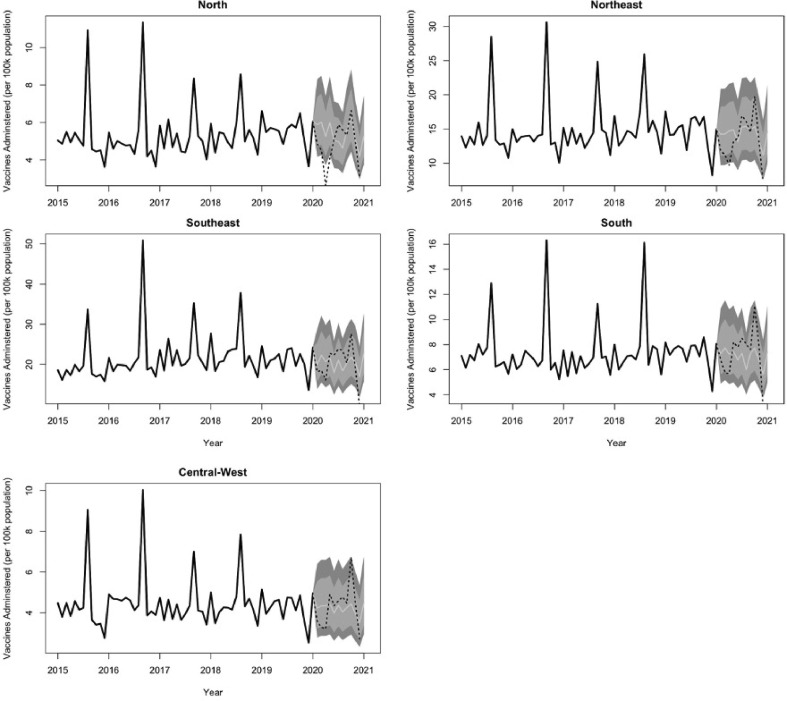
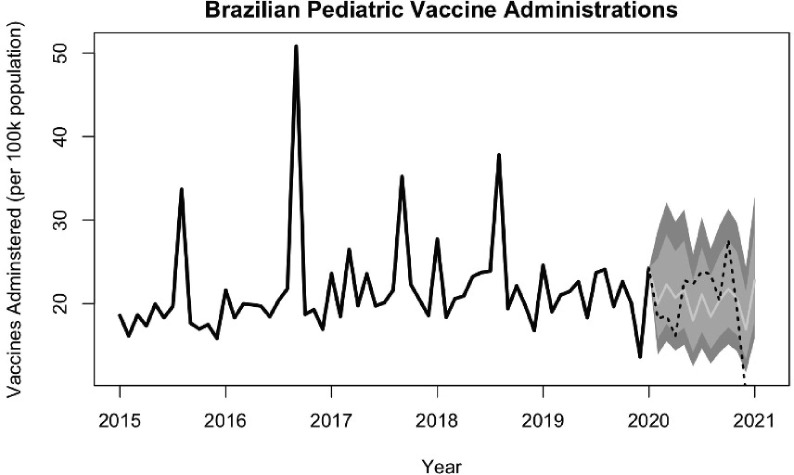
Data on the number of vaccines administered to children under 10 years of age nationally and in each of Brazil's five regions were extracted from Brazil's federal health delivery database. Population adjusted monthly vaccination rates from 2015 through 2019 were determined, and autoregressive integrated moving average (ARIMA) models were used to forecast expected vaccinated rates in 2020. We compared the forecasts to reported vaccine administrations to assess adequacy of pediatric vaccine delivery during the COVID-19 pandemic.
From January 2015 to February 2020, the average rate of vaccine administration to children was 53.4 per 100,000. After February 2020, this rate decreased to 50.4, a 9.4% drop compared to 2019 and fell outside of forecasted ranges in December 2020. In Brazil's poorest region, the North, vaccine delivery fell outside of the forecasted ranges earlier in 2020 but subsequently rebounded, meeting expected targets by the end of 2020. However, in Brazil's wealthiest South and Southeast regions, initial vaccine delivery fell and remained well below forecasted rates through the end of 2020.
In Brazil, despite a model national pediatric vaccination program with an over 95% national coverage, vaccination rates decreased during the COVID-19 pandemic. Coordinated governmental efforts have ameliorated some of the decrease, but more efforts are needed to ensure continued protection from preventable communicable diseases for children globally.
在 COVID-19 大流行期间,儿童疫苗接种率显著下降。巴西免疫计划(Programa Nacional de Imunização,PNI)是一项模范工作,实现了可与高收入国家相媲美的免疫接种率。本研究旨在评估 COVID-19 大流行对 PNI 管理的儿科疫苗接种的影响,以此作为 2020 年疫苗接种依从性的替代指标。
从巴西联邦卫生服务数据库中提取了全国和巴西五个地区 10 岁以下儿童接种疫苗的数量数据。确定了 2015 年至 2019 年每月调整人口的疫苗接种率,并使用自回归综合移动平均(ARIMA)模型预测 2020 年预计接种率。我们将预测值与报告的疫苗接种情况进行比较,以评估 COVID-19 大流行期间儿科疫苗接种的充足性。
从 2015 年 1 月至 2020 年 2 月,儿童疫苗接种率平均为每 10 万人 53.4 剂。2020 年 2 月后,这一比例降至 50.4,比 2019 年下降 9.4%,且 2020 年 12 月的实际值已超出预测范围。在巴西最贫困的北部地区,疫苗接种在 2020 年初就已超出预测范围,但随后有所反弹,到 2020 年底已达到预期目标。然而,在巴西最富裕的南部和东南部地区,最初的疫苗接种率下降且一直远低于预测值,直到 2020 年底。
尽管巴西拥有一个全国性的儿科疫苗接种计划,覆盖率超过 95%,但在 COVID-19 大流行期间,疫苗接种率仍有所下降。协调一致的政府努力缓解了部分下降,但仍需要做出更多努力,以确保全球儿童继续免受可预防的传染病的侵害。