ifo Institute - Leibniz Institute for Economic Research at the University of Munich, Poschingerstr. 5, 81679, Munich, Germany.
Economics Department, University of Munich, Ludwigstr. 28, 80539, Munich, Germany.
Eur J Health Econ. 2023 Feb;24(1):67-74. doi: 10.1007/s10198-022-01452-y. Epub 2022 Mar 19.
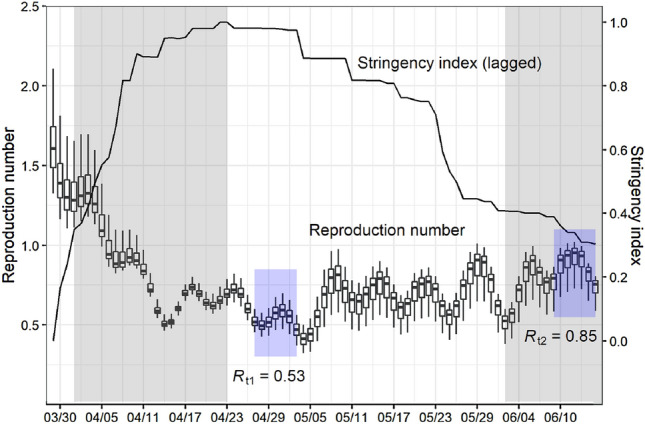
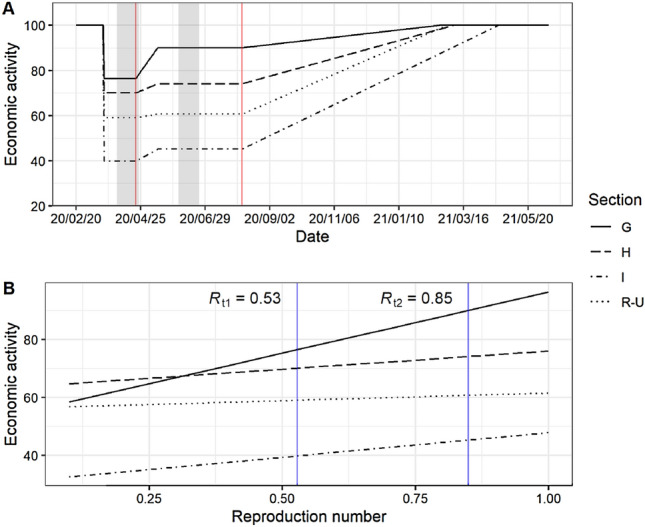
We develop a novel approach integrating epidemiological and economic models that allows data-based simulations during a pandemic. We examine the economically optimal opening strategy that can be reconciled with the containment of a pandemic. The empirical evidence is based on data from Germany during the SARS-CoV-2 pandemic. Our empirical findings reject the view that there is necessarily a conflict between health protection and economic interests and suggest a non-linear U-shape relationship: it is in the interest of public health and the economy to balance non-pharmaceutical interventions in a manner that further reduces the incidence of infections. Our simulations suggest that a prudent strategy that leads to a reproduction number of around 0.75 is economically optimal. Too restrictive policies cause massive economic costs. Conversely, policies that are too loose lead to higher death tolls and higher economic costs in the long run. We suggest this finding as a guide for policy-makers in balancing interests of public health and the economy during a pandemic.
我们开发了一种新的方法,将流行病学和经济模型结合起来,允许在大流行期间进行基于数据的模拟。我们研究了经济上最优的开放策略,该策略可以与大流行的控制相协调。实证证据基于 SARS-CoV-2 大流行期间德国的数据。我们的实证研究结果否定了这样一种观点,即健康保护和经济利益之间必然存在冲突,并表明存在一种非线性 U 型关系:通过非药物干预进一步降低感染发生率,符合公共卫生和经济利益。我们的模拟表明,一种谨慎的策略,导致繁殖数约为 0.75,在经济上是最优的。过于严格的政策会导致巨大的经济成本。相反,过于宽松的政策从长远来看会导致更高的死亡率和更高的经济成本。我们建议这一发现作为决策者在大流行期间平衡公共卫生和经济利益的指导。