Ragab Mahmoud, Albukhari Ashwag, Alyami Jaber, Mansour Romany F
Information Technology Department, Faculty of Computing and Information Technology, King Abdulaziz University, Jeddah 21589, Saudi Arabia.
Centre for Artificial Intelligence in Precision Medicines, King Abdulaziz University, Jeddah 21589, Saudi Arabia.
Biology (Basel). 2022 Mar 14;11(3):439. doi: 10.3390/biology11030439.
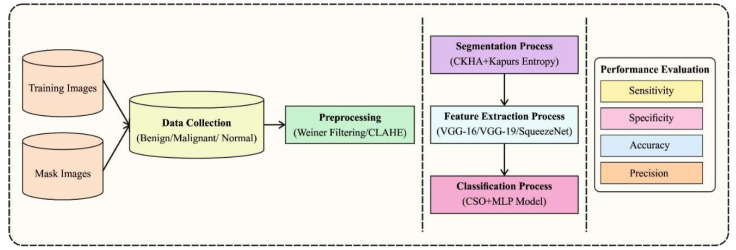
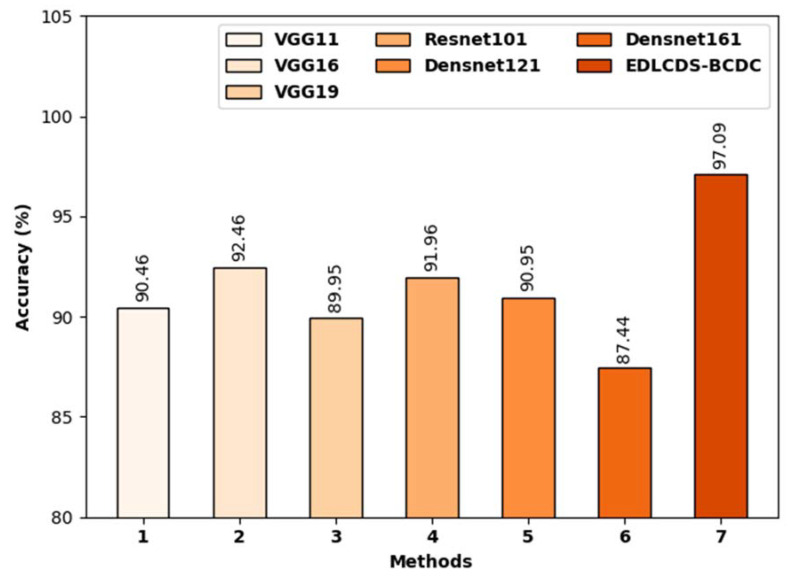
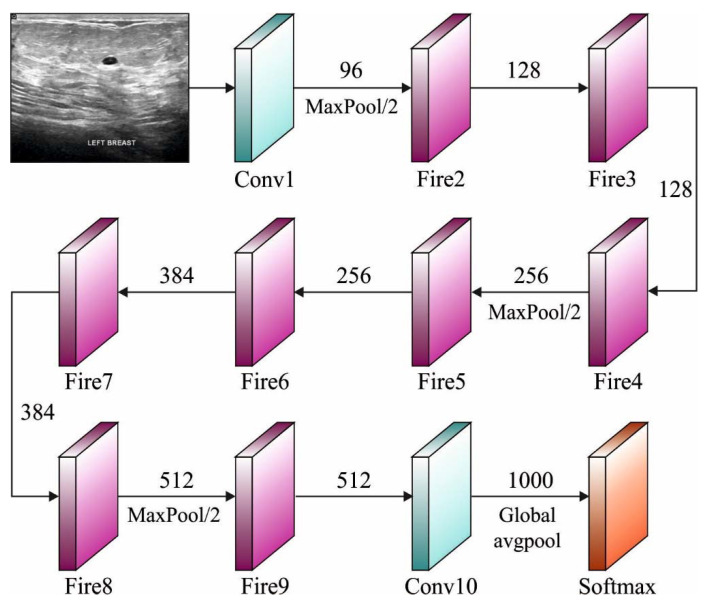
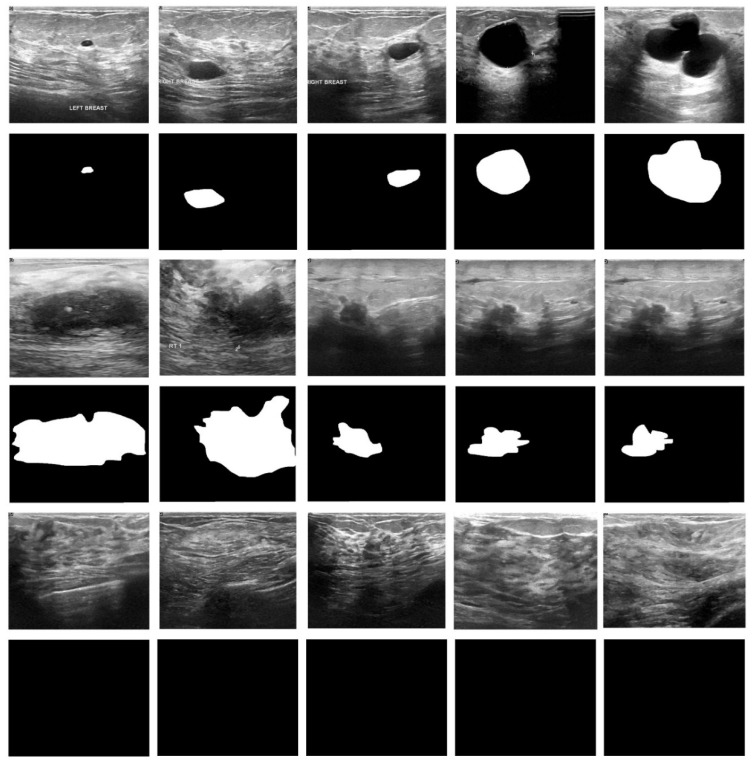
Clinical Decision Support Systems (CDSS) provide an efficient way to diagnose the presence of diseases such as breast cancer using ultrasound images (USIs). Globally, breast cancer is one of the major causes of increased mortality rates among women. Computer-Aided Diagnosis (CAD) models are widely employed in the detection and classification of tumors in USIs. The CAD systems are designed in such a way that they provide recommendations to help radiologists in diagnosing breast tumors and, furthermore, in disease prognosis. The accuracy of the classification process is decided by the quality of images and the radiologist's experience. The design of Deep Learning (DL) models is found to be effective in the classification of breast cancer. In the current study, an Ensemble Deep-Learning-Enabled Clinical Decision Support System for Breast Cancer Diagnosis and Classification (EDLCDS-BCDC) technique was developed using USIs. The proposed EDLCDS-BCDC technique was intended to identify the existence of breast cancer using USIs. In this technique, USIs initially undergo pre-processing through two stages, namely wiener filtering and contrast enhancement. Furthermore, Chaotic Krill Herd Algorithm (CKHA) is applied with Kapur's entropy (KE) for the image segmentation process. In addition, an ensemble of three deep learning models, VGG-16, VGG-19, and SqueezeNet, is used for feature extraction. Finally, Cat Swarm Optimization (CSO) with the Multilayer Perceptron (MLP) model is utilized to classify the images based on whether breast cancer exists or not. A wide range of simulations were carried out on benchmark databases and the extensive results highlight the better outcomes of the proposed EDLCDS-BCDC technique over recent methods.
临床决策支持系统(CDSS)提供了一种利用超声图像(USI)诊断乳腺癌等疾病的有效方法。在全球范围内,乳腺癌是导致女性死亡率上升的主要原因之一。计算机辅助诊断(CAD)模型广泛应用于超声图像中肿瘤的检测和分类。CAD系统的设计目的是为放射科医生提供建议,以帮助诊断乳腺肿瘤,并进一步进行疾病预后评估。分类过程的准确性取决于图像质量和放射科医生的经验。研究发现,深度学习(DL)模型的设计在乳腺癌分类中是有效的。在当前的研究中,利用超声图像开发了一种用于乳腺癌诊断和分类的集成深度学习临床决策支持系统(EDLCDS-BCDC)技术。所提出的EDLCDS-BCDC技术旨在利用超声图像识别乳腺癌的存在。在该技术中,超声图像首先经过两个阶段的预处理,即维纳滤波和对比度增强。此外,将混沌磷虾群算法(CKHA)与卡普尔熵(KE)应用于图像分割过程。此外,使用VGG-16、VGG-19和SqueezeNet这三种深度学习模型的集成进行特征提取。最后,利用基于多层感知器(MLP)模型的猫群优化(CSO)算法对图像进行分类,判断是否存在乳腺癌。在基准数据库上进行了广泛的模拟,大量结果突出了所提出的EDLCDS-BCDC技术相对于最近方法的更好效果。