Rubbert Christian, Wolf Luisa, Turowski Bernd, Hedderich Dennis M, Gaser Christian, Dahnke Robert, Caspers Julian
University Dusseldorf, Medical Faculty, Department of Diagnostic and Interventional Radiology, D-40225, Dusseldorf, Germany.
Department of Diagnostic and Interventional Neuroradiology, School of Medicine, Technical University of Munich, 81675, Munich, Germany.
Insights Imaging. 2022 Mar 26;13(1):54. doi: 10.1186/s13244-022-01195-7.
Defacing has become mandatory for anonymization of brain MRI scans; however, concerns regarding data integrity were raised. Thus, we systematically evaluated the effect of different defacing procedures on automated brain atrophy estimation.
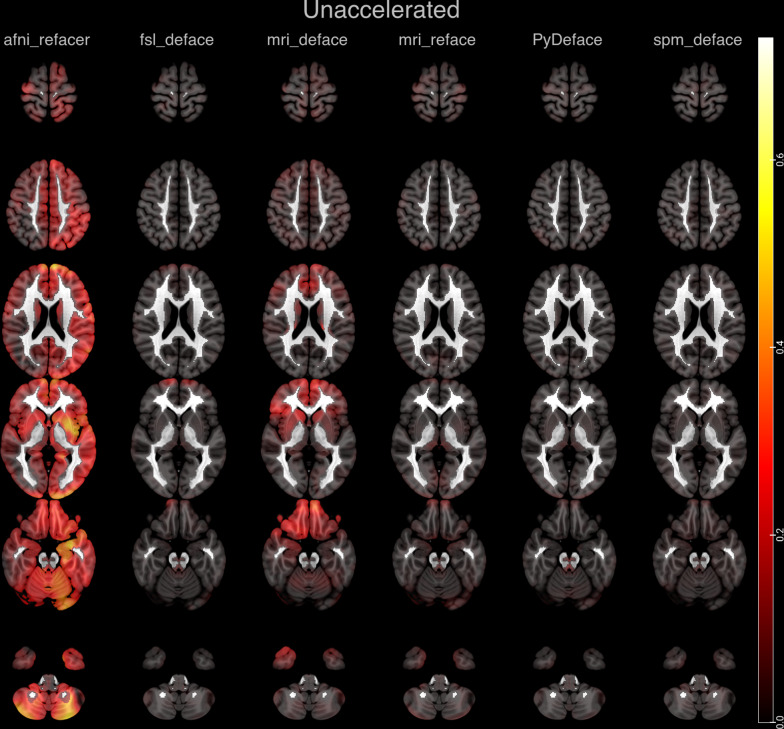
In total, 268 Alzheimer's disease patients were included from ADNI, which included unaccelerated (n = 154), within-session unaccelerated repeat (n = 67) and accelerated 3D T1 imaging (n = 114). Atrophy maps were computed using the open-source software veganbagel for every original, unmodified scan and after defacing using afni_refacer, fsl_deface, mri_deface, mri_reface, PyDeface or spm_deface, and the root-mean-square error (RMSE) between z-scores was calculated. RMSE values derived from unaccelerated and unaccelerated repeat imaging served as a benchmark. Outliers were defined as RMSE > 75th percentile and by using Grubbs's test.
Benchmark RMSE was 0.28 ± 0.1 (range 0.12-0.58, 75th percentile 0.33). Outliers were found for unaccelerated and accelerated T1 imaging using the 75th percentile cutoff: afni_refacer (unaccelerated: 18, accelerated: 16), fsl_deface (unaccelerated: 4, accelerated: 18), mri_deface (unaccelerated: 0, accelerated: 15), mri_reface (unaccelerated: 0, accelerated: 2) and spm_deface (unaccelerated: 0, accelerated: 7). PyDeface performed best with no outliers (unaccelerated mean RMSE 0.08 ± 0.05, accelerated mean RMSE 0.07 ± 0.05). The following outliers were found according to Grubbs's test: afni_refacer (unaccelerated: 16, accelerated: 13), fsl_deface (unaccelerated: 10, accelerated: 21), mri_deface (unaccelerated: 7, accelerated: 20), mri_reface (unaccelerated: 7, accelerated: 6), PyDeface (unaccelerated: 5, accelerated: 8) and spm_deface (unaccelerated: 10, accelerated: 12).
Most defacing approaches have an impact on atrophy estimation, especially in accelerated 3D T1 imaging. Only PyDeface showed good results with negligible impact on atrophy estimation.
对脑部磁共振成像(MRI)扫描进行匿名化处理时,毁损已成为一项强制性要求;然而,人们对数据完整性提出了担忧。因此,我们系统地评估了不同毁损程序对脑萎缩自动估计的影响。
总共从阿尔茨海默病神经影像倡议(ADNI)中纳入了268例阿尔茨海默病患者,其中包括未加速成像(n = 154)、同次扫描内未加速重复成像(n = 67)和加速三维T1成像(n = 114)。使用开源软件veganbagel对每幅原始未修改扫描图像以及使用afni_refacer、fsl_deface、mri_deface、mri_reface、PyDeface或spm_deface进行毁损后的图像计算萎缩图谱,并计算z分数之间的均方根误差(RMSE)。来自未加速成像和未加速重复成像的RMSE值作为基准。异常值定义为RMSE > 第75百分位数,并通过格拉布斯检验确定。
基准RMSE为0.28 ± 0.1(范围0.12 - 0.58,第75百分位数为0.33)。使用第75百分位数临界值时,在未加速和加速T1成像中发现了异常值:afni_refacer(未加速:18例,加速:16例)、fsl_deface(未加速:4例,加速:18例)、mri_deface(未加速:0例,加速:15例)、mri_reface(未加速:0例,加速:2例)和spm_deface(未加速:0例,加速:7例)。PyDeface表现最佳,未发现异常值(未加速平均RMSE 0.08 ± 0.05,加速平均RMSE 0.07 ± 0.05)。根据格拉布斯检验发现了以下异常值:afni_refacer(未加速:16例,加速:13例)、fsl_deface(未加速:10例,加速:21例)、mri_deface(未加速:7例,加速:20例)、mri_reface(未加速:7例,加速:6例)、PyDeface(未加速:5例,加速:8例)和spm_deface(未加速:10例,加速:12例)。
大多数毁损方法都会对萎缩估计产生影响,尤其是在加速三维T1成像中。只有PyDeface显示出良好的结果,对萎缩估计的影响可忽略不计。