Canadian Centre for Disease Modeling (Yuan, Juan Li, Aruffo, Q. Li, Zheng, Heffernan, Tan, Jun Li, Arino, Bélair, Watmough, Kong, Moyles, Zhu), and Department of Mathematics and Statistics (Yuan, Aruffo, Heffernan, Tan, Kong, Moyles, Zhu), York University, Toronto, Ont.; Complex Systems Research Center (Juan Li), Shanxi University, Taiyuan, Shanxi, China; Toronto Public Health (Gatov, Collier), City of Toronto, Toronto, Ont.; Department of Mathematics (Q. Li), Shanghai Normal University, Shanghai, China; College of Mathematics and System Science (Zheng), Xinjiang University, Urumqi, Xinjiang, China; Public Health Risk Sciences Division (Ogden), National Microbiology Laboratory, Public Health Agency of Canada, Sainte-Hyacinthe, Que.; Toronto Health Economics and Technology Assessment (THETA) Collaborative (Sander), University Health Network; Dalla Lana School of Public Health (Sander), University of Toronto, Toronto, Ont.; School of Mathematics and Statistics (Jun Li), Xidian University, Xi'an, Shaanxi, China; Department of Mathematics (Arino), University of Manitoba, Winnipeg, Man.; Département de mathématiques et de statistique (Bélair), Université de Montréal, Montréal, Que.; Department of Mathematics and Statistics (Watmough), University of New Brunswick, Fredericton, NB.
Canadian Centre for Disease Modeling (Yuan, Juan Li, Aruffo, Q. Li, Zheng, Heffernan, Tan, Jun Li, Arino, Bélair, Watmough, Kong, Moyles, Zhu), and Department of Mathematics and Statistics (Yuan, Aruffo, Heffernan, Tan, Kong, Moyles, Zhu), York University, Toronto, Ont.; Complex Systems Research Center (Juan Li), Shanxi University, Taiyuan, Shanxi, China; Toronto Public Health (Gatov, Collier), City of Toronto, Toronto, Ont.; Department of Mathematics (Q. Li), Shanghai Normal University, Shanghai, China; College of Mathematics and System Science (Zheng), Xinjiang University, Urumqi, Xinjiang, China; Public Health Risk Sciences Division (Ogden), National Microbiology Laboratory, Public Health Agency of Canada, Sainte-Hyacinthe, Que.; Toronto Health Economics and Technology Assessment (THETA) Collaborative (Sander), University Health Network; Dalla Lana School of Public Health (Sander), University of Toronto, Toronto, Ont.; School of Mathematics and Statistics (Jun Li), Xidian University, Xi'an, Shaanxi, China; Department of Mathematics (Arino), University of Manitoba, Winnipeg, Man.; Département de mathématiques et de statistique (Bélair), Université de Montréal, Montréal, Que.; Department of Mathematics and Statistics (Watmough), University of New Brunswick, Fredericton, NB
CMAJ Open. 2022 Apr 19;10(2):E367-E378. doi: 10.9778/cmajo.20200242. Print 2022 Apr-Jun.
Globally, nonpharmaceutical interventions for COVID-19, including stay-at-home policies, limitations on gatherings and closure of public spaces, are being lifted. We explored the effect of lifting a stay-at-home policy on virus resurgence under different conditions.
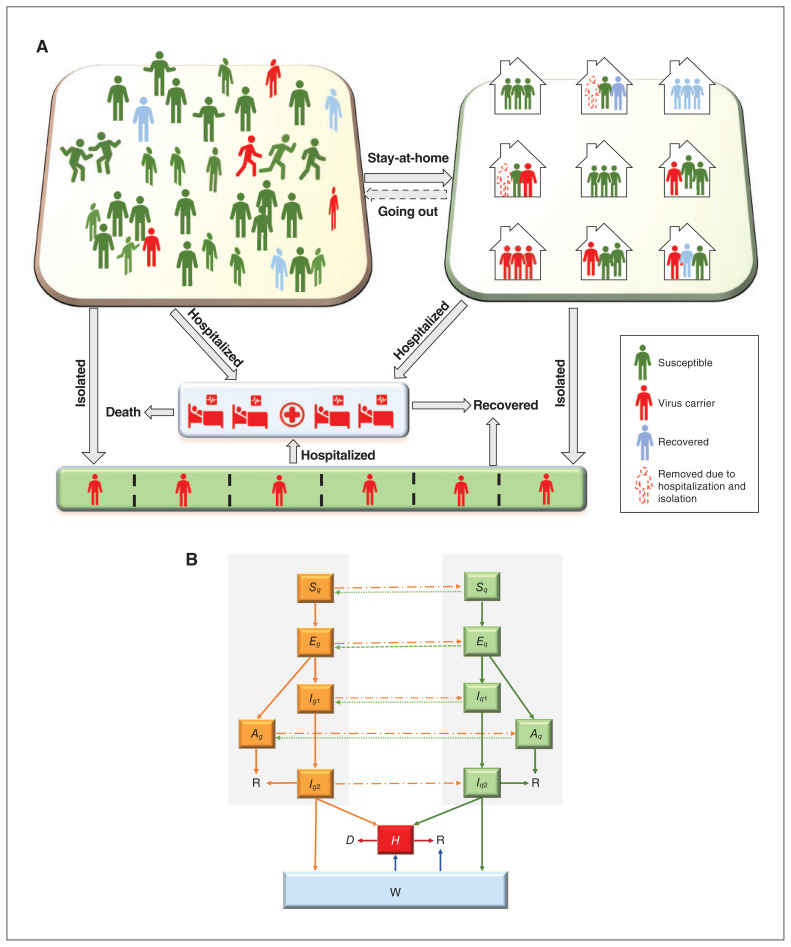
Using confirmed case data from Toronto, Canada, between Feb. 24 and June 24, 2020, we ran a compartmental model with household structure to simulate the impact of the stay-at-home policy considering different levels of compliance. We estimated threshold values for the maximum number of contacts, probability of transmission and testing rates required for the safe reopening of the community.
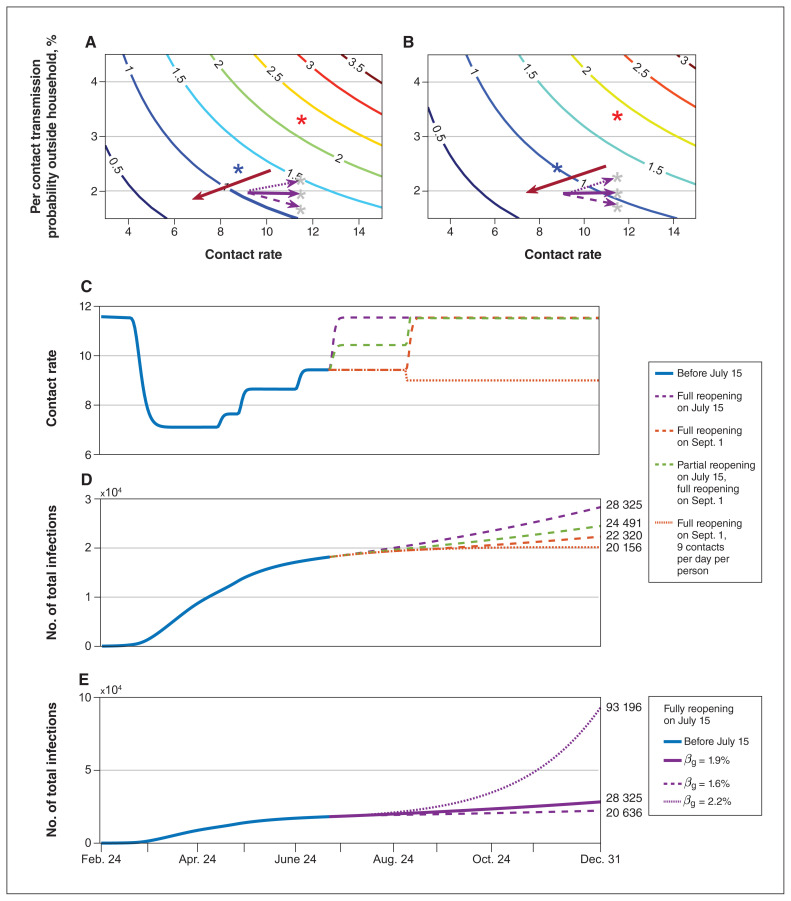
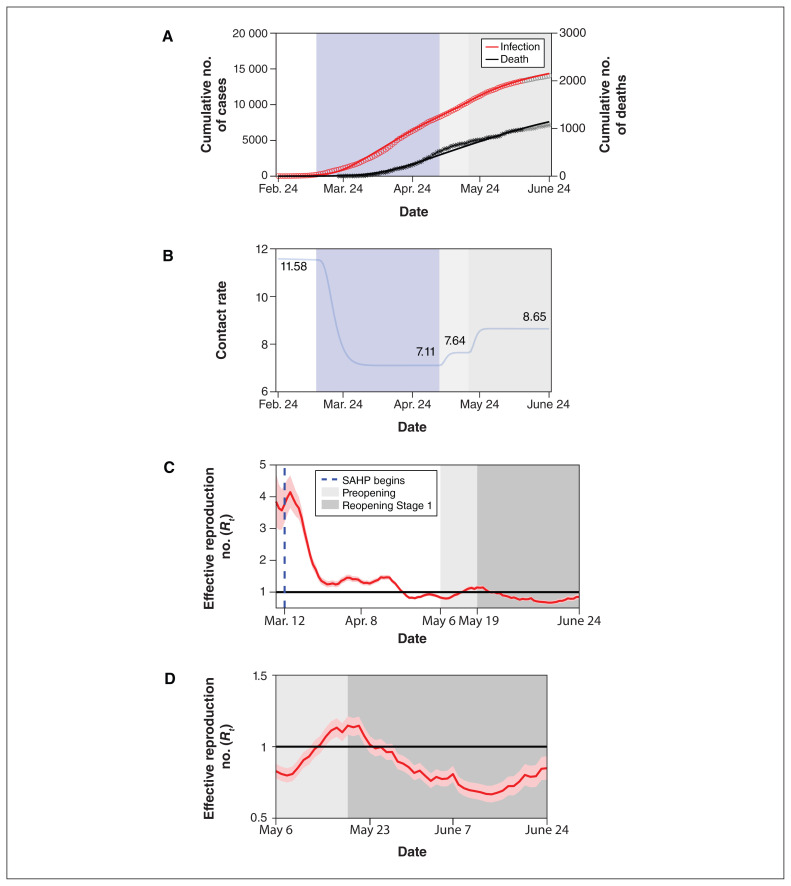
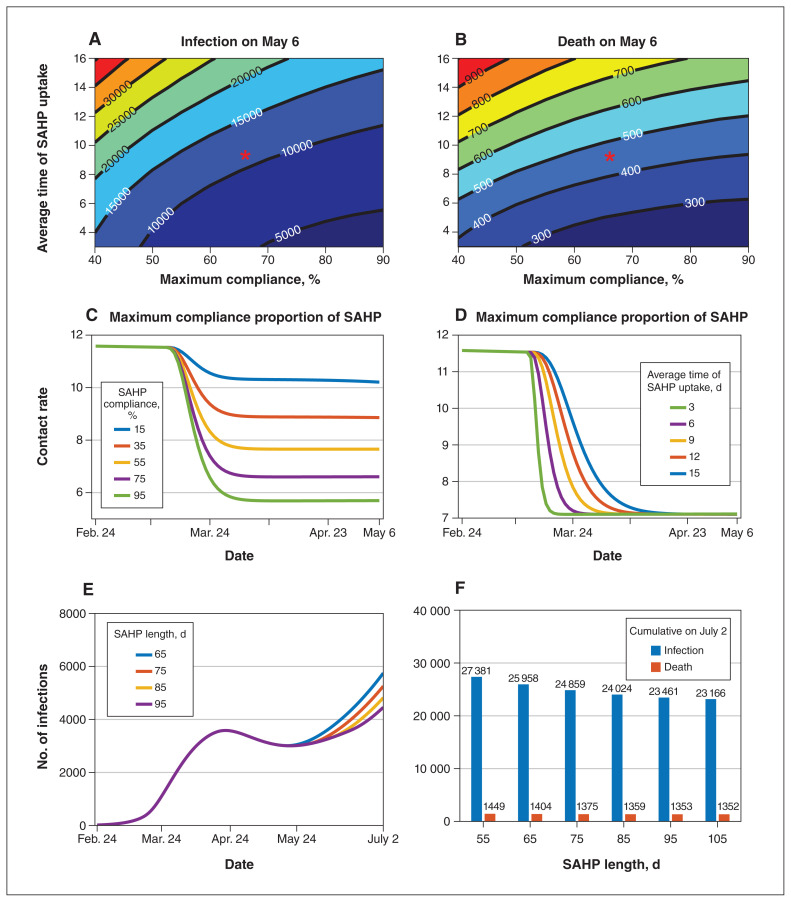
After the implementation of the stay-at-home policy, the contact rate outside the household fell by 39% (from 11.58 daily contacts to 7.11). The effective reproductive number decreased from 3.56 (95% confidence interval [CI] 3.02-4.14) on Mar. 12 to 0.84 (95% CI 0.79-0.89) on May 6. Strong adherence to stay-at-home policies appeared to prevent SARS-CoV-2 resurgence, but extending the duration of stay-at-home policies beyond 2 months had little added effect on cumulative cases (25 958 for 65 days of a stay-at-home policy and 23 461 for 95 days, by July 2, 2020) and deaths (1404 for 65 days and 1353 for 95 days). To avoid a resurgence, the average number of contacts per person per day should be kept below 9, with strict nonpharmaceutical interventions in place.
Our study demonstrates that the stay-at-home policy implemented in Toronto in March 2020 had a substantial impact on mitigating the spread of SARS-CoV-2. In the context of the early pandemic, before the emergence of variants of concern, reopening schools and workplaces was possible only with other nonpharmaceutical interventions in place.
在全球范围内,包括居家令、限制集会和关闭公共场所在内的新冠病毒非药物干预措施正在解除。我们探讨了在不同条件下解除居家令对病毒反弹的影响。
我们使用 2020 年 2 月 24 日至 6 月 24 日期间加拿大多伦多的确诊病例数据,通过具有家庭结构的房室模型模拟了考虑不同遵守程度的居家令的影响。我们估计了社区安全重新开放所需的最大接触次数、传播概率和检测率的阈值。
实施居家令后,家庭以外的接触率下降了 39%(从每天 11.58 次接触降至 7.11 次)。有效繁殖数从 3 月 12 日的 3.56(95%置信区间[CI]3.02-4.14)降至 5 月 6 日的 0.84(95%CI0.79-0.89)。严格遵守居家令似乎阻止了 SARS-CoV-2 的反弹,但将居家令的持续时间延长至 2 个月以上对累计病例(截至 2020 年 7 月 2 日,居家令 65 天为 25958 例,95 天为 23461 例)和死亡人数(居家令 65 天为 1404 例,95 天为 1353 例)没有明显影响。为避免反弹,每个人每天的平均接触人数应保持在 9 人以下,并实施严格的非药物干预措施。
我们的研究表明,2020 年 3 月多伦多实施的居家令对减缓 SARS-CoV-2 的传播产生了重大影响。在大流行早期,在出现关注变体之前,只有在实施其他非药物干预措施的情况下,才有可能重新开放学校和工作场所。