Khalil Muhammad-Adil, Lee Yu-Ching, Lien Huang-Chun, Jeng Yung-Ming, Wang Ching-Wei
Graduate Institute of Applied Science and Technology, National Taiwan University of Science and Technology, Taipei 106335, Taiwan.
Department of Pathology, National Taiwan University Hospital, Taipei 100229, Taiwan.
Diagnostics (Basel). 2022 Apr 14;12(4):990. doi: 10.3390/diagnostics12040990.
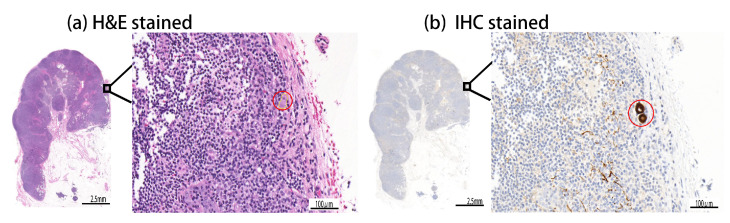
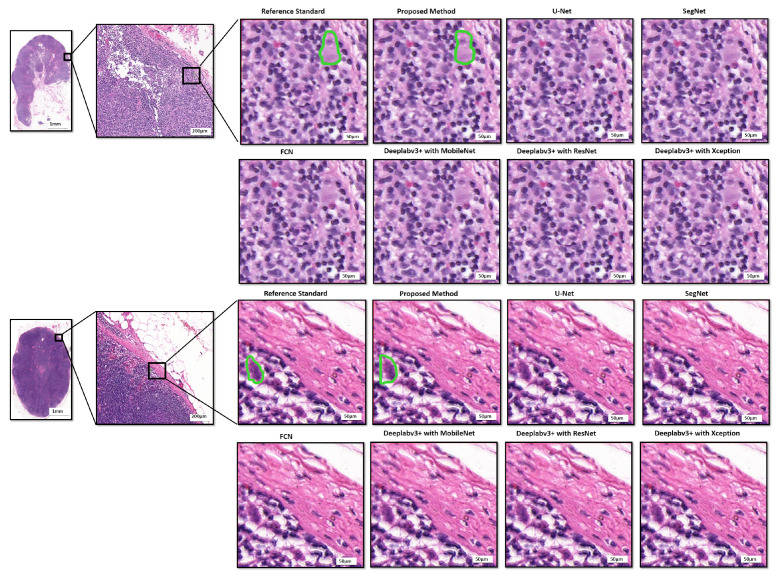
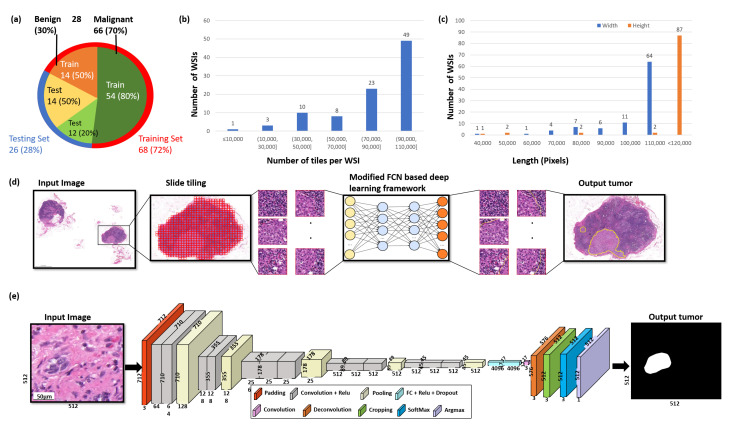
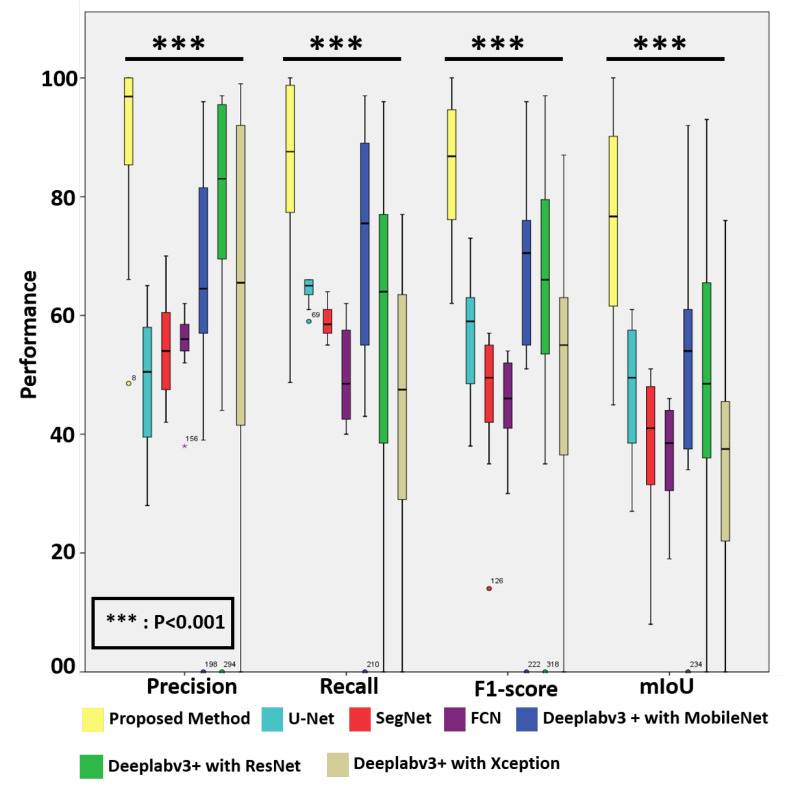
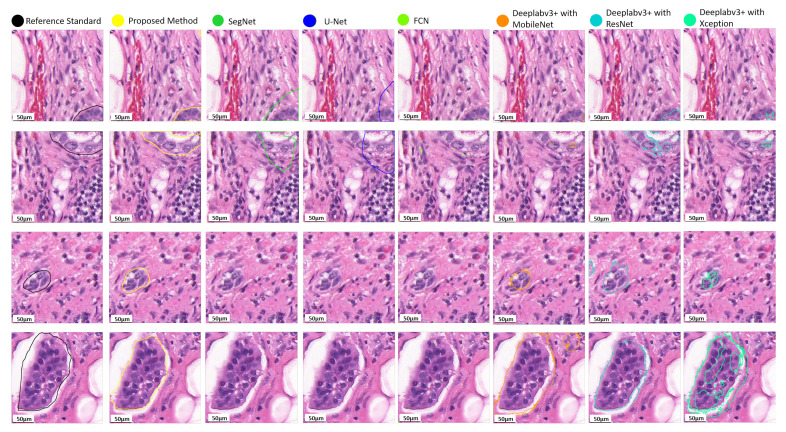
Breast cancer is the leading cause of death for women globally. In clinical practice, pathologists visually scan over enormous amounts of gigapixel microscopic tissue slide images, which is a tedious and challenging task. In breast cancer diagnosis, micro-metastases and especially isolated tumor cells are extremely difficult to detect and are easily neglected because tiny metastatic foci might be missed in visual examinations by medical doctors. However, the literature poorly explores the detection of isolated tumor cells, which could be recognized as a viable marker to determine the prognosis for T1NoMo breast cancer patients. To address these issues, we present a deep learning-based framework for efficient and robust lymph node metastasis segmentation in routinely used histopathological hematoxylin−eosin-stained (H−E) whole-slide images (WSI) in minutes, and a quantitative evaluation is conducted using 188 WSIs, containing 94 pairs of H−E-stained WSIs and immunohistochemical CK(AE1/AE3)-stained WSIs, which are used to produce a reliable and objective reference standard. The quantitative results demonstrate that the proposed method achieves 89.6% precision, 83.8% recall, 84.4% F1-score, and 74.9% mIoU, and that it performs significantly better than eight deep learning approaches, including two recently published models (v3_DCNN and Xception-65), and three variants of Deeplabv3+ with three different backbones, namely, U-Net, SegNet, and FCN, in precision, recall, F1-score, and mIoU (p<0.001). Importantly, the proposed system is shown to be capable of identifying tiny metastatic foci in challenging cases, for which there are high probabilities of misdiagnosis in visual inspection, while the baseline approaches tend to fail in detecting tiny metastatic foci. For computational time comparison, the proposed method takes 2.4 min for processing a WSI utilizing four NVIDIA Geforce GTX 1080Ti GPU cards and 9.6 min using a single NVIDIA Geforce GTX 1080Ti GPU card, and is notably faster than the baseline methods (4-times faster than U-Net and SegNet, 5-times faster than FCN, 2-times faster than the 3 different variants of Deeplabv3+, 1.4-times faster than v3_DCNN, and 41-times faster than Xception-65).
乳腺癌是全球女性的主要死因。在临床实践中,病理学家需要目视扫描大量数十亿像素的微观组织切片图像,这是一项繁琐且具有挑战性的任务。在乳腺癌诊断中,微转移灶,尤其是孤立肿瘤细胞极难检测,且容易被忽视,因为医生在目视检查时可能会遗漏微小的转移灶。然而,目前文献对孤立肿瘤细胞检测的探讨较少,而孤立肿瘤细胞可被视为确定T1NoMo期乳腺癌患者预后的一个可行标志物。为解决这些问题,我们提出了一个基于深度学习的框架,可在数分钟内对常规使用的苏木精-伊红染色(H-E)全切片图像(WSI)中的淋巴结转移进行高效且稳健的分割,并使用188张WSI进行定量评估,其中包括94对H-E染色的WSI和免疫组化CK(AE1/AE3)染色的WSI,用于生成可靠且客观的参考标准。定量结果表明,所提出的方法实现了89.6%的精度、83.8%的召回率、84.4%的F1分数和74.9%的平均交并比,并且在精度、召回率、F1分数和平均交并比方面,其性能显著优于八种深度学习方法,包括两个最近发表的模型(v3_DCNN和Xception-65),以及带有三种不同骨干网络的Deeplabv3+的三个变体,即U-Net、SegNet和FCN(p<0.001)。重要的是,所提出的系统能够在具有挑战性的病例中识别微小转移灶,而在目视检查中这些病例很可能被误诊,而基线方法往往无法检测到微小转移灶。在计算时间比较方面,所提出的方法使用四张NVIDIA Geforce GTX 1080Ti GPU卡处理一张WSI需要2.4分钟,使用一张NVIDIA Geforce GTX 1080Ti GPU卡需要9.6分钟,并且明显比基线方法更快(比U-Net和SegNet快4倍,比FCN快5倍,比Deeplabv3+的三种不同变体快2倍,比v3_DCNN快1.4倍,比Xception-65快41倍)。