Krueger Annika, Mohamed Ahmed, Kolka Cathryn M, Stoll Thomas, Zaugg Julian, Linedale Richard, Morrison Mark, Soyer H Peter, Hugenholtz Philip, Frazer Ian H, Hill Michelle M
The University of Queensland Diamantina Institute, Faculty of Medicine, The University of Queensland, Translational Research Institute, Woolloongabba, QLD 4102, Australia.
QIMR Berghofer Medical Research Institute, Herston, Brisbane, QLD 4006, Australia.
Cancers (Basel). 2022 Apr 25;14(9):2143. doi: 10.3390/cancers14092143.
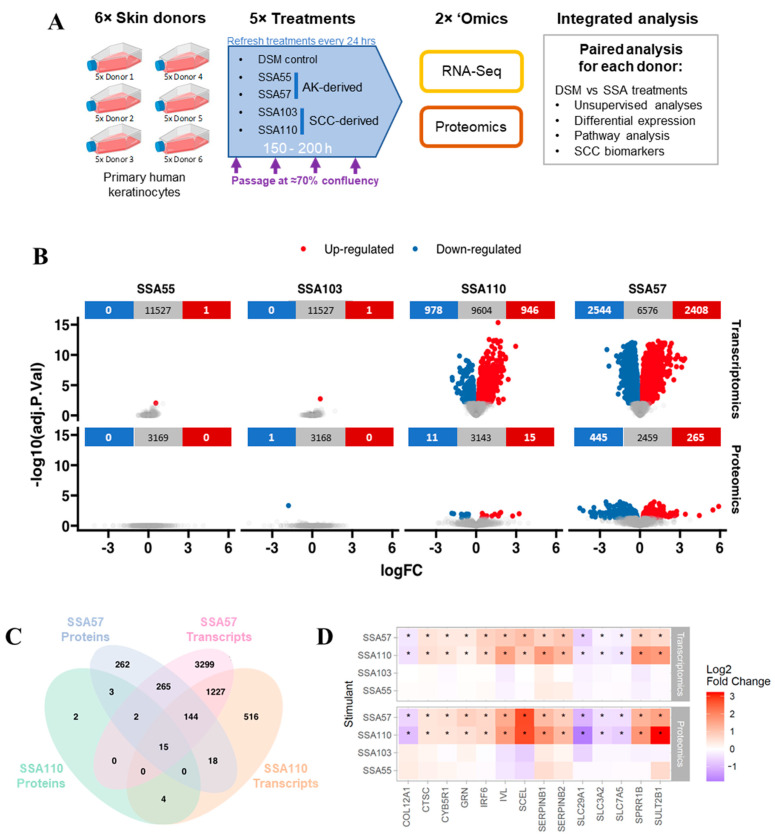
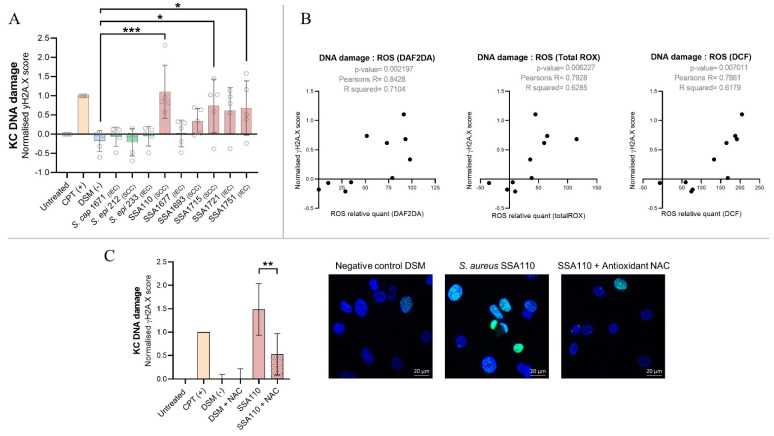
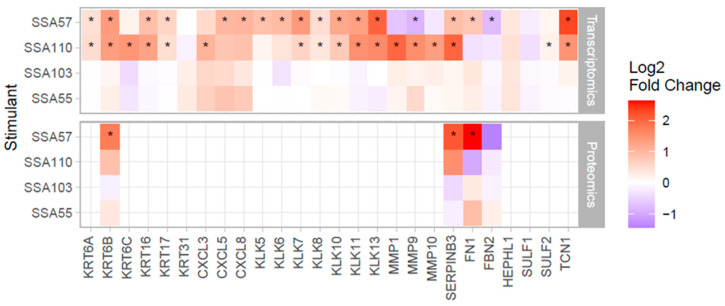
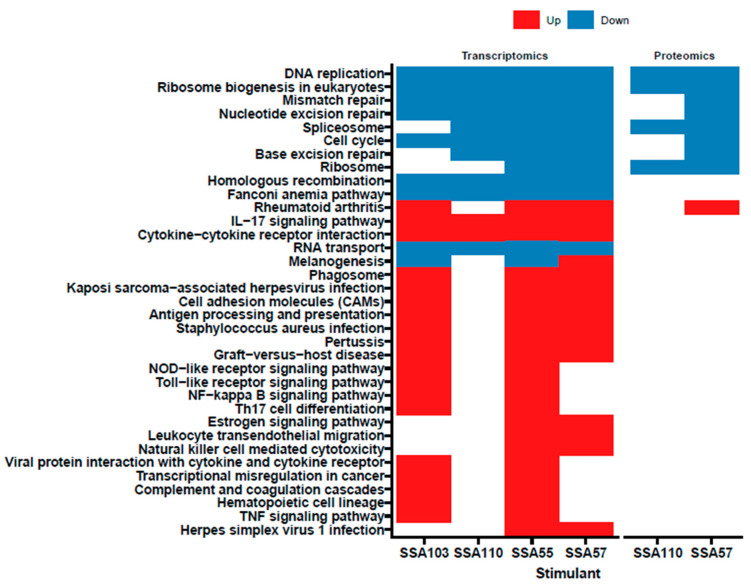
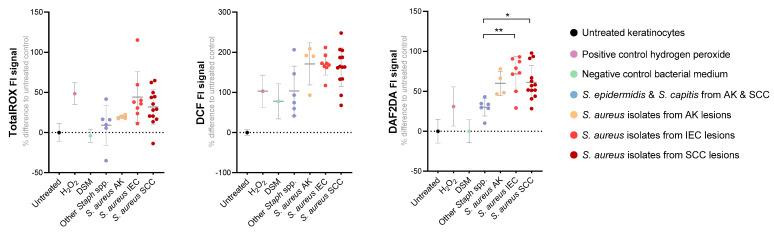
Actinic keratosis (AK) is a premalignant lesion, common on severely photodamaged skin, that can progress over time to cutaneous squamous cell carcinoma (SCC). A high bacterial load of is associated with AK and SCC, but it is unknown whether this has a direct impact on skin cancer development. To determine whether can have cancer-promoting effects on skin cells, we performed RNA sequencing and shotgun proteomics on primary human keratinocytes after challenge with sterile culture supernatant ('secretome') from four clinical strains isolated from AK and SCC. Secretomes of two of the strains induced keratinocytes to overexpress biomarkers associated with skin carcinogenesis and upregulated the expression of enzymes linked to reduced skin barrier function. Further, these strains induced oxidative stress markers and all secretomes downregulated DNA repair mechanisms. Subsequent experiments on an expanded set of lesion-associated strains confirmed that exposure to their secretomes led to increased oxidative stress and DNA damage in primary human keratinocytes. A significant correlation between the concentration of phenol soluble modulin toxins in secretome and the secretome-induced level of oxidative stress and genotoxicity in keratinocytes was observed. Taken together, these data demonstrate that secreted compounds from lesion-associated clinical isolates of can have cancer-promoting effects in keratinocytes that may be relevant to skin oncogenesis.
光化性角化病(AK)是一种癌前病变,常见于严重光损伤的皮肤,随着时间的推移可发展为皮肤鳞状细胞癌(SCC)。[具体细菌名称]的高细菌载量与AK和SCC相关,但尚不清楚这是否对皮肤癌的发展有直接影响。为了确定[具体细菌名称]是否对皮肤细胞有促癌作用,我们用从AK和SCC分离出的四株[具体细菌名称]临床菌株的无菌培养上清液(“分泌组”)刺激原代人角质形成细胞后,进行了RNA测序和鸟枪法蛋白质组学分析。其中两株[具体细菌名称]的分泌组诱导角质形成细胞过表达与皮肤致癌相关的生物标志物,并上调与皮肤屏障功能降低相关的酶的表达。此外,这些菌株诱导氧化应激标志物,并且所有分泌组均下调DNA修复机制。随后对一组扩大的病变相关[具体细菌名称]菌株进行的实验证实,暴露于它们的分泌组会导致原代人角质形成细胞中的氧化应激和DNA损伤增加。观察到分泌组中[具体细菌名称]酚溶性调节素毒素的浓度与分泌组诱导的角质形成细胞氧化应激水平和遗传毒性之间存在显著相关性。综上所述,这些数据表明,病变相关临床分离株[具体细菌名称]分泌的化合物可对角质形成细胞产生促癌作用,这可能与皮肤肿瘤发生有关。