Faculty of Natural Sciences and Mathematics, University of Maribor, Koroška cesta 160, 2000 Maribor, Slovenia.
Department of Physics, Institute of Mathematics, Physics and Mechanics, Jadranska ulica 19, 1000 Ljubljana, Slovenia.
Sensors (Basel). 2022 Apr 21;22(9):3184. doi: 10.3390/s22093184.
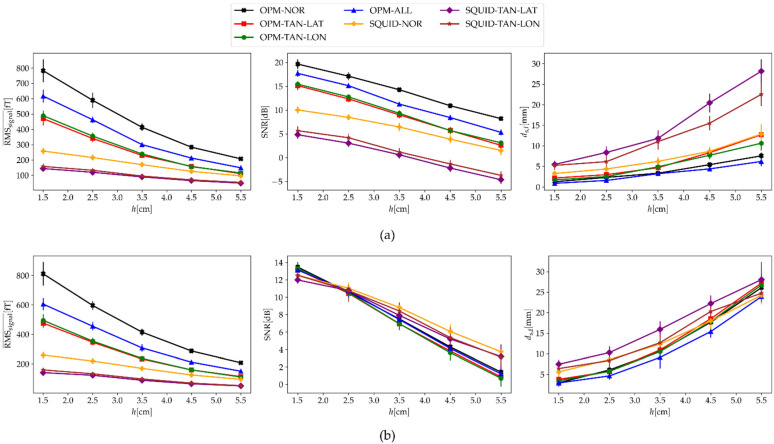
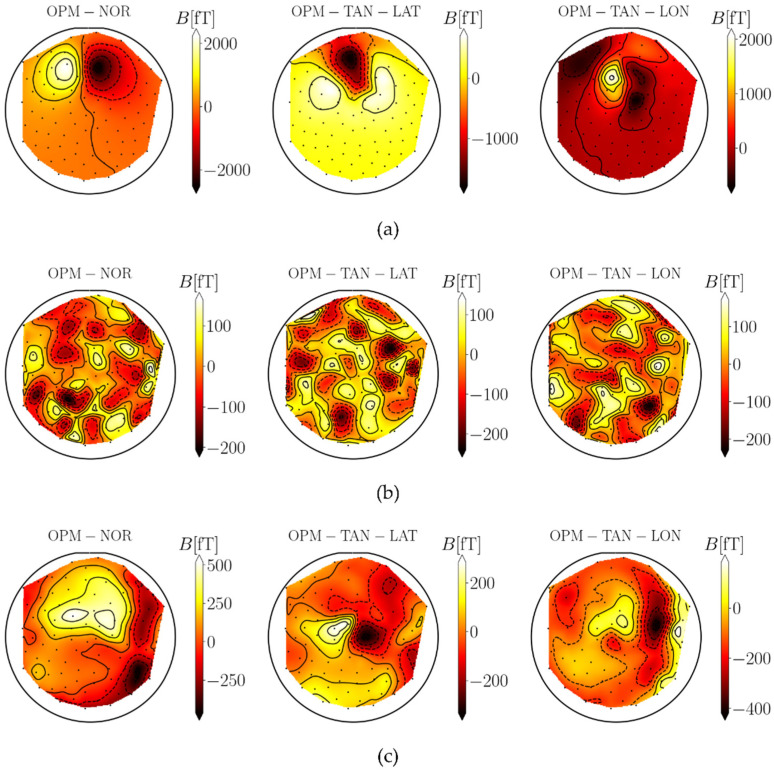
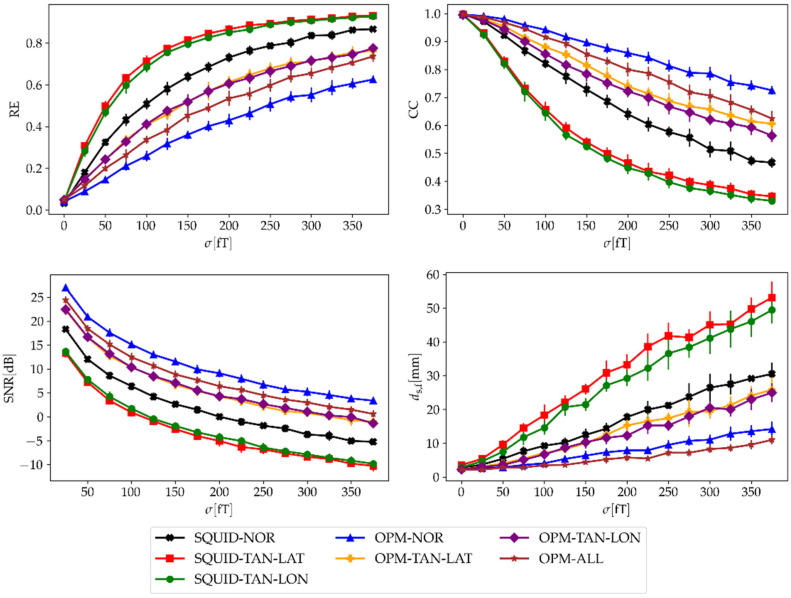
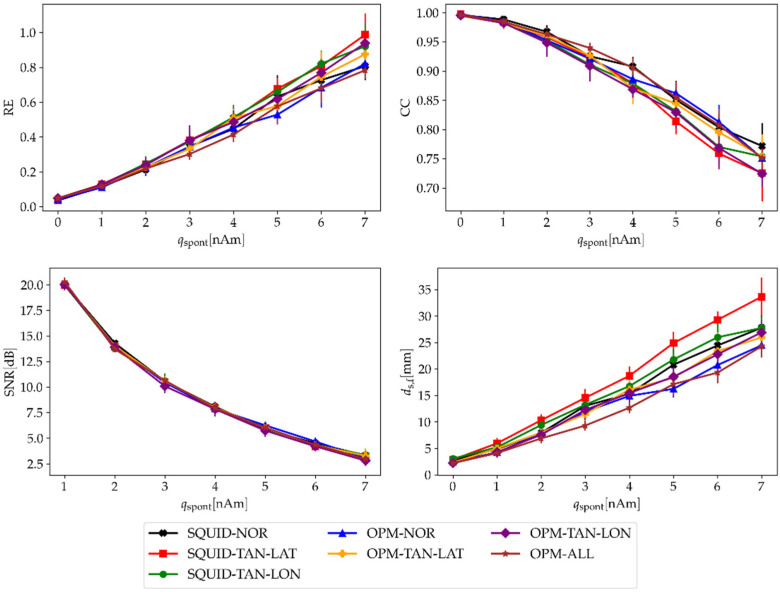
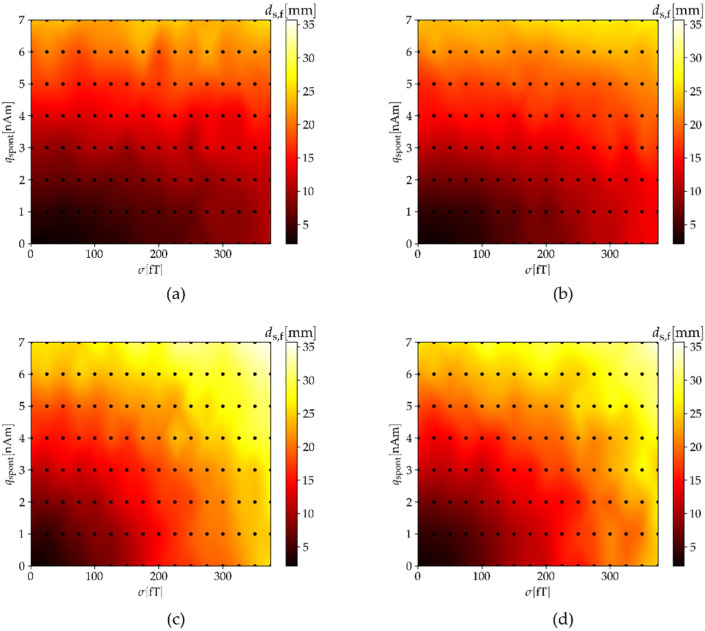
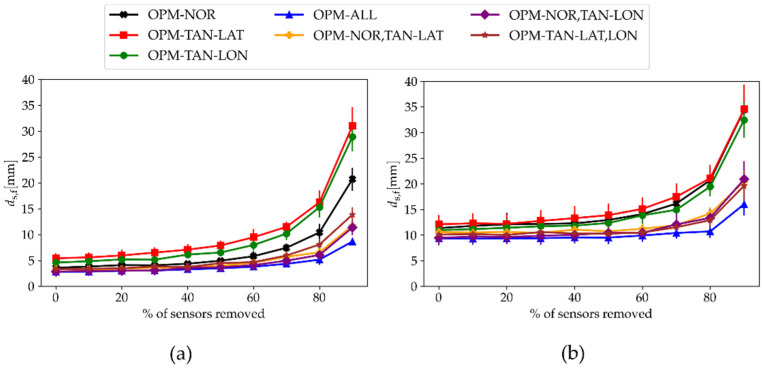
Magnetoencephalography (MEG) is a neuroimaging technique that measures the magnetic fields of the brain outside of the head. In the past, the most suitable magnetometer for MEG was the superconducting quantum interference device (SQUID), but in recent years, a new type has also been used, the optically pumped magnetometer (OPM). OPMs can be configured to measure multiple directions of magnetic field simultaneously. This work explored whether combining multiple directions of the magnetic field lowers the source localization error of brain sources under various conditions of noise. We simulated dipolar-like sources for multiple configurations of both SQUID- and OPM-MEG systems. To test the performance of a given layout, we calculated the average signal-to-noise ratio and the root mean square of the simulated magnetic field; furthermore, we evaluated the performance of the dipole fit. The results showed that the field direction normal to the scalp yields a higher signal-to-noise ratio and that ambient noise has a much lower impact on its localization error; therefore, this is the optimal choice for source localization when only one direction of magnetic field can be measured. For a low number of OPMs, combining multiple field directions greatly improves the source localization results. Lastly, we showed that MEG sensors that can be placed closer to the brain are more suitable for localizing deeper sources.
脑磁图(MEG)是一种测量头部外大脑磁场的神经影像学技术。过去,最适合 MEG 的磁力计是超导量子干涉仪(SQUID),但近年来,也开始使用一种新型的磁力计,即光泵磁力计(OPM)。OPM 可以配置为同时测量多个方向的磁场。本工作探讨了在不同噪声条件下,组合多个磁场方向是否会降低脑源的源定位误差。我们模拟了 SQUID 和 OPM-MEG 系统的多种配置下的偶极子样源。为了测试给定布局的性能,我们计算了模拟磁场的平均信噪比和均方根;此外,我们还评估了偶极子拟合的性能。结果表明,头皮垂直方向的磁场产生更高的信噪比,并且环境噪声对其定位误差的影响要小得多;因此,当只能测量一个方向的磁场时,这是源定位的最佳选择。对于较少数量的 OPM,组合多个磁场方向可以大大改善源定位结果。最后,我们表明可以更靠近大脑放置的 MEG 传感器更适合定位较深的源。