Wang Wenjie, Wang Xiaoyan, Cao Shiling, Duan Yiting, Xu Chengquan, Gan Da, He Wei
Chronic Disease Research Institute, The Children's Hospital, and National Clinical Research Center for Child Health, School of Public Health, School of Medicine, Zhejiang University, Hangzhou, China.
Department of Nutrition and Food Hygiene, School of Public Health, School of Medicine, Zhejiang University, Hangzhou, China.
Front Nutr. 2022 May 4;9:849727. doi: 10.3389/fnut.2022.849727. eCollection 2022.
The potential beneficial effect of individual antioxidants on mortality has been reported. However, the association of overall intakes of dietary antioxidants with all-cause and cause-specific mortality among adults with diabetes remained unclear.
A total of 4,699 US adults with diabetes were enrolled in 2003-2014 in the National Health and Nutrition Examination Survey (NHANES) and followed for mortality until 31 December 2015. The Dietary Antioxidant Quality Score (DAQS) and the Dietary Antioxidant Index (DAI), which indicate the total antioxidant properties, were calculated based on the intakes of vitamins A, C, E, zinc, selenium, and magnesium. The Cox proportional hazards regression models were used to investigate the associations of the DAQS or the DAI with all-cause and cause-specific mortality.
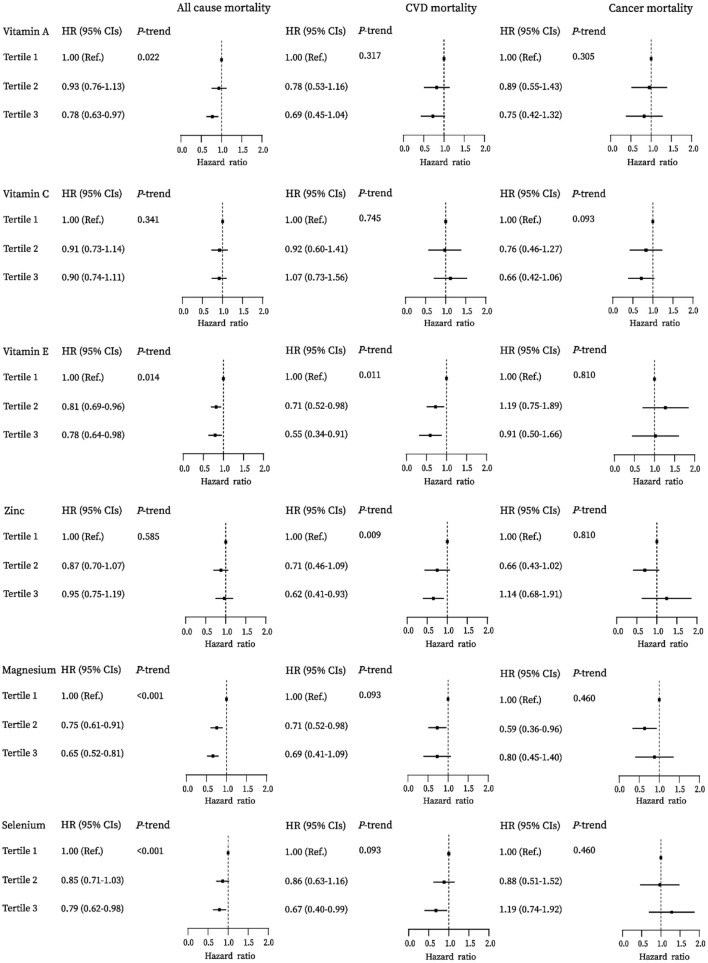
A total of 913 deaths occurred during 27,735 person-years of follow-up, including 215 deaths due to cardiovascular disease (CVD) and 173 deaths due to cancer. The higher intakes of antioxidant vitamins A, E, magnesium, and selenium were associated with lower all-cause mortality. The adjusted hazard ratios (HRs) (95% CIs) comparing the highest DAQS (5-6) to the lowest DAQS (0-2) were 0.70 (0.53-0.92) for all-cause mortality, 0.56 (0.35-0.90) for CVD mortality, and 0.59 (0.33-1.04) for cancer mortality. Consistent inverse associations were found between the DAI and mortality.
Higher intake of overall dietary antioxidants was associated with lower risk of death from all-cause and CVD in adults with diabetes. Future dietary intervention studies are needed to determine whether increasing overall antioxidant micronutrients intake could prevent premature death among adults with diabetes.
已有报道称个体抗氧化剂对死亡率具有潜在的有益影响。然而,糖尿病成年人膳食抗氧化剂的总体摄入量与全因死亡率及特定病因死亡率之间的关联仍不明确。
2003年至2014年期间,共有4699名美国糖尿病成年人参加了国家健康与营养检查调查(NHANES),并随访至2015年12月31日的死亡率情况。基于维生素A、C、E、锌、硒和镁的摄入量,计算了表明总抗氧化特性的膳食抗氧化质量评分(DAQS)和膳食抗氧化指数(DAI)。采用Cox比例风险回归模型研究DAQS或DAI与全因死亡率及特定病因死亡率之间的关联。
在27735人年的随访期间,共发生913例死亡,其中包括215例心血管疾病(CVD)死亡和173例癌症死亡。抗氧化维生素A、E、镁和硒的较高摄入量与较低的全因死亡率相关。将最高DAQS(5 - 6)与最低DAQS(0 - 2)进行比较,全因死亡率的调整风险比(HRs)(95%置信区间)为0.70(0.53 - 0.92),CVD死亡率为0.56(0.35 - 0.90),癌症死亡率为0.59(0.33 - 1.04)。在DAI与死亡率之间发现了一致的反向关联。
糖尿病成年人中,较高的膳食抗氧化剂总体摄入量与较低的全因死亡风险和CVD死亡风险相关。未来需要进行膳食干预研究,以确定增加抗氧化微量营养素的总体摄入量是否可以预防糖尿病成年人过早死亡。