Rodríguez-Rodríguez Elena, Salas-González M Dolores, Ortega Rosa M, López-Sobaler Ana M
VALORNUT Research Group, Analytical Chemistry Unit, Department of Chemistry in Pharmaceutical Science, Faculty of Pharmacy, Complutense University of Madrid, Madrid, Spain.
VALORNUT Research Group, Department of Nutrition and Food Science, Faculty of Pharmacy, Complutense University of Madrid, Madrid, Spain.
Front Nutr. 2022 May 6;8:811081. doi: 10.3389/fnut.2021.811081. eCollection 2021.
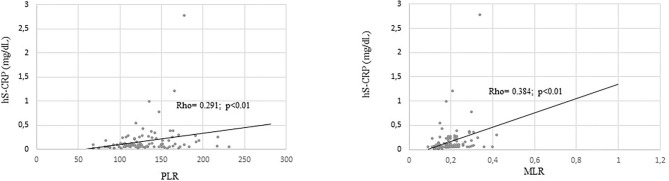
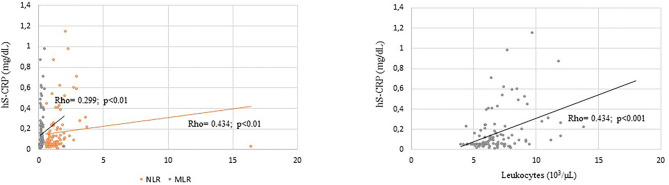
Inflammation in overweight/obesity may condition the development of insulin resistance (IR). New markers of inflammation and systemic inflammation, such as leukocyte and platelet counts, the neutrophil-to-lymphocyte ratio (NLR), platelet-to-lymphocyte ratio (PLR), and monocyte-to-lymphocyte ratio (MLR), could be used as indicators of IR. The aim of the present study was to investigate the relationship between these markers and IR in overweight/obese children.
A total of 1,035 schoolchildren were studied (398 overweight/obese). Anthropometric, hematological and biochemical measurements were collected. Inflammation was considered to be present when the values of leukocytes, platelets, NLR, PLR and MLR were ≥75 for each sex. IR was defined as HOMA-IR >3.16.
In overweight/obese schoolchildren, leukocytes were higher in both boys and girls, and platelets and NLR were higher in boys with IR than in boys with insulin sensitivity. An association between leucocytes and NLR values (≥75) and IR was found in the entire population [2.911 (1.328-6.381); = 0.008 and 2.660 (1.185-5.968); = 0.018, respectively] and in boys [9.255 (1.896-45.168); = 0.006 and 6.996 (1.377-35.544); = 0.019, respectively].
Elevated white blood cell values and elevated NLR in overweight/obese children, and particularly in boys, could be indicators of the presence of IR in these subjects and should be considered when predicting possible complications, such as type II diabetes mellitus.
超重/肥胖状态下的炎症可能会影响胰岛素抵抗(IR)的发展。炎症和全身炎症的新标志物,如白细胞和血小板计数、中性粒细胞与淋巴细胞比值(NLR)、血小板与淋巴细胞比值(PLR)以及单核细胞与淋巴细胞比值(MLR),可用作IR的指标。本研究旨在探讨这些标志物与超重/肥胖儿童IR之间的关系。
共研究了1035名学童(398名超重/肥胖)。收集了人体测量、血液学和生化测量数据。当白细胞、血小板、NLR、PLR和MLR的值对于每种性别均≥75时,认为存在炎症。IR定义为稳态模型评估的胰岛素抵抗(HOMA-IR)>3.16。
在超重/肥胖学童中,男孩和女孩的白细胞均较高,且患有IR的男孩的血小板和NLR高于具有胰岛素敏感性的男孩。在整个人口中发现白细胞和NLR值(≥75)与IR之间存在关联[分别为2.911(1.328 - 6.381);P = 0.008和2.660(1.185 - 5.968);P = 0.018],在男孩中也存在关联[分别为9.255(1.896 - 45.168);P = 0.006和6.996(1.377 - 35.544);P = 0.019]。
超重/肥胖儿童,尤其是男孩,白细胞值升高和NLR升高可能是这些受试者存在IR的指标,在预测可能的并发症,如2型糖尿病时应予以考虑。