Tsuchiya Atsunori, Terai Shuji, Horiguchi Ikki, Homma Yasuhiro, Saito Atsuhiro, Nakamura Norimasa, Sato Yoji, Ochiya Takahiro, Kino-Oka Masahiro
Division of Gastroenterology and Hepatology, Graduate School of Medical and Dental Sciences, Niigata University, Niigata, Japan.
Department of Biotechnology, Graduate School of Engineering, Osaka University, Osaka, Japan.
Regen Ther. 2022 May 19;21:19-24. doi: 10.1016/j.reth.2022.05.003. eCollection 2022 Dec.
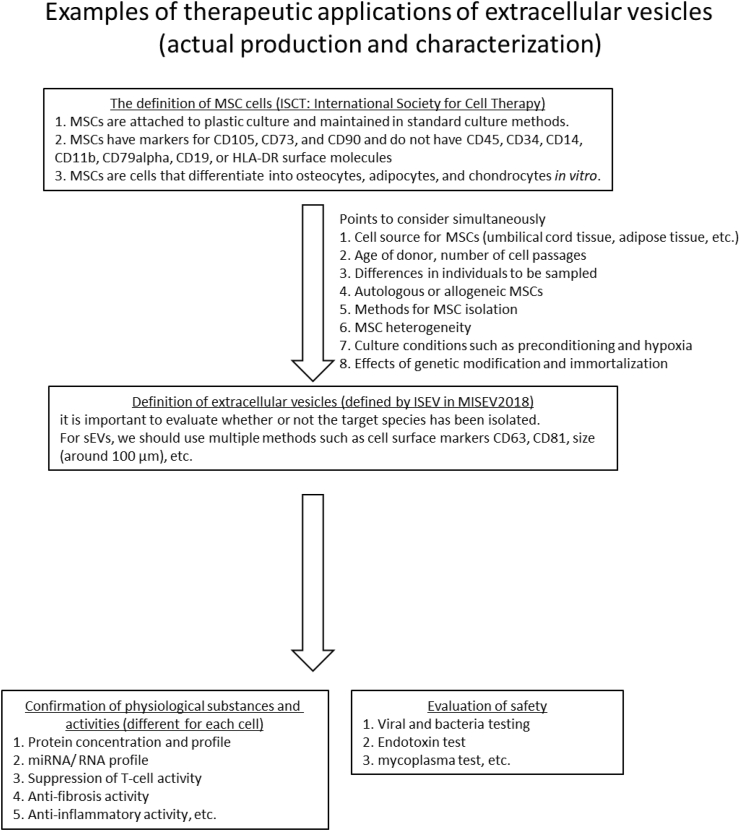
In recent years, extracellular vesicles (EVs) have attracted attention as a new therapeutic tool. In Europe, the United States, and Asia, there is an accelerating trend of moving beyond basic research on clinical trials. However, treatment using EVs is still in the research and development stage, and the general public has insufficient awareness and understanding of the risks involved in ensuring safety and efficacy, the status of laws and regulations, and global research and development trends regarding their use. The Japanese Society for Regenerative Medicine, which has promoted the research and development of regenerative medicine, an innovative medical technology based on the principle of delivering it safely, effectively, and promptly, including the establishment of laws and regulations, would like to express two positions in light of the rapid development of therapies using EVs: 1) concern about treatments that are based solely on the discretion of medical practitioners, and 2) active promotion of treatments based on sound scientific evidence. Because EVs are released from cells, there are many similarities between EVs and processed cells in terms of manufacturing processes and safety hazards. As for efficacy, the mechanism of action of EVs is still unclear, as is the case with specified processed cells; in such cases, it is difficult to measure potency, identify efficacy-related quality attributes, and evaluate the comparability of quality before and after a change in the manufacturing process. In other words, the number of quality attributes that can be obtained for EVs is limited because of their complex characteristics, and it is difficult to grasp their quality through specifications and characterization. Therefore, while designing a quality control strategy for EVs, it is important to ensure the quality of the final product (EVs) by controlling the raw materials and manufacturing process. On the contrary, since EVs do not contain living cell components and are not classified into specified processed cells, non-commercial clinical research on treatments using EVs and individual medical treatments with EVs at the discretion of medical practitioners are out of the scope of the Act on the Safety of Regenerative Medicine of Japan. At present, there are no relevant laws or regulations for the use of EVs other than the Medical Practitioners' Act and the Medical Care Act in Japan. Therefore, there is a concern that treatment will be performed without sufficient objective evaluation of the scientific basis for safety and efficacy. Despite these concerns, the development of therapies using EVs is underway worldwide. This could potentially lead to a wide variety of new therapeutic areas if the methods needed to stably secure and mass cultivate cells as raw materials and the technologies needed for the mass production of EVs can be developed, in addition to understanding the risks involved and developing relevant laws and regulations. As part of the Japanese Society for Regenerative Medicine, we will continue to work on the development of these methods and technologies and hope that such a promising field will be promoted with a high level of safety before reaching the public.
近年来,细胞外囊泡(EVs)作为一种新型治疗工具受到关注。在欧洲、美国和亚洲,超越基础研究进入临床试验的趋势正在加速。然而,使用EVs进行治疗仍处于研发阶段,公众对确保安全性和有效性所涉及的风险、法律法规状况以及其使用的全球研发趋势的认识和了解不足。日本再生医学协会推动了再生医学的研发,再生医学是一种基于安全、有效、及时地提供治疗原则的创新医学技术,包括法律法规的制定。鉴于使用EVs的治疗方法迅速发展,协会想表明两个立场:1)对仅基于医生判断的治疗方法表示担忧;2)积极推广基于可靠科学证据的治疗方法。由于EVs是从细胞中释放出来的,在制造过程和安全风险方面,EVs与经过处理的细胞有许多相似之处。至于疗效,EVs的作用机制仍不清楚,就像特定的经过处理的细胞一样;在这种情况下,很难测量效力、识别与疗效相关的质量属性以及评估制造过程变化前后质量的可比性。换句话说,由于EVs的特性复杂,可获得的质量属性数量有限,很难通过规格和表征来掌握其质量。因此,在设计EVs的质量控制策略时,通过控制原材料和制造过程来确保最终产品(EVs)的质量非常重要。相反,由于EVs不包含活细胞成分,也不属于特定的经过处理的细胞,使用EVs的非商业临床研究和医生自行决定的使用EVs的个体医疗治疗不在日本《再生医学安全法》的范围内。目前,除了日本的《医师法》和《医疗法》外,没有关于使用EVs的相关法律法规。因此,人们担心在没有对安全性和有效性的科学依据进行充分客观评估的情况下就进行治疗。尽管存在这些担忧,但全球范围内使用EVs的治疗方法的研发仍在进行。如果除了了解所涉及的风险并制定相关法律法规外,还能开发出稳定获取和大量培养作为原材料的细胞所需的方法以及大规模生产EVs所需的技术,这可能会带来各种各样的新治疗领域。作为日本再生医学协会的一部分,我们将继续致力于这些方法和技术的开发,并希望在面向公众之前,以高度的安全性推动这样一个有前景领域的发展。