University of Klagenfurt, Austria.
University of Illinois Chicago, USA.
Pers Soc Psychol Rev. 2022 Nov;26(4):342-374. doi: 10.1177/10888683221094650. Epub 2022 Jun 2.
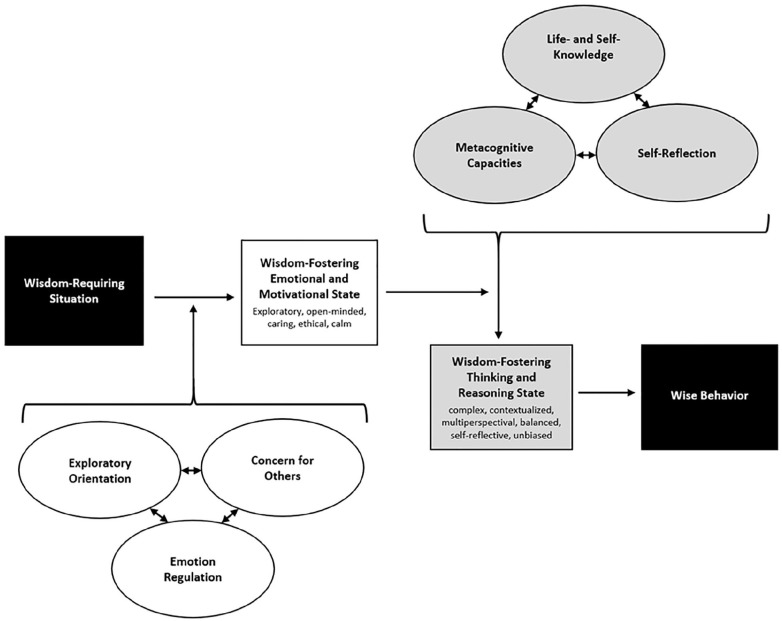
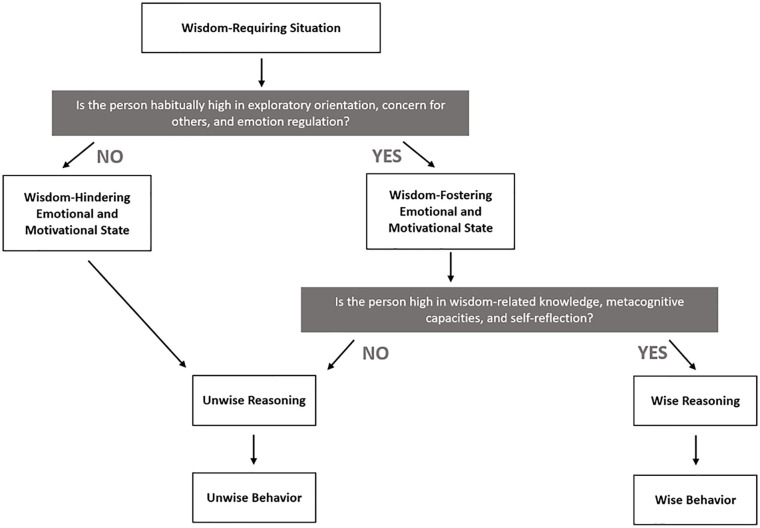
This article proposes an integrative model of wise behavior in real life. While current research findings depend considerably on how wisdom is conceptualized and measured, there are strong conceptual commonalities across psychological wisdom models. The proposed model integrates the components of several existing models into a dynamic framework explaining wise behavior. The article first specifies which real-life situations require wisdom and discusses characteristics of wise behavior. The core proposition of the model is that in challenging real-life situations, noncognitive wisdom components (an exploratory orientation, concern for others, and emotion regulation) moderate the effect of cognitive components (knowledge, metacognitive capacities, and self-reflection) on wise behavior. The model can explain the situation specificity of wisdom and the commonalities and differences between personal and general wisdom. Empirically, it accounts for the considerable variation in correlations among wisdom measures and between wisdom measures and other variables. The model has implications for the design of wisdom-fostering interventions and new wisdom measures.
本文提出了一个现实生活中明智行为的综合模型。虽然目前的研究结果在很大程度上取决于智慧的概念化和衡量方式,但心理智慧模型之间存在着很强的概念共性。所提出的模型将几个现有模型的组成部分整合到一个动态框架中,以解释明智的行为。本文首先明确了哪些现实生活情境需要智慧,并讨论了明智行为的特征。该模型的核心命题是,在具有挑战性的现实生活情境中,非认知智慧成分(探索性取向、关心他人和情绪调节)会调节认知成分(知识、元认知能力和自我反思)对明智行为的影响。该模型可以解释智慧的情境特异性,以及个人智慧和一般智慧之间的共性和差异。在经验上,它解释了智慧衡量标准之间以及智慧衡量标准与其他变量之间的相关性的巨大差异。该模型对促进智慧的干预措施和新的智慧衡量标准的设计具有启示意义。