Institute of Medical Sociology, Centre for Health and Society, Medical Faculty and University Hospital, Heinrich Heine University Duesseldorf Moorenstrasse 5, 40225 Düsseldorf, Germany.
Scand J Work Environ Health. 2022 Sep 1;48(6):446-456. doi: 10.5271/sjweh.4037. Epub 2022 Jun 7.
The aim of this study was to identify the occupational risk for a SARS-CoV-2 infection in a nationwide sample of German workers during the first wave of the COVID-19 pandemic (1 February-31 August 2020).
We used the data of 108 960 workers who participated in a COVID follow-up survey of the German National Cohort (NAKO). Occupational characteristics were derived from the German Classification of Occupations 2010 (Klassifikation der Berufe 2010). PCR-confirmed SARS-CoV-2 infections were assessed from self-reports. Incidence rates (IR) and incidence rate ratios (IRR) were estimated using robust Poisson regression, adjusted for person-time at risk, age, sex, migration background, study center, working hours, and employment relationship.
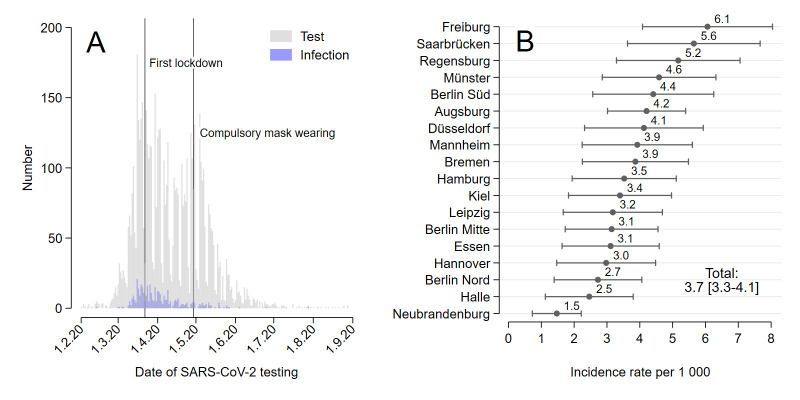
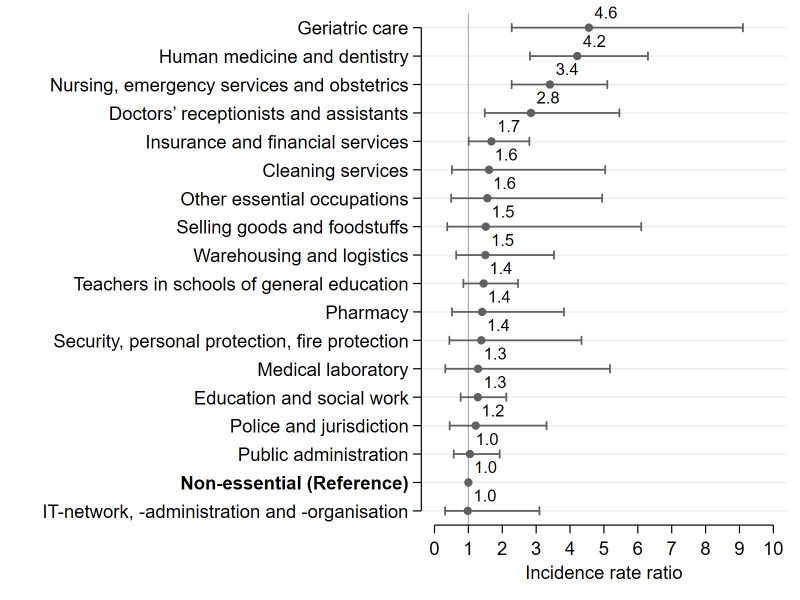
The IR was 3.7 infections per 1000 workers [95% confidence interval (CI) 3.3-4.1]. IR differed by occupational sector, with the highest rates observed in personal (IR 4.8, 95% CI 4.0-5.6) and business administration (IR 3.4, 95% CI 2.8-3.9) services and the lowest rates in occupations related to the production of goods (IR 2.0, 95% CI 1.5-2.6). Infections were more frequent among essential workers compared with workers in non-essential occupations (IRR 1.95, 95% CI 1.59-2.40) and among highly skilled compared with skilled professions (IRR 1.36, 95% CI 1.07-1.72).
The results emphasize higher infection risks in essential occupations and personal-related services, especially in the healthcare sector. Additionally, we found evidence that infections were more common in higher occupational status positions at the beginning of the pandemic.
本研究旨在确定 2020 年 COVID-19 大流行第一波期间(2 月 1 日至 8 月 31 日)德国全国范围内工人感染 SARS-CoV-2 的职业风险。
我们使用了参加德国国家队列(NAKO)COVID 随访调查的 108960 名工人的数据。职业特征来自 2010 年德国职业分类(Klassifikation der Berufe 2010)。通过自我报告评估聚合酶链反应(PCR)确诊的 SARS-CoV-2 感染。使用稳健泊松回归估计发病率(IR)和发病率比值(IRR),并调整了风险人时、年龄、性别、移民背景、研究中心、工作时间和雇佣关系。
工人的 IR 为每 1000 名工人 3.7 例感染(95%置信区间[CI]为 3.3-4.1)。IR 因职业部门而异,个人(IR 4.8,95%CI 4.0-5.6)和商业管理(IR 3.4,95%CI 2.8-3.9)服务业的感染率最高,与生产相关的职业(IR 2.0,95%CI 1.5-2.6)的感染率最低。与非必要职业的工人相比,基本工人(IRR 1.95,95%CI 1.59-2.40)和高技能工人(IRR 1.36,95%CI 1.07-1.72)感染更为频繁。
这些结果强调了基本职业和个人相关服务中的感染风险更高,尤其是在医疗保健部门。此外,我们发现证据表明,在大流行初期,高职业地位的感染更为普遍。