
磁热疗和癌症治疗中的磁性纳米颗粒:挑战与展望
Magnetite Nanoparticles in Magnetic Hyperthermia and Cancer Therapies: Challenges and Perspectives.
作者信息
Włodarczyk Agnieszka, Gorgoń Szymon, Radoń Adrian, Bajdak-Rusinek Karolina
机构信息
Department of Medical Genetics, Faculty of Medical Sciences in Katowice, Medical University of Silesia, Medyków 18, 40-752 Katowice, Poland.
Department of Surgical and Perioperative Sciences, Surgery, Umeå University, 901 87 Umeå, Sweden.
出版信息
Nanomaterials (Basel). 2022 May 25;12(11):1807. doi: 10.3390/nano12111807.
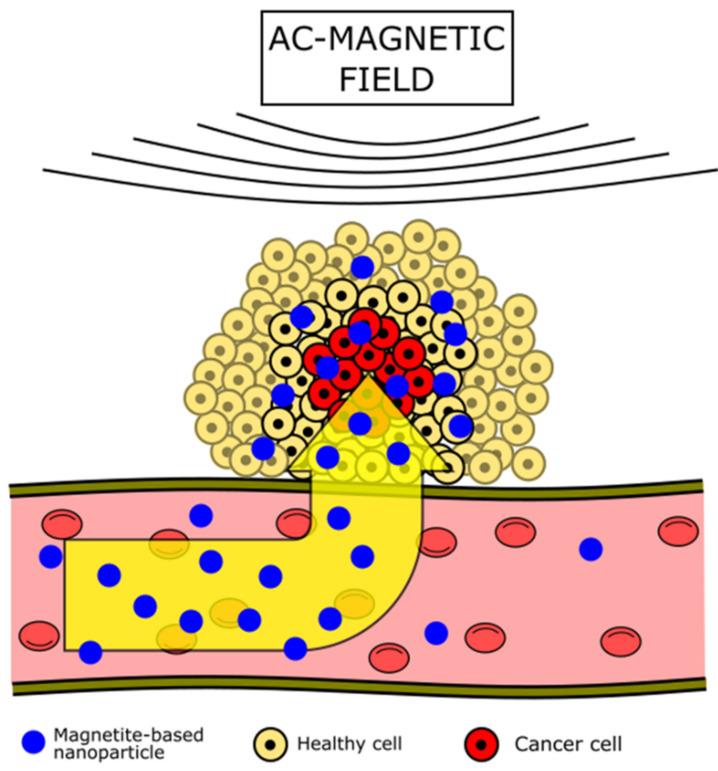
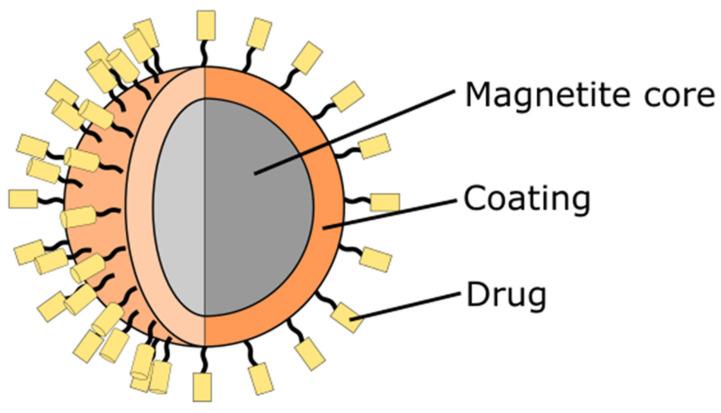
Until now, strategies used to treat cancer are imperfect, and this generates the need to search for better and safer solutions. The biggest issue is the lack of selective interaction with neoplastic cells, which is associated with occurrence of side effects and significantly reduces the effectiveness of therapies. The use of nanoparticles in cancer can counteract these problems. One of the most promising nanoparticles is magnetite. Implementation of this nanoparticle can improve various treatment methods such as hyperthermia, targeted drug delivery, cancer genotherapy, and protein therapy. In the first case, its feature makes magnetite useful in magnetic hyperthermia. Interaction of magnetite with the altered magnetic field generates heat. This process results in raised temperature only in a desired part of a patient body. In other therapies, magnetite-based nanoparticles could serve as a carrier for various types of therapeutic load. The magnetic field would direct the drug-related magnetite nanoparticles to the pathological site. Therefore, this material can be used in protein and gene therapy or drug delivery. Since the magnetite nanoparticle can be used in various types of cancer treatment, they are extensively studied. Herein, we summarize the latest finding on the applicability of the magnetite nanoparticles, also addressing the most critical problems faced by smart nanomedicine in oncological therapies.
到目前为止,用于治疗癌症的策略并不完善,因此需要寻找更好、更安全的解决方案。最大的问题是缺乏与肿瘤细胞的选择性相互作用,这会导致副作用的出现,并显著降低治疗效果。在癌症治疗中使用纳米颗粒可以解决这些问题。最有前景的纳米颗粒之一是磁铁矿。这种纳米颗粒的应用可以改善多种治疗方法,如热疗、靶向给药、癌症基因治疗和蛋白质治疗。在第一种情况下,磁铁矿的特性使其在磁热疗中很有用。磁铁矿与交变磁场相互作用会产生热量。这个过程只会使患者身体的特定部位温度升高。在其他治疗中,基于磁铁矿的纳米颗粒可以作为各种治疗载荷的载体。磁场会将与药物相关的磁铁矿纳米颗粒导向病理部位。因此,这种材料可用于蛋白质和基因治疗或药物递送。由于磁铁矿纳米颗粒可用于各种类型的癌症治疗,因此它们受到了广泛研究。在此,我们总结了关于磁铁矿纳米颗粒适用性的最新发现,同时也探讨了智能纳米医学在肿瘤治疗中面临的最关键问题。
 Zotero 插件