Rosman Tom, Bosnjak Michael, Silber Henning, Koßmann Joanna, Heycke Tobias
Leibniz Institute for Psychology (ZPID), Germany.
GESIS - Leibniz-Institute for the Social Sciences, Germany.
Public Underst Sci. 2022 Nov;31(8):1046-1062. doi: 10.1177/09636625221100686. Epub 2022 Jun 14.
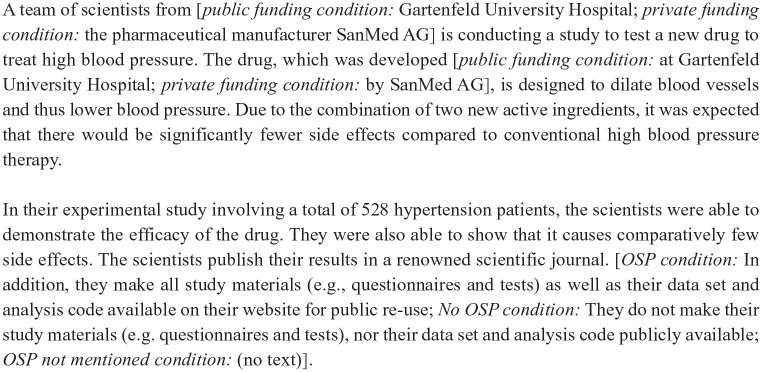
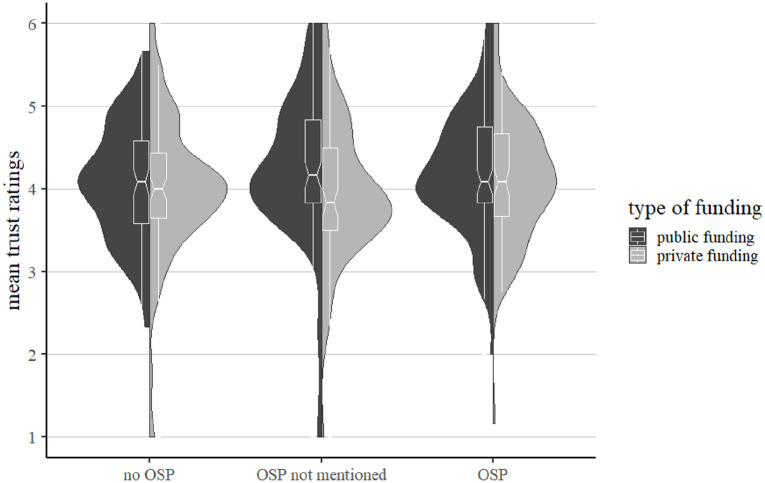
In two studies, we examined whether open science practices, such as making materials, data, and code of a study openly accessible, positively affect public trust in science. Furthermore, we investigated whether the potential trust-damaging effects of research being funded privately (e.g. by a commercial enterprise) may be buffered by such practices. After preregistering six hypotheses, we conducted a survey study (Study 1; = 504) and an experimental study (Study 2; = 588) in two German general population samples. In both studies, we found evidence for the positive effects of open science practices on trust, though it should be noted that in Study 2, results were more inconsistent. We did not however find evidence for the aforementioned buffering effect. We conclude that while open science practices may contribute to increasing trust in science, the importance of making use of open science practices visible should not be underestimated.
在两项研究中,我们考察了开放科学实践,比如使一项研究的材料、数据和代码可公开获取,是否会对公众对科学的信任产生积极影响。此外,我们还研究了由私人(如商业企业)资助研究可能产生的损害信任的潜在影响是否会因这些实践而得到缓解。在预先登记了六个假设之后,我们在两个德国普通人群样本中进行了一项调查研究(研究1;n = 504)和一项实验研究(研究2;n = 588)。在两项研究中,我们都发现了开放科学实践对信任有积极影响的证据,不过应该指出的是,在研究2中,结果的一致性较差。然而,我们没有找到上述缓解效应的证据。我们得出结论,虽然开放科学实践可能有助于增强对科学的信任,但利用开放科学实践的重要性不应被低估。