Gera Aswani Kumar, Burra Rajesh Kumar
Department of Electrical, Electronics & Communication Engineering, School of Technology, GITAM, Deemed to Be University, Visakhapatnam 530045, India.
J Funct Biomater. 2022 Jun 15;13(2):81. doi: 10.3390/jfb13020081.
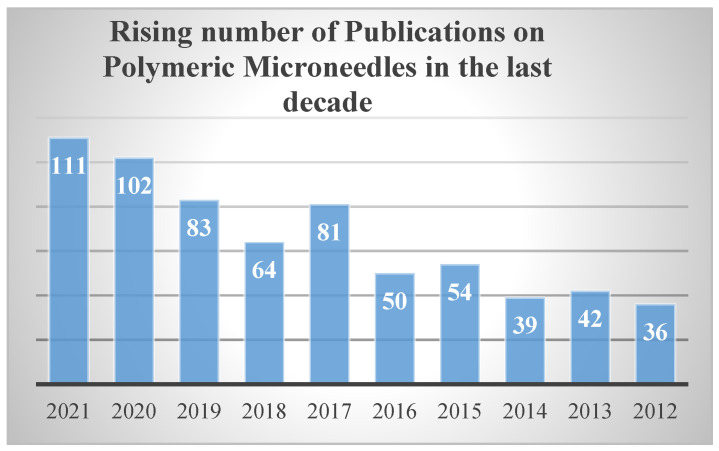
The current scenario of the quest for microneedles (MNs) with biodegradability and biocompatibility properties is a potential research area of interest. Microneedles are considered to be robust, can penetrate the skin's deep-seated layers, and are easy to manufacture, and their applications from the clinical perspective are still ongoing with standard escalation. This review paper focuses on some of the pivotal variants of polymeric microneedles which are specifically dissolvable and swell-based MNs. It further explores the drug dissolution kinetics and insertion behavior mechanisms with an emphasis on the need for mathematical modeling of MNs. This review further evaluates the multifarious fabrication methods, with an update on the advances in the fabrication of polymeric MNs, the choice of materials used for the fabrication, the challenges in polymeric MN fabrication, and the prospects of polymeric MNs with applications pertinent to healthcare, by exclusively focusing on the procurable literature over the last decade.
目前对具有生物可降解性和生物相容性的微针(MNs)的研究是一个潜在的感兴趣的研究领域。微针被认为坚固耐用,能够穿透皮肤深层,易于制造,并且从临床角度来看,其应用仍在随着标准的提升而不断发展。这篇综述文章聚焦于聚合物微针的一些关键变体,即特定可溶解和基于膨胀的微针。它进一步探讨了药物溶解动力学和插入行为机制,重点强调了微针数学建模的必要性。本综述进一步评估了多种制造方法,更新了聚合物微针制造方面的进展、制造所用材料的选择、聚合物微针制造中的挑战,以及聚合物微针在医疗保健相关应用方面的前景,专门关注了过去十年中可获取的文献。