Major of Biomedical Engineering, Division of Smart Healthcare, College of Information Technology and Convergence and New-Senior Healthcare Innovation Center (BK21 Plus), Pukyong National University, Busan 48531, Korea.
Marine Integrated Biomedical Technology Center, The National Key Research Institutes in Universities, Pukyong National University, Busan 48513, Korea.
Mar Drugs. 2022 May 25;20(6):344. doi: 10.3390/md20060344.
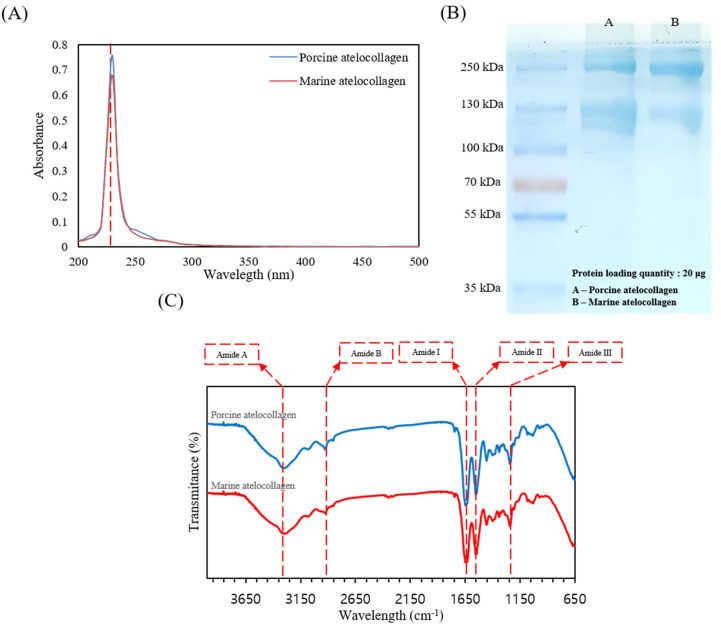
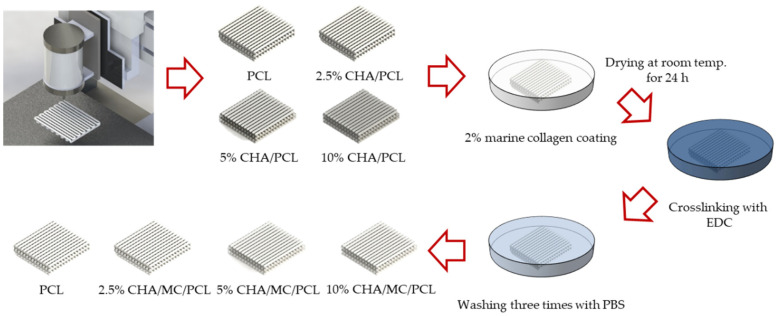
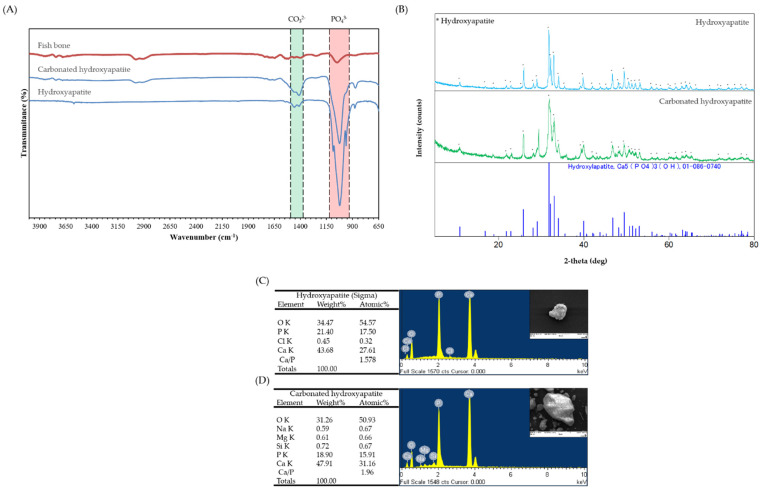
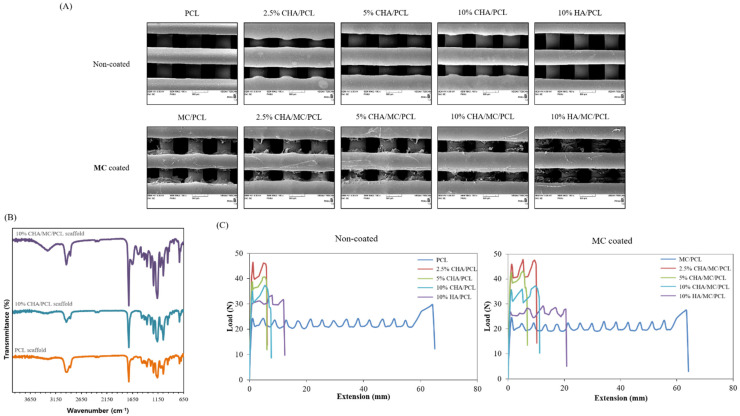
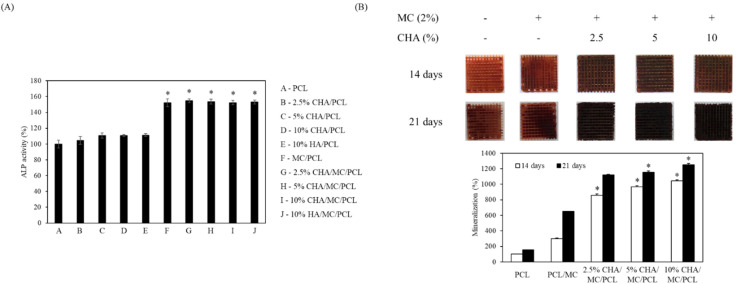
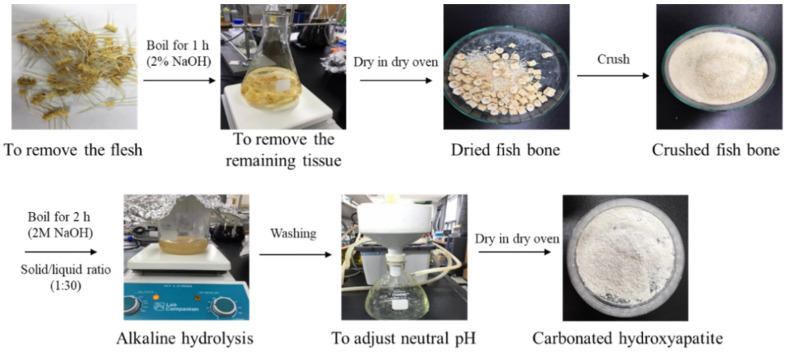
In bone tissue regeneration, extracellular matrix (ECM) and bioceramics are important factors, because of their osteogenic potential and cell-matrix interactions. Surface modifications with hydrophilic material including proteins show significant potential in tissue engineering applications, because scaffolds are generally fabricated using synthetic polymers and bioceramics. In the present study, carbonated hydroxyapatite (CHA) and marine atelocollagen (MC) were extracted from the bones and skins, respectively, of . The extracted CHA was characterized using Fourier transform infrared (FTIR) spectroscopy and X-ray diffraction (XRD) analysis, while MC was characterized using FTIR spectroscopy and sodium dodecyl sulfate-polyacrylamide gel electrophoresis (SDS-PAGE). The scaffolds consisting of polycaprolactone (PCL), and different compositions of CHA (2.5%, 5%, and 10%) were fabricated using a three-axis plotting system and coated with 2% MC. Then, the MC3T3-E1 cells were seeded on the scaffolds to evaluate the osteogenic differentiation in vitro, and in vivo calvarial implantation of the scaffolds was performed to study bone tissue regeneration. The results of mineralization confirmed that the MC/PCL, 2.5% CHA/MC/PCL, 5% CHA/MC/PCL, and 10% CHA/MC/PCL scaffolds increased osteogenic differentiation by 302%, 858%, 970%, and 1044%, respectively, compared with pure PCL scaffolds. Consequently, these results suggest that CHA and MC obtained from byproducts of are superior alternatives for land animal-derived substances.
在骨组织再生中,细胞外基质 (ECM) 和生物陶瓷是重要的因素,因为它们具有成骨潜力和细胞基质相互作用。表面用亲水材料进行改性,包括蛋白质,在组织工程应用中具有显著的潜力,因为支架通常是使用合成聚合物和生物陶瓷制造的。在本研究中,从. 的骨骼和皮肤中分别提取了碳酸化羟基磷灰石 (CHA) 和海洋型胶原蛋白 (MC)。用傅里叶变换红外 (FTIR) 光谱和 X 射线衍射 (XRD) 分析对提取的 CHA 进行了表征,而 MC 则用 FTIR 光谱和十二烷基硫酸钠-聚丙烯酰胺凝胶电泳 (SDS-PAGE) 进行了表征。用三轴绘图系统制备了由聚己内酯 (PCL) 和不同比例 CHA (2.5%、5%和 10%) 组成的支架,并在其表面涂覆 2% MC。然后,将 MC3T3-E1 细胞接种到支架上,以评估体外成骨分化,同时进行支架的体内颅骨植入,以研究骨组织再生。矿化结果证实,与纯 PCL 支架相比,MC/PCL、2.5% CHA/MC/PCL、5% CHA/MC/PCL 和 10% CHA/MC/PCL 支架分别使成骨分化增加了 302%、858%、970%和 1044%。因此,这些结果表明,从. 的副产品中获得的 CHA 和 MC 是优于陆地动物源性物质的替代品。