Biochemistry Department, Faculty of Veterinary Medicine, Benha University, Banha, Egypt.
Aquatic Animal Diseases and Management Department, Faculty of Veterinary Medicine, Benha University, Banha, Egypt.
Vet Res Commun. 2023 Jun;47(2):445-455. doi: 10.1007/s11259-022-09961-0. Epub 2022 Jun 30.
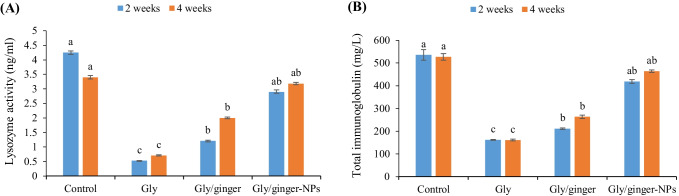
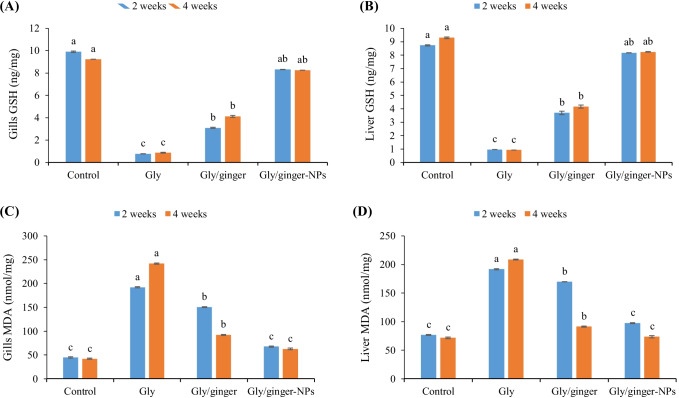
The water-borne herbicides are involved in the toxicity of aquatic animals resulting in impaired health status and low productivity. Dietary medicinal herbs present a practical solution to relieve the impacts of herbicides toxicity on the performances of aquatic animals. Herein, we investigated the toxicity of commercial glyphosate-induced oxidative stress, immunosuppression, liver and kidney dysfunction, and the protective role of ginger or ginger nanoparticles in Nile tilapia. Fish were allocated into four groups: the first group presented the control without glyphosate toxicity and ginger feeding, the second group intoxicated with glyphosate at 0.6 mg/L and fed ginger free diet, the third group intoxicated with glyphosate and fed ginger at 2.5 g/kg, and the fourth group intoxicated with glyphosate and fed ginger nanoparticles at 2.5 g/kg. Fish were kept under the experimental conditions for four weeks, and the samples of blood and tissues were collected after 2 and 4 weeks. Markedly, fish exposed to glyphosate showed the highest ALT and AST activities, glucose and cortisol levels, and malondialdehyde levels (MDA) in gills and tissues. While fish in the control and fish intoxicated with glyphosate and fed ginger nanoparticles had the lowest ALT and AST activities, glucose and cortisol levels, and MDA levels after 2 and 4 weeks (P < 0.05). Fish fed dietary ginger had lower ALT and AST activities, glucose and cortisol levels, and MDA levels than the glyphosate intoxicated group after 2 and 4 weeks (P < 0.05). Interestingly, fish-fed ginger nanoparticles showed lower urea and creatinine levels and higher total protein, albumin, and globulin than the glyphosate intoxicated group (P < 0.05) and similar to the control (P > 0.05). Further, fish intoxicated with glyphosate and fed ginger nanoparticles had the highest GSH, lysozyme activity, and immunoglobulin levels after 2 and 4 weeks (P < 0.05). In conclusion, ginger nanoparticles are superior to the standard ginger form in enhancing the antioxidative and immune responses of Nile tilapia exposed to glyphosate.
水基除草剂会对水生动物的毒性产生影响,导致其健康状况受损和生产力降低。膳食中草药是一种缓解除草剂毒性对水生动物性能影响的实用方法。在此,我们研究了商业草甘膦诱导的氧化应激、免疫抑制、肝肾功能障碍的毒性,以及生姜或姜纳米粒子对尼罗罗非鱼的保护作用。将鱼分为四组:第一组为无草甘膦毒性和生姜喂养的对照组,第二组为 0.6mg/L 草甘膦中毒且不喂生姜组,第三组为 0.6mg/L 草甘膦中毒且喂 2.5g/kg 生姜组,第四组为 0.6mg/L 草甘膦中毒且喂 2.5g/kg 姜纳米粒子组。鱼在实验条件下饲养四周,分别在 2 周和 4 周后采集血液和组织样本。结果表明,暴露于草甘膦的鱼表现出最高的 ALT 和 AST 活性、血糖和皮质醇水平以及鳃和组织中的 MDA 水平。而在对照组和草甘膦中毒且喂姜纳米粒子的鱼中,2 周和 4 周后 ALT 和 AST 活性、血糖和皮质醇水平以及 MDA 水平最低(P < 0.05)。2 周和 4 周后,与草甘膦中毒组相比,摄食姜的鱼具有更低的 ALT 和 AST 活性、血糖和皮质醇水平以及 MDA 水平(P < 0.05)。有趣的是,摄食姜纳米粒子的鱼比草甘膦中毒组具有更低的尿素和肌酐水平以及更高的总蛋白、白蛋白和球蛋白水平(P < 0.05),与对照组相似(P > 0.05)。此外,2 周和 4 周后,草甘膦中毒且喂姜纳米粒子的鱼具有最高的 GSH、溶菌酶活性和免疫球蛋白水平(P < 0.05)。综上所述,与标准生姜形式相比,姜纳米粒子在增强暴露于草甘膦的尼罗罗非鱼的抗氧化和免疫反应方面更具优势。