Petrović Željka, Šarić Ankica, Despotović Ines, Katić Jozefina, Peter Robert, Petravić Mladen, Ivanda Mile, Petković Marin
Division of Materials Chemistry, Ruđer Bošković Institute, Bijenička cesta 54, 10002 Zagreb, Croatia.
Division of Materials Physics, Ruđer Bošković Institute, Bijenička cesta 54, 10002 Zagreb, Croatia.
Materials (Basel). 2022 Jul 23;15(15):5127. doi: 10.3390/ma15155127.
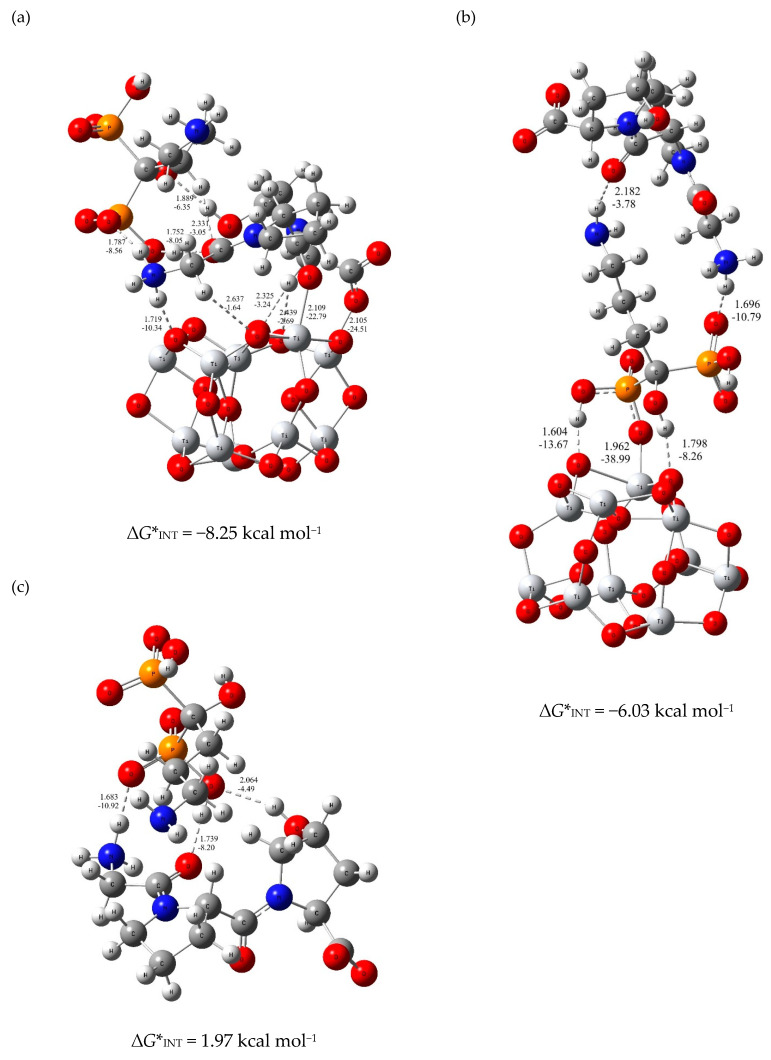
The success of the osseointegration process depends on the surface characteristics and chemical composition of dental implants. Therefore, the titanium dental implant was functionalised with a composite coating of alendronate and hydrolysed collagen, which are molecules with a positive influence on the bone formation. The results of the quantum chemical calculations at the density functional theory level confirm a spontaneous formation of the composite coating on the titanium implant, ∆* = -8.25 kcal mol. The combination of the results of X-ray photoelectron spectroscopy and quantum chemical calculations reveals the structure of the coating. The alendronate molecules dominate in the outer part, while collagen tripeptides prevail in the inner part of the coating. The electrochemical stability and resistivity of the implant modified with the composite coating in a contact with the saliva depend on the chemical nature of alendronate and collagen molecules, as well as their inter- and intramolecular interactions. The formed composite coating provides a 98% protection to the implant after the 7-day immersion in the artificial saliva. From an application point of view, the composite coating could effectively promote osseointegration and improve the implant's resistivity in contact with an aggressive environment such as saliva.
骨结合过程的成功取决于牙科植入物的表面特性和化学成分。因此,对钛牙科植入物进行了阿仑膦酸盐和水解胶原蛋白复合涂层的功能化处理,这两种分子对骨形成有积极影响。密度泛函理论水平的量子化学计算结果证实了钛植入物上复合涂层的自发形成,∆* = -8.25千卡/摩尔。X射线光电子能谱结果与量子化学计算结果相结合揭示了涂层的结构。阿仑膦酸盐分子在涂层外部占主导地位,而胶原蛋白三肽在涂层内部占优势。与唾液接触时,用复合涂层改性的植入物的电化学稳定性和电阻率取决于阿仑膦酸盐和胶原蛋白分子的化学性质以及它们的分子间和分子内相互作用。在人工唾液中浸泡7天后,形成的复合涂层可为植入物提供98%的保护。从应用角度来看,复合涂层可有效促进骨结合并提高植入物在与唾液等侵蚀性环境接触时的电阻率。