Palm Constantin L, Nijholt Kirsten T, Bakker Barbara M, Westenbrink B Daan
Department of Cardiology, University Medical Centre Groningen, University of Groningen, Groningen, Netherlands.
Department of Pediatrics, University Medical Centre Groningen, University of Groningen, Groningen, Netherlands.
Front Cardiovasc Med. 2022 Jul 11;9:915102. doi: 10.3389/fcvm.2022.915102. eCollection 2022.
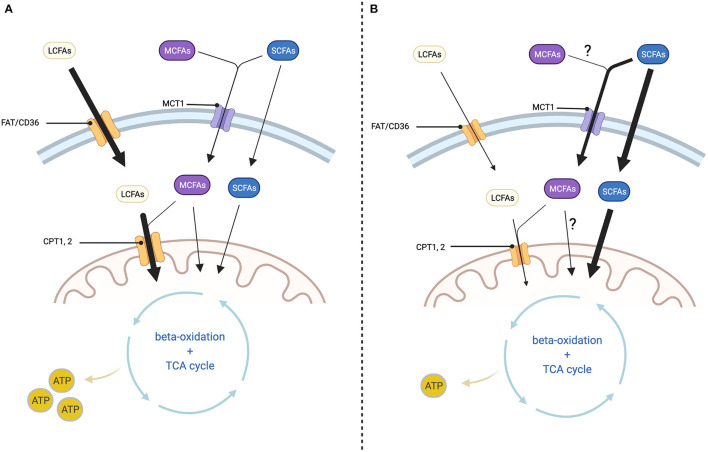
Heart failure (HF) remains a disease with immense global health burden. During the development of HF, the myocardium and therefore cardiac metabolism undergoes specific changes, with decreased long-chain fatty acid oxidation and increased anaerobic glycolysis, diminishing the overall energy yield. Based on the dogma that the failing heart is oxygen-deprived and on the fact that carbohydrates are more oxygen-efficient than FA, metabolic HF drugs have so far aimed to stimulate glucose oxidation or inhibit FA oxidation. Unfortunately, these treatments have failed to provide meaningful clinical benefits. We believe it is time to rethink the concept that fat is harmful to the failing heart. In this review we discuss accumulating evidence that short-chain fatty acids (SCFAs) may be an effective fuel for the failing heart. In contrast to long-chain fatty acids, SCFAs are readily taken up and oxidized by the heart and could serve as a nutraceutical treatment strategy. In addition, we discuss how SCFAs activate pathways that increase long chain fatty acid oxidation, which could help increase the overall energy availability. Another potential beneficial effect we discuss lies within the anti-inflammatory effect of SCFAs, which has shown to inhibit cardiac fibrosis - a key pathological process in the development of HF.
心力衰竭(HF)仍然是一种给全球健康带来巨大负担的疾病。在HF的发展过程中,心肌以及心脏代谢会发生特定变化,长链脂肪酸氧化减少,无氧糖酵解增加,导致整体能量产生减少。基于衰竭心脏缺氧的教条以及碳水化合物比脂肪酸更具氧效率这一事实,迄今为止,代谢性HF药物旨在刺激葡萄糖氧化或抑制脂肪酸氧化。不幸的是,这些治疗未能带来有意义的临床益处。我们认为是时候重新思考脂肪对衰竭心脏有害这一观念了。在本综述中,我们讨论了越来越多的证据表明短链脂肪酸(SCFAs)可能是衰竭心脏的有效燃料。与长链脂肪酸不同,SCFAs很容易被心脏摄取和氧化,并可作为一种营养治疗策略。此外,我们还讨论了SCFAs如何激活增加长链脂肪酸氧化的途径,这有助于提高整体能量供应。我们讨论的另一个潜在有益作用在于SCFAs的抗炎作用,它已被证明可抑制心脏纤维化——HF发展过程中的一个关键病理过程。