• 文献检索
  • 文档翻译
  • 深度研究
  • 学术资讯
  • Suppr Zotero 插件Zotero 插件
  • 邀请有礼
  • 套餐&价格
  • 历史记录
应用&插件
Suppr Zotero 插件Zotero 插件浏览器插件Mac 客户端Windows 客户端微信小程序
定价
高级版会员购买积分包购买API积分包
服务
文献检索文档翻译深度研究API 文档MCP 服务
关于我们
关于 Suppr公司介绍联系我们用户协议隐私条款
关注我们

Suppr 超能文献

核心技术专利:CN118964589B侵权必究
粤ICP备2023148730 号-1Suppr @ 2026

文献检索

告别复杂PubMed语法,用中文像聊天一样搜索,搜遍4000万医学文献。AI智能推荐,让科研检索更轻松。

立即免费搜索

文件翻译

保留排版,准确专业,支持PDF/Word/PPT等文件格式,支持 12+语言互译。

免费翻译文档

深度研究

AI帮你快速写综述,25分钟生成高质量综述,智能提取关键信息,辅助科研写作。

立即免费体验

用于肌肉骨骼康复的移动健康应用程序:在应用商店中的系统搜索与内容分析

mHealth Apps for Musculoskeletal Rehabilitation: Systematic Search in App Stores and Content Analysis.

作者信息

Ryan Shíofra, Ní Chasaide Noirín, O' Hanrahan Shane, Corcoran Darragh, Caulfield Brian, Argent Rob

机构信息

School of Public Health, Physiotherapy and Sports Science, University College Dublin, Dublin, Ireland.

Insight Centre for Data Analytics, University College Dublin, Dublin, Ireland.

出版信息

JMIR Rehabil Assist Technol. 2022 Aug 1;9(3):e34355. doi: 10.2196/34355.

DOI:10.2196/34355
PMID:35916688
原文链接:https://pmc.ncbi.nlm.nih.gov/articles/PMC9379789/
Abstract

BACKGROUND

The number of mobile health (mHealth) apps released for musculoskeletal (MSK) injury treatment and self-management with home exercise programs (HEPs) has risen rapidly in recent years as digital health interventions are explored and researched in more detail. As this number grows, it is becoming increasingly difficult for users to navigate the market and select the most appropriate app for their use case. It is also unclear what features the developers of these apps are harnessing to support patient self-management and how they fit into clinical care pathways.

OBJECTIVE

The objective of this study was to scope the current market of mHealth apps for MSK rehabilitation and to report on their features, claims, evidence base, and functionalities.

METHODS

A cross-sectional study of apps for MSK rehabilitation was performed across the iTunes App Store and Google Play Store. Four search terms were used, namely, physiotherapy rehabilitation, physical therapy rehabilitation, rehabilitation exercise, and therapeutic exercise to identify apps, which were then cross-referenced against set selection criteria by 4 reviewers. Each reviewer, where possible, downloaded the app and accessed supplementary literature available on the product to assist in data extraction.

RESULTS

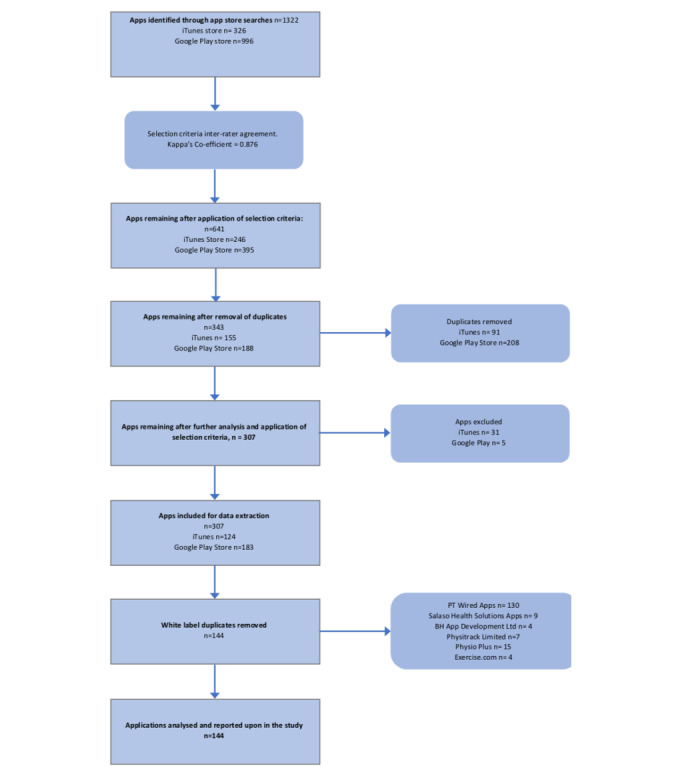
A total of 1322 apps were identified. After applying the inclusion and exclusion criteria and removing duplicates, 144 apps were included in the study. Over half (n=81, 56.3%) of the included apps had been released within the past 3 years. Three quarters (n=107, 74.3%) of the apps made no reference to evidence supporting the design or efficacy of the app, with only 11.1% (n=16) providing direct citations to research. Most of the apps did utilize exercise pictures (n=138, 95.8%) or videos (n=97, 67.4%); however, comparatively few harnessed additional features to encourage engagement and support self-management, such as an adherence log (n=66, 45.8%), communication portal (n=32, 22.2%), patient-reported outcome capture (n=36, 25%), or direct feedback (n=57, 39.6%). Of note and concern, many of these apps prescribed generic exercises (n=93, 64.6%) in the absence of individualized input to the user, with few providing specific patient education (n=43, 34%) and safety advice or disclaimers (n=38, 26.4%).

CONCLUSIONS

The cohort of apps included in this study contained a large heterogeneity of features, so it is difficult for users to identify the most appropriate or effective app. Many apps are missing the opportunity to offer key features that could promote exercise adherence and encourage self-management in MSK rehabilitation. Furthermore, very few developers currently offering products on the market are providing evidence to support the design and efficacy of their technologies.
https://cdn.ncbi.nlm.nih.gov/pmc/blobs/03ca/9379789/bd1426a75a0e/rehab_v9i3e34355_fig1.jpg
摘要

背景

近年来,随着对数字健康干预措施的深入探索和研究,用于肌肉骨骼(MSK)损伤治疗及通过家庭锻炼计划(HEP)进行自我管理的移动健康(mHealth)应用程序数量迅速增加。随着此类应用数量的增长,用户在市场中进行筛选并为其特定需求选择最合适的应用程序变得越来越困难。此外,目前尚不清楚这些应用程序的开发者利用了哪些功能来支持患者自我管理,以及它们如何融入临床护理路径。

目的

本研究旨在梳理用于MSK康复的mHealth应用程序的当前市场情况,并报告其功能、宣称、证据基础及实用功能。

方法

在iTunes应用商店和谷歌Play商店中对用于MSK康复的应用程序开展了一项横断面研究。使用了四个搜索词,即物理治疗康复、物理疗法康复、康复锻炼和治疗性锻炼来识别应用程序,然后由4名评审员根据既定的选择标准进行交叉核对。每位评审员在可能的情况下下载应用程序,并查阅产品上提供的补充文献以协助数据提取。

结果

共识别出1322个应用程序。在应用纳入和排除标准并去除重复项后,144个应用程序被纳入研究。超过半数(n = 81,56.3%)的纳入应用程序是在过去3年内发布的。四分之三(n = 107,74.3%)的应用程序未提及支持该应用程序设计或功效的证据,只有11.1%(n = 16)提供了对研究的直接引用。大多数应用程序确实使用了锻炼图片(n = 138,95.8%)或视频(n = 97,67.4%);然而,相对较少的应用程序利用其他功能来促进参与和支持自我管理,如依从性记录(n = 66,45.8%)、沟通门户(n = 32,22.2%)、患者报告结局采集(n = 36,25%)或直接反馈(n = 57,39.6%)。值得注意且令人担忧的是,许多此类应用程序在未向用户提供个性化输入的情况下规定了通用锻炼(n = 93,64.6%),很少提供特定的患者教育(n = 43,34%)以及安全建议或免责声明(n = 38,26.4%)。

结论

本研究纳入的应用程序群组在功能方面存在很大的异质性,因此用户很难识别最合适或最有效的应用程序。许多应用程序错失了提供关键功能的机会,这些功能本可促进MSK康复中的锻炼依从性并鼓励自我管理。此外,目前在市场上提供产品的开发者中,很少有人提供证据来支持其技术的设计和功效。

相似文献

1
mHealth Apps for Musculoskeletal Rehabilitation: Systematic Search in App Stores and Content Analysis.用于肌肉骨骼康复的移动健康应用程序:在应用商店中的系统搜索与内容分析
JMIR Rehabil Assist Technol. 2022 Aug 1;9(3):e34355. doi: 10.2196/34355.
2
The Current State of Mobile Apps Owned by Large Pediatric Hospitals in the United States: Systematic Search and Analysis on Google Play and Apple App Stores.美国大型儿科医院拥有的移动应用程序的现状:对谷歌Play商店和苹果应用商店的系统搜索与分析
JMIR Pediatr Parent. 2022 Oct 6;5(4):e38940. doi: 10.2196/38940.
3
Evaluation of Patient-Facing Mobile Apps to Support Physiotherapy Care: Systematic Review.评估面向患者的移动应用程序以支持物理治疗护理:系统评价
JMIR Mhealth Uhealth. 2024 Mar 4;12:e55003. doi: 10.2196/55003.
4
Mobile Health Apps on COVID-19 Launched in the Early Days of the Pandemic: Content Analysis and Review.大流行早期推出的 COVID-19 移动健康应用程序:内容分析和综述。
JMIR Mhealth Uhealth. 2020 Sep 16;8(9):e19796. doi: 10.2196/19796.
5
Evaluating Evidence-Based Content, Features of Exercise Instruction, and Expert Involvement in Physical Activity Apps for Pregnant Women: Systematic Search and Content Analysis.评估基于证据的内容、运动指导功能以及专家在孕妇运动应用程序中的参与情况:系统搜索和内容分析。
JMIR Mhealth Uhealth. 2022 Jan 19;10(1):e31607. doi: 10.2196/31607.
6
Patient-Facing Mobile Apps to Support Physiotherapy Care: Protocol for a Systematic Review of Apps Within App Stores.支持物理治疗护理的面向患者的移动应用程序:应用商店内应用程序系统评价方案
JMIR Res Protoc. 2021 Dec 9;10(12):e29047. doi: 10.2196/29047.
7
Quality, Features, and Presence of Behavior Change Techniques in Mobile Apps Designed to Improve Physical Activity in Pregnant Women: Systematic Search and Content Analysis.旨在改善孕妇身体活动的移动应用程序中行为改变技术的质量、特征和存在:系统搜索和内容分析。
JMIR Mhealth Uhealth. 2021 Apr 7;9(4):e23649. doi: 10.2196/23649.
8
Supply and Demand in mHealth Apps for Persons With Multiple Sclerosis: Systematic Search in App Stores and Scoping Literature Review.多发性硬化症患者移动健康应用程序的供需情况:应用商店系统搜索与文献综述
JMIR Mhealth Uhealth. 2018 May 23;6(5):e10512. doi: 10.2196/10512.
9
Functional and Technical Aspects of Self-management mHealth Apps: Systematic App Search and Literature Review.自我管理移动健康应用程序的功能和技术方面:系统的应用程序搜索与文献综述
JMIR Hum Factors. 2022 May 25;9(2):e29767. doi: 10.2196/29767.
10
Evaluating Chinese Mobile Health Apps for Ankylosing Spondylitis Management: Systematic App Search.评估用于强直性脊柱炎管理的中文移动医疗应用程序:系统应用搜索。
JMIR Mhealth Uhealth. 2021 Jul 14;9(7):e27234. doi: 10.2196/27234.

引用本文的文献

1
Advancing Musculoskeletal Care Using AI and Digital Health Applications: A Review of Commercial Solutions.利用人工智能和数字健康应用推进肌肉骨骼护理:商业解决方案综述
HSS J. 2025 May 30:15563316251341321. doi: 10.1177/15563316251341321.
2
Gamification in mHealth Apps for Rehabilitation: Protocol for a Scoping Review.用于康复的移动健康应用程序中的游戏化:一项范围综述的方案
JMIR Res Protoc. 2025 Apr 28;14:e63600. doi: 10.2196/63600.
3
Reviewing Mobile Apps for Teaching Human Anatomy: Search and Quality Evaluation Study.用于人体解剖学教学的移动应用程序综述:搜索与质量评估研究

本文引用的文献

1
The NICE Evidence Standards Framework for digital health and care technologies - Developing and maintaining an innovative evidence framework with global impact.数字健康与护理技术的英国国家卫生与临床优化研究所(NICE)证据标准框架——开发并维护具有全球影响力的创新证据框架。
Digit Health. 2021 Jun 24;7:20552076211018617. doi: 10.1177/20552076211018617. eCollection 2021 Jan-Dec.
2
Mobile Health Intervention Promoting Physical Activity in Adults Post Cardiac Rehabilitation: Pilot Randomized Controlled Trial.移动健康干预促进心脏康复后成年人身体活动:试点随机对照试验
JMIR Form Res. 2021 Apr 16;5(4):e20468. doi: 10.2196/20468.
3
JMIR Med Educ. 2025 Feb 14;11:e64550. doi: 10.2196/64550.
4
Impact of Remote Symptom Management on Exercise Adherence After Video-Assisted Thoracic Surgery for Lung Cancer in a Tertiary Hospital in China: Protocol for a Prospective Randomized Controlled Trial.中国一家三级医院中远程症状管理对肺癌电视辅助胸腔镜手术后运动依从性的影响:一项前瞻性随机对照试验方案
JMIR Res Protoc. 2025 Jan 1;14:e60420. doi: 10.2196/60420.
5
Technology Update in Management of Multi-Ligament Knee Injuries.多韧带膝关节损伤管理的技术更新
Indian J Orthop. 2024 Oct 24;58(11):1537-1547. doi: 10.1007/s43465-024-01281-6. eCollection 2024 Nov.
6
Mobile Apps for Patients with Peritoneal Dialysis: Systematic App Search and Evaluation.适用于腹膜透析患者的移动应用程序:系统的应用程序搜索与评估
Healthcare (Basel). 2024 Mar 25;12(7):719. doi: 10.3390/healthcare12070719.
7
Functionality and Usability of mHealth Apps in Patients with Peritoneal Dialysis: A Systematic Review.移动健康应用程序在腹膜透析患者中的功能与可用性:一项系统评价
Healthcare (Basel). 2024 Mar 5;12(5):593. doi: 10.3390/healthcare12050593.
8
Evaluation of Patient-Facing Mobile Apps to Support Physiotherapy Care: Systematic Review.评估面向患者的移动应用程序以支持物理治疗护理:系统评价
JMIR Mhealth Uhealth. 2024 Mar 4;12:e55003. doi: 10.2196/55003.
9
Exercise therapy as a digital therapeutic for chronic disease management: consideration for clinical product development.运动疗法作为一种用于慢性病管理的数字疗法:临床产品开发的考量
Front Digit Health. 2023 Dec 20;5:1250979. doi: 10.3389/fdgth.2023.1250979. eCollection 2023.
10
The potential of a multimodal digital care program in addressing healthcare inequities in musculoskeletal pain management.多模式数字护理计划在解决肌肉骨骼疼痛管理中医疗保健不平等问题方面的潜力。
NPJ Digit Med. 2023 Oct 10;6(1):188. doi: 10.1038/s41746-023-00936-2.
Harnessing Digital Health Technologies During and After the COVID-19 Pandemic: Context Matters.
在新冠疫情期间及之后利用数字健康技术:背景很重要。
J Med Internet Res. 2020 Dec 30;22(12):e21815. doi: 10.2196/21815.
4
Patient Experiences of Rehabilitation and the Potential for an mHealth System with Biofeedback After Breast Cancer Surgery: Qualitative Study.患者在乳腺癌手术后接受康复治疗和使用带生物反馈的移动健康系统的体验:定性研究。
JMIR Mhealth Uhealth. 2020 Jul 29;8(7):e19721. doi: 10.2196/19721.
5
Rapid Utilization of Telehealth in a Comprehensive Cancer Center as a Response to COVID-19: Cross-Sectional Analysis.综合癌症中心对COVID-19的应对:远程医疗的快速应用——横断面分析
J Med Internet Res. 2020 Jul 6;22(7):e19322. doi: 10.2196/19322.
6
Digital health and care in pandemic times: impact of COVID-19.疫情时期的数字健康与照护:新冠疫情的影响
BMJ Health Care Inform. 2020 Jun;27(1). doi: 10.1136/bmjhci-2020-100166.
7
Effectiveness of Mobile App-Assisted Self-Care Interventions for Improving Patient Outcomes in Type 2 Diabetes and/or Hypertension: Systematic Review and Meta-Analysis of Randomized Controlled Trials.移动应用辅助自我护理干预在改善 2 型糖尿病和/或高血压患者结局中的有效性:随机对照试验的系统评价和荟萃分析。
JMIR Mhealth Uhealth. 2020 Aug 4;8(8):e15779. doi: 10.2196/15779.
8
The use of smartphone apps in clinical practice: A survey of South African physiotherapists.智能手机应用程序在临床实践中的应用:南非物理治疗师的一项调查。
S Afr J Physiother. 2020 Apr 20;76(1):1327. doi: 10.4102/sajp.v76i1.1327. eCollection 2020.
9
Managing patients with chronic pain during the COVID-19 outbreak: considerations for the rapid introduction of remotely supported (eHealth) pain management services.在2019冠状病毒病疫情期间管理慢性疼痛患者:快速引入远程支持(电子健康)疼痛管理服务的注意事项
Pain. 2020 May;161(5):889-893. doi: 10.1097/j.pain.0000000000001885.
10
Beyond validation: getting health apps into clinical practice.超越验证:将健康应用程序应用于临床实践。
NPJ Digit Med. 2020 Feb 3;3:14. doi: 10.1038/s41746-019-0212-z. eCollection 2020.