Cochrane Netherlands, University Medical Center Utrecht, Utrecht University, the Netherlands; Julius Center for Health Sciences and Primary Care, University Medical Center Utrecht, Utrecht University, the Netherlands.
Cochrane Netherlands, University Medical Center Utrecht, Utrecht University, the Netherlands; Julius Center for Health Sciences and Primary Care, University Medical Center Utrecht, Utrecht University, the Netherlands.
Clin Microbiol Infect. 2023 Apr;29(4):434-440. doi: 10.1016/j.cmi.2022.07.019. Epub 2022 Aug 4.
Prognostic models are typically developed to estimate the risk that an individual in a particular health state will develop a particular health outcome, to support (shared) decision making. Systematic reviews of prognostic model studies can help identify prognostic models that need to further be validated or are ready to be implemented in healthcare.
To provide a step-by-step guidance on how to conduct and read a systematic review of prognostic model studies and to provide an overview of methodology and guidance available for every step of the review progress.
Published, peer-reviewed guidance articles.
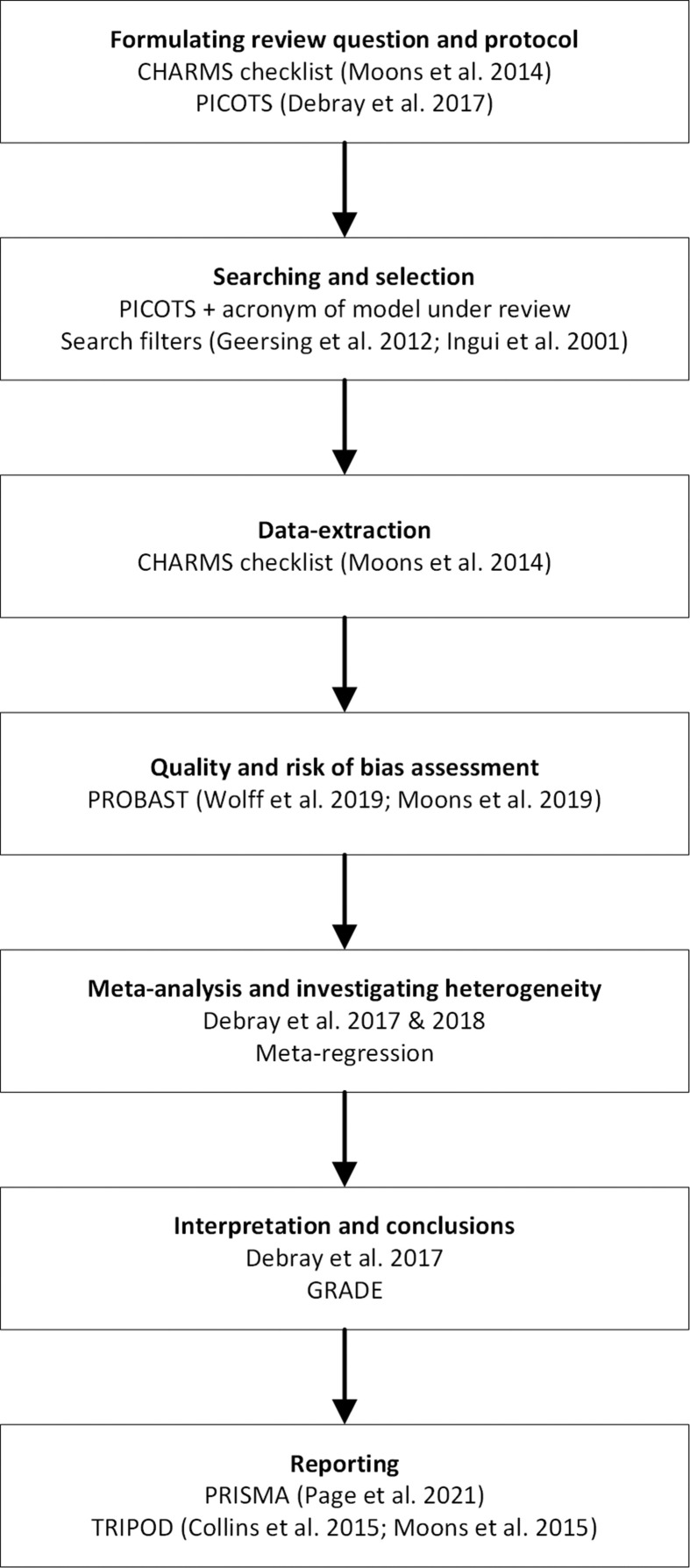
We describe the following steps for conducting a systematic review of prognosis studies: 1) Developing the review question using the Population, Index model, Comparator model, Outcome(s), Timing, Setting format, 2) Searching and selection of articles, 3) Data extraction using the Critical Appraisal and Data Extraction for Systematic Reviews of Prediction Modelling Studies (CHARMS) checklist, 4) Quality and risk of bias assessment using the Prediction model Risk Of Bias ASsessment (PROBAST) tool, 5) Analysing data and undertaking quantitative meta-analysis, and 6) Presenting summary of findings, interpreting results, and drawing conclusions. Guidance for each step is described and illustrated using a case study on prognostic models for patients with COVID-19.
Guidance for conducting a systematic review of prognosis studies is available, but the implications of these reviews for clinical practice and further research highly depend on complete reporting of primary studies.
预后模型通常用于估计特定健康状态下的个体发生特定健康结果的风险,以支持(共同)决策。预后模型研究的系统评价可以帮助识别需要进一步验证或准备在医疗保健中实施的预后模型。
提供关于如何进行和阅读预后模型研究的系统评价的逐步指导,并概述每个审查步骤可用的方法和指导。
已发表的同行评审指导文章。
我们描述了进行预后研究的系统评价的以下步骤:1)使用人群、指标模型、比较模型、结局、时间、设置格式制定审查问题,2)搜索和选择文章,3)使用关键评估和系统评价预测模型研究的数据提取检查表(CHARMS)提取数据,4)使用预测模型风险评估工具(PROBAST)评估质量和偏倚风险,5)分析数据并进行定量荟萃分析,6)呈现发现总结、解释结果并得出结论。使用关于 COVID-19 患者预后模型的案例研究描述和说明每个步骤的指导。
有关于进行预后研究的系统评价的指导,但这些综述对临床实践和进一步研究的影响在很大程度上取决于主要研究的完整报告。