Faculty of Kinesiology, University of Zagreb, Zagreb, Croatia.
Proprio Centre, Physical Rehabilitation Centre, Zadar, Croatia.
JMIR Mhealth Uhealth. 2022 Aug 9;10(8):e37547. doi: 10.2196/37547.
A large number of wearable activity monitor models are released and used each year by consumers and researchers. As more studies are being carried out on children and adolescents in terms of sedentary behavior (SB) assessment, knowledge about accurate and precise monitoring devices becomes increasingly important.
The main aim of this systematic review was to investigate and communicate findings on the accuracy and precision of consumer-grade physical activity monitors in assessing the time spent in SB in children and adolescents.
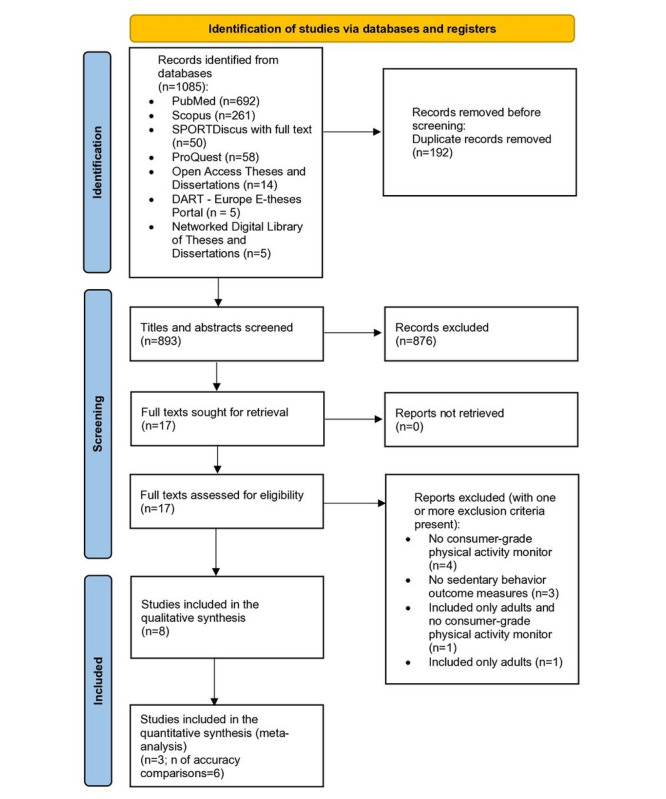
Searches of PubMed (MEDLINE), Scopus, SPORTDiscus (full text), ProQuest, Open Access Theses and Dissertations, DART Europe E-theses Portal, and Networked Digital Library of Theses and Dissertations electronic databases were performed. All relevant studies that compared different types of consumer-grade monitors using a comparison method in the assessment of SB, published in European languages from 2015 onward were considered for inclusion. The risk of bias was estimated using Consensus-Based Standards for the Selection of Health Status Measurement Instruments. For enabling comparisons of accuracy measures within the studied outcome domain, measurement accuracy interpretation was based on group mean or percentage error values and 90% CI. Acceptable limits were predefined as -10% to +10% error in controlled and free-living settings. For determining the number of studies with group error percentages that fall within or outside one of the sides from previously defined acceptable limits, two 1-sided tests of equivalence were carried out, and the direction of measurement error was examined.
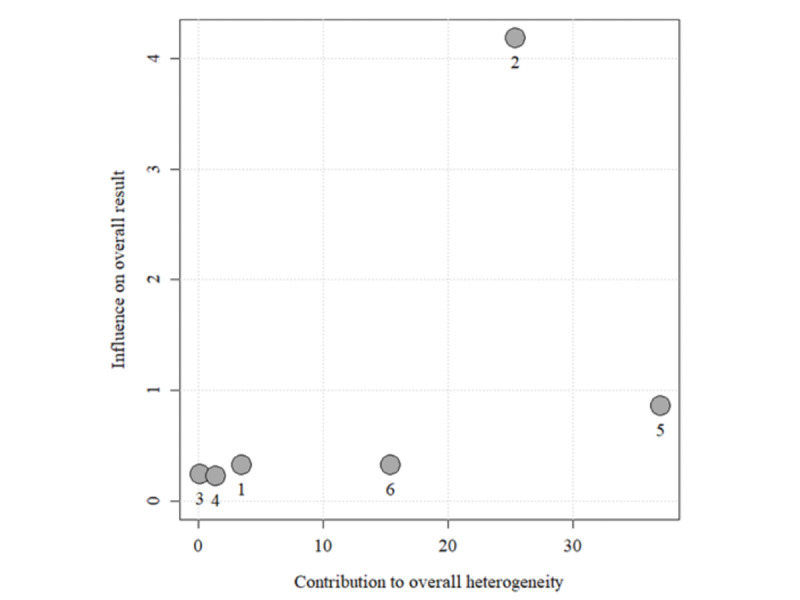
A total of 8 studies complied with the predefined inclusion criteria, and 3 studies provided acceptable data for quantitative analyses. In terms of the presented accuracy comparisons, 14 were subsequently identified, with 6 of these comparisons being acceptable in terms of quantitative analysis. The results of the Cochran Q test indicated that the included studies did not share a common effect size (Q=82.86; P<.001). I, which represents the percentage of total variation across studies due to heterogeneity, amounted to 94%. The summary effect size based on the random effects model was not statistically significant (effect size=14.36, SE 12.04, 90% CI -5.45 to 34.17; P=.23). According to the equivalence test results, consumer-grade physical activity monitors did not generate equivalent estimates of SB in relation to the comparison methods. Majority of the studies (3/7, 43%) that reported the mean absolute percentage errors have reported values of <30%.
This is the first study that has attempted to synthesize available evidence on the accuracy and precision of consumer-grade physical activity monitors in measuring SB in children and adolescents. We found very few studies on the accuracy and almost no evidence on the precision of wearable activity monitors. The presented results highlight the large heterogeneity in this area of research.
PROSPERO CRD42021251922; https://www.crd.york.ac.uk/prospero/display_record.php?RecordID=251922.
每年都有大量的可穿戴活动监测器模型被消费者和研究人员使用。随着越来越多的研究针对儿童和青少年的久坐行为(SB)评估展开,对准确和精确监测设备的了解变得越来越重要。
本系统评价的主要目的是调查和交流关于消费级体力活动监测器在评估儿童和青少年 SB 时间方面的准确性和精密度的研究结果。
在 PubMed(MEDLINE)、Scopus、SPORTDiscus(全文)、ProQuest、开放获取论文和论文、DART Europe E-theses Portal 和网络数字论文和论文电子数据库中进行了搜索。考虑纳入了自 2015 年以来,以欧洲语言发表的使用比较方法评估 SB 的不同类型消费级监测器的所有相关研究。使用共识基础标准选择健康状况测量仪器来评估偏倚风险。为了在研究的结果领域内进行准确性测量的比较,基于组平均值或百分比误差值和 90%CI 来解释测量准确性。在受控和自由生活环境中,可接受的限制被预定义为-10%至+10%的误差。为了确定落在之前定义的可接受限制的一侧内或外的研究数量,进行了两次单侧等效性检验,并检查了测量误差的方向。
共有 8 项研究符合预先确定的纳入标准,其中 3 项研究提供了可用于定量分析的可接受数据。就呈现的准确性比较而言,随后确定了 14 个,其中 6 个在定量分析方面是可接受的。Cochran Q 检验的结果表明,纳入的研究没有共同的效应大小(Q=82.86;P<.001)。I 表示由于异质性导致研究之间总变异的百分比,为 94%。基于随机效应模型的汇总效应大小没有统计学意义(效应大小=14.36,SE 12.04,90%CI -5.45 至 34.17;P=.23)。根据等效性检验结果,消费级体力活动监测器在与比较方法相关的 SB 方面没有产生等效的估计值。报告平均绝对百分比误差的大多数研究(3/7,43%)报告的值<30%。
这是第一项尝试综合有关消费级体力活动监测器在测量儿童和青少年 SB 方面的准确性和精密度的现有证据的研究。我们发现有关准确性的研究很少,几乎没有关于可穿戴活动监测器精密度的证据。呈现的结果突出了该研究领域的高度异质性。
PROSPERO CRD42021251922;https://www.crd.york.ac.uk/prospero/display_record.php?RecordID=251922。