Centre for Genomic Regulation, Barcelona Institute of Science and Technology, 08003 Barcelona, Spain.
The Francis Crick Institute, London NW1 1AT, United Kingdom.
Proc Natl Acad Sci U S A. 2022 Aug 16;119(33):e2206398119. doi: 10.1073/pnas.2206398119. Epub 2022 Aug 12.
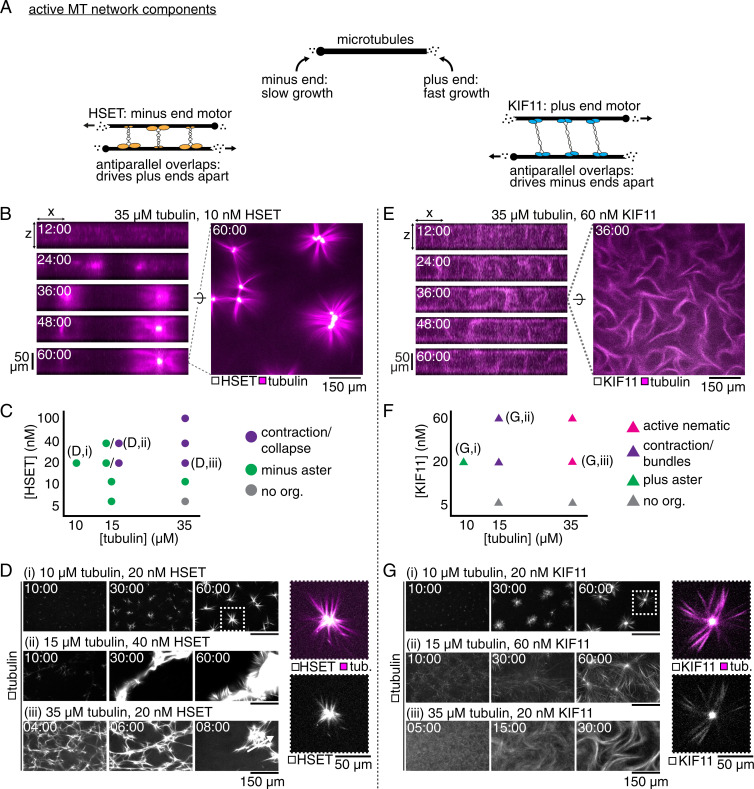
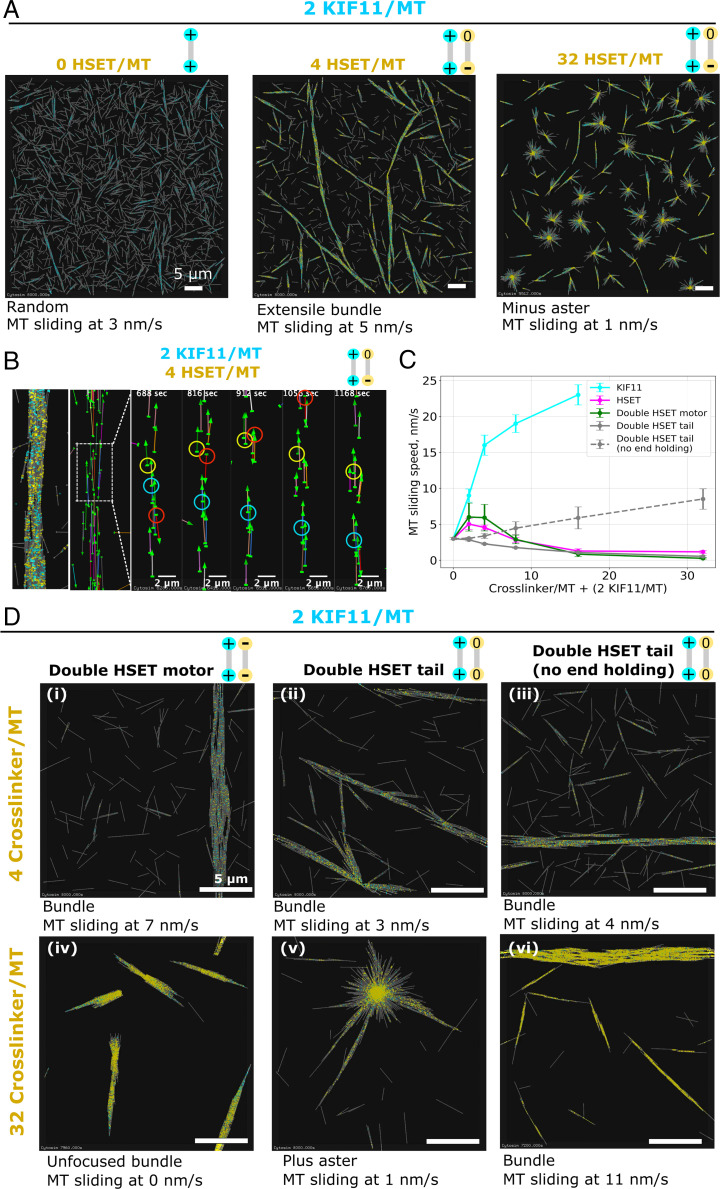
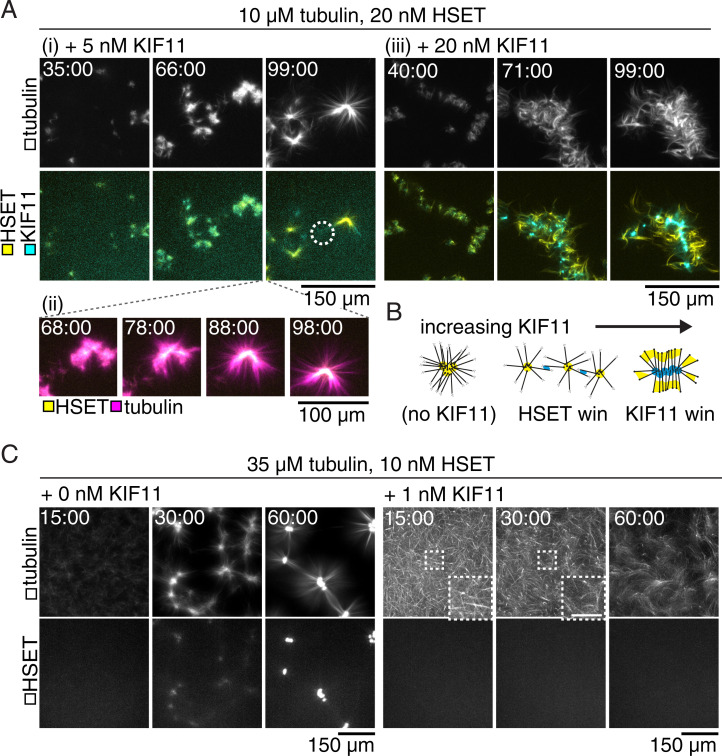
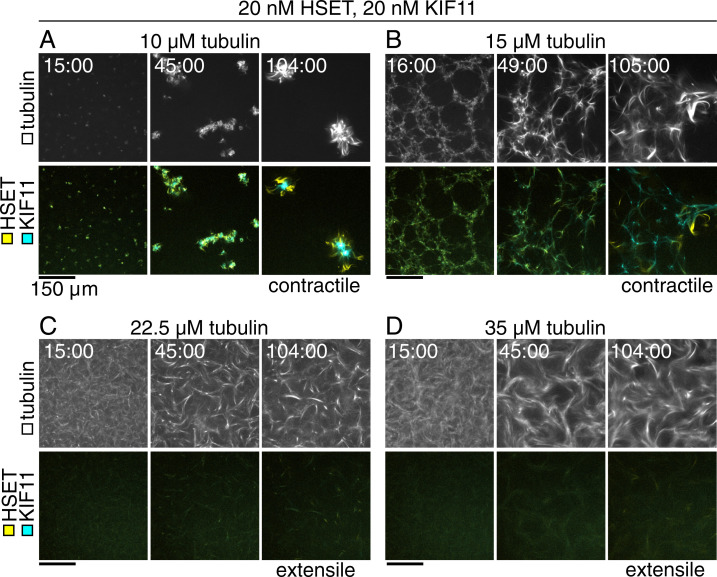
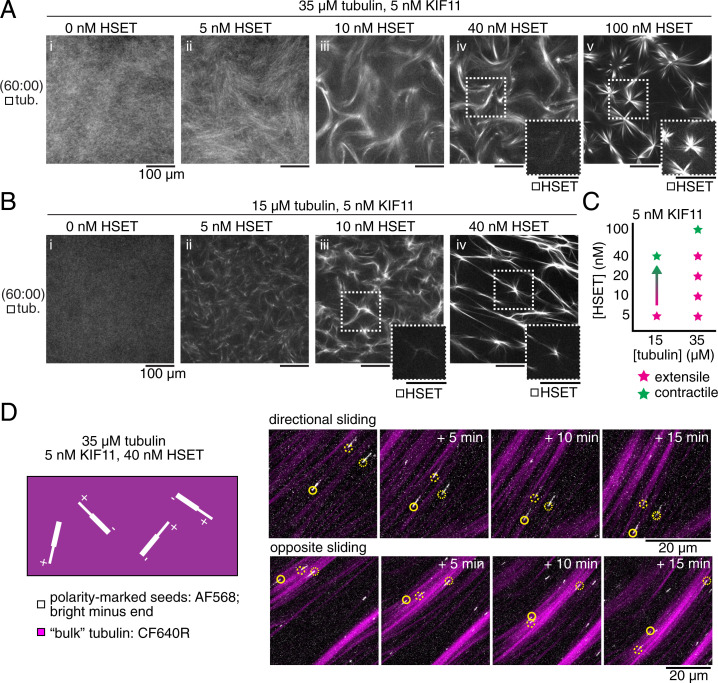
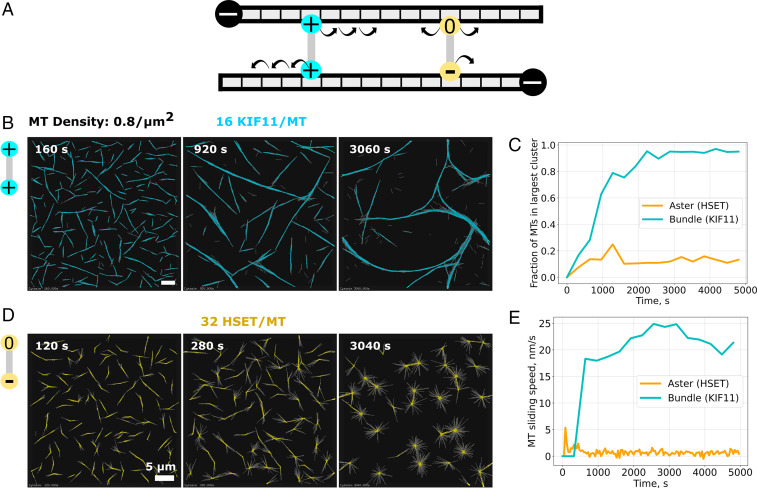
During cell division, cross-linking motors determine the architecture of the spindle, a dynamic microtubule network that segregates the chromosomes in eukaryotes. It is unclear how motors with opposite directionality coordinate to drive both contractile and extensile behaviors in the spindle. Particularly, the impact of different cross-linker designs on network self-organization is not understood, limiting our understanding of self-organizing structures in cells but also our ability to engineer new active materials. Here, we use experiment and theory to examine active microtubule networks driven by mixtures of motors with opposite directionality and different cross-linker design. We find that although the kinesin-14 HSET causes network contraction when dominant, it can also assist the opposing kinesin-5 KIF11 to generate extensile networks. This bifunctionality results from HSET's asymmetric design, distinct from symmetric KIF11. These findings expand the set of rules underlying patterning of active microtubule assemblies and allow a better understanding of motor cooperation in the spindle.
在细胞分裂过程中,交联马达决定纺锤体的结构,纺锤体是一种动态微管网络,可将真核生物的染色体分开。目前尚不清楚具有相反方向的马达如何协调以驱动纺锤体中的收缩和延伸行为。特别是,不同交联器设计对网络自组织的影响尚不清楚,这限制了我们对细胞内自组织结构的理解,也限制了我们设计新型活性材料的能力。在这里,我们使用实验和理论来研究由具有相反方向性和不同交联器设计的马达混合物驱动的活性微管网络。我们发现,尽管主导的 kinesin-14 HSET 会导致网络收缩,但它也可以协助相反的 kinesin-5 KIF11 产生伸展网络。这种双重功能源于 HSET 的不对称设计,与对称的 KIF11 不同。这些发现扩展了活性微管组件模式形成的基础规则集,并允许更好地理解纺锤体中的马达合作。