Gómez-Balcácer Lucía, Somarriba Arechavala Noelia, Gómez-Costilla Patricia
Department of Applied Economics, University of Valladolid, María Zambrano Campus, Plaza de la Universidad 1, 40005 Segovia, Spain.
Department of Economic Analysis, University of Valladolid, María Zambrano Campus, Plaza de la Universidad 1, 40005 Segovia, Spain.
Appl Res Qual Life. 2023;18(1):601-624. doi: 10.1007/s11482-022-10097-1. Epub 2022 Aug 22.
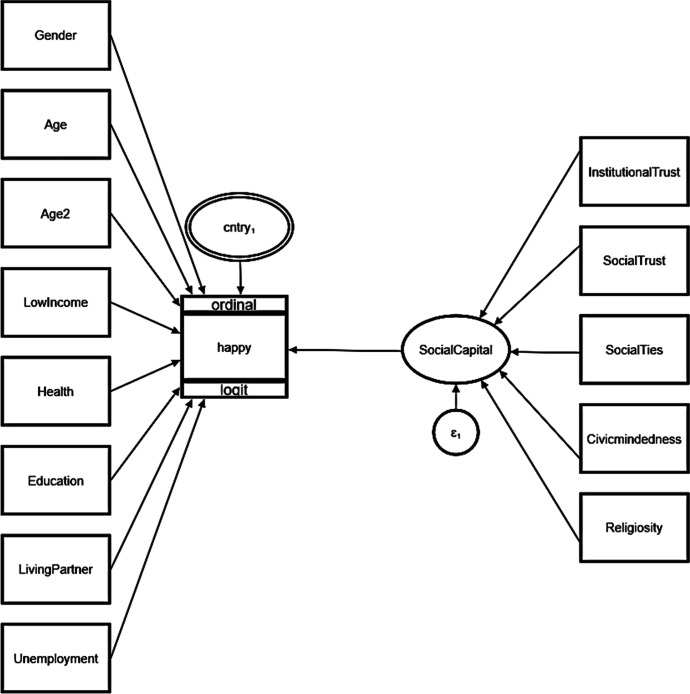
This paper investigates the effects of different dimensions of social capital on happiness of Europeans. Unlike other studies, a categorical principal component analysis (CATPCA) is applied to obtain the dimensions of social capital. The data used come from the ninth wave of the European Social Survey (ESS), year 2018. Happiness is modelled using a multilevel structural equations model (GSEM) by country to study the role of social capital in Europeans' happiness, when controlling for the effect of factors such as gender, unemployment, age, low income, higher education, and living with a partner. Social capital is measured as a multidimensional concept composed of institutional trust, social trust, social ties and voluntary association, civility and sense of belonging, and religiosity. Among the results, we found that the five dimensions that build social capital have a positive impact on happiness. In addition to the positive effects of social capital, the control variables have the expected impact. In a context marked by growing individualism and social isolation, the results of this work can guide policy makers in using the dimensions of social capital to increase the subjective well-being of the population.
本文研究了社会资本的不同维度对欧洲人幸福感的影响。与其他研究不同,本文应用了分类主成分分析(CATPCA)来获取社会资本的维度。所使用的数据来自2018年欧洲社会调查(ESS)的第九轮调查。通过国家层面的多水平结构方程模型(GSEM)对幸福感进行建模,以研究社会资本在欧洲人幸福感中的作用,同时控制性别、失业、年龄、低收入、高等教育以及与伴侣同住等因素的影响。社会资本被衡量为一个多维概念,由制度信任、社会信任、社会关系和自愿协会、文明和归属感以及宗教信仰组成。在研究结果中,我们发现构成社会资本的五个维度对幸福感有积极影响。除了社会资本的积极影响外,控制变量也产生了预期的影响。在一个以个人主义和社会孤立不断加剧为特征的背景下,这项工作的结果可以指导政策制定者利用社会资本的维度来提高民众的主观幸福感。