Veldhuis Lars I, Woittiez Nicky J C, Nanayakkara Prabath W B, Ludikhuize Jeroen
Department of Anesthesiology, Amsterdam UMC, Location Academic Medical Center, Amsterdam, The Netherlands.
Department of Intensive Care, Amsterdam UMC, Location VU University Medical Centre, Amsterdam, The Netherlands.
Crit Care Explor. 2022 Aug 26;4(9):e0744. doi: 10.1097/CCE.0000000000000744. eCollection 2022 Sep.
To analyze the available literature on the performance of artificial intelligence-generated clinical models for the prediction of serious life-threatening events in non-ICU adult patients and evaluate their potential clinical usage.
The PubMed database was searched for relevant articles in English literature from January 1, 2000, to January 23, 2022. Search terms, including artificial intelligence, machine learning, deep learning, and deterioration, were both controlled terms and free-text terms.
We performed a systematic search reporting studies that showed performance of artificial intelligence-based models with outcome mortality and clinical deterioration.
Two review authors independently performed study selection and data extraction. Studies with the same outcome were grouped, namely mortality and various forms of deterioration (including ICU admission, adverse events, and cardiac arrests). Meta-analysis was planned in case sufficient data would be extracted from each study and no considerable heterogeneity between studies was present.
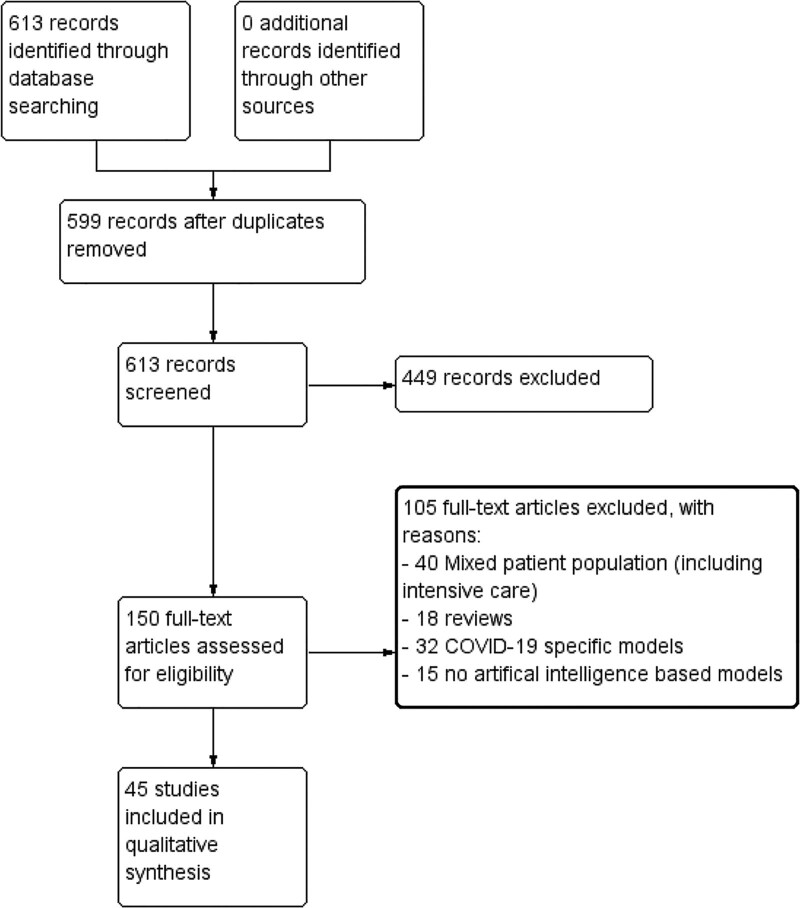
In total, 45 articles were included for analysis, in which multiple methods of artificial intelligence were used. Twenty-four articles described models for the prediction of mortality and 21 for clinical deterioration. Due to heterogeneity of study characteristics (patient cohort, outcomes, and prediction models), meta-analysis could not be performed. The main reported measure of performance was the area under the receiver operating characteristic (AUROC) ( = 38), of which 33 (87%) had an AUROC greater than 0.8. The highest reported performance in a model predicting mortality had an AUROC of 0.935 and an area under the precision-recall curve of 0.96.
Currently, a growing number of studies develop and analyzes artificial intelligence-based prediction models to predict critical illness and deterioration. We show that artificial intelligence-based prediction models have an overall good performance in predicting deterioration of patients. However, external validation of existing models and its performance in a clinical setting is highly recommended.
分析关于人工智能生成的临床模型在预测非重症监护病房成年患者严重危及生命事件方面的现有文献,并评估其潜在的临床应用。
在PubMed数据库中检索2000年1月1日至2022年1月23日英文文献中的相关文章。检索词包括人工智能、机器学习、深度学习和病情恶化,既有受控词也有自由文本词。
我们进行了一项系统检索,报告展示基于人工智能模型在死亡率和临床病情恶化方面表现的研究。
两位综述作者独立进行研究选择和数据提取。具有相同结局的研究进行分组,即死亡率和各种形式的病情恶化(包括重症监护病房入院、不良事件和心脏骤停)。如果能从每项研究中提取足够的数据且研究之间不存在显著异质性,则计划进行荟萃分析。
总共纳入45篇文章进行分析,其中使用了多种人工智能方法。24篇文章描述了死亡率预测模型,21篇描述了临床病情恶化预测模型。由于研究特征(患者队列、结局和预测模型)的异质性,无法进行荟萃分析。主要报告的性能指标是受试者工作特征曲线下面积(AUROC)(=38),其中33个(87%)的AUROC大于0.8。在一个死亡率预测模型中报告的最高性能的AUROC为0.935,精确召回率曲线下面积为0.96。
目前,越来越多的研究开发并分析基于人工智能的预测模型来预测危重病和病情恶化。我们表明基于人工智能的预测模型在预测患者病情恶化方面总体表现良好。然而,强烈建议对现有模型进行外部验证及其在临床环境中的性能验证。