Stephenson School of Biomedical Engineering, University of Oklahoma, Norman, Oklahoma73019, United States.
Department of Biochemistry and Molecular Biology, University of Oklahoma Health Sciences Center, Oklahoma City, Oklahoma73104, United States.
Nano Lett. 2022 Sep 14;22(17):7119-7128. doi: 10.1021/acs.nanolett.2c02226. Epub 2022 Sep 1.
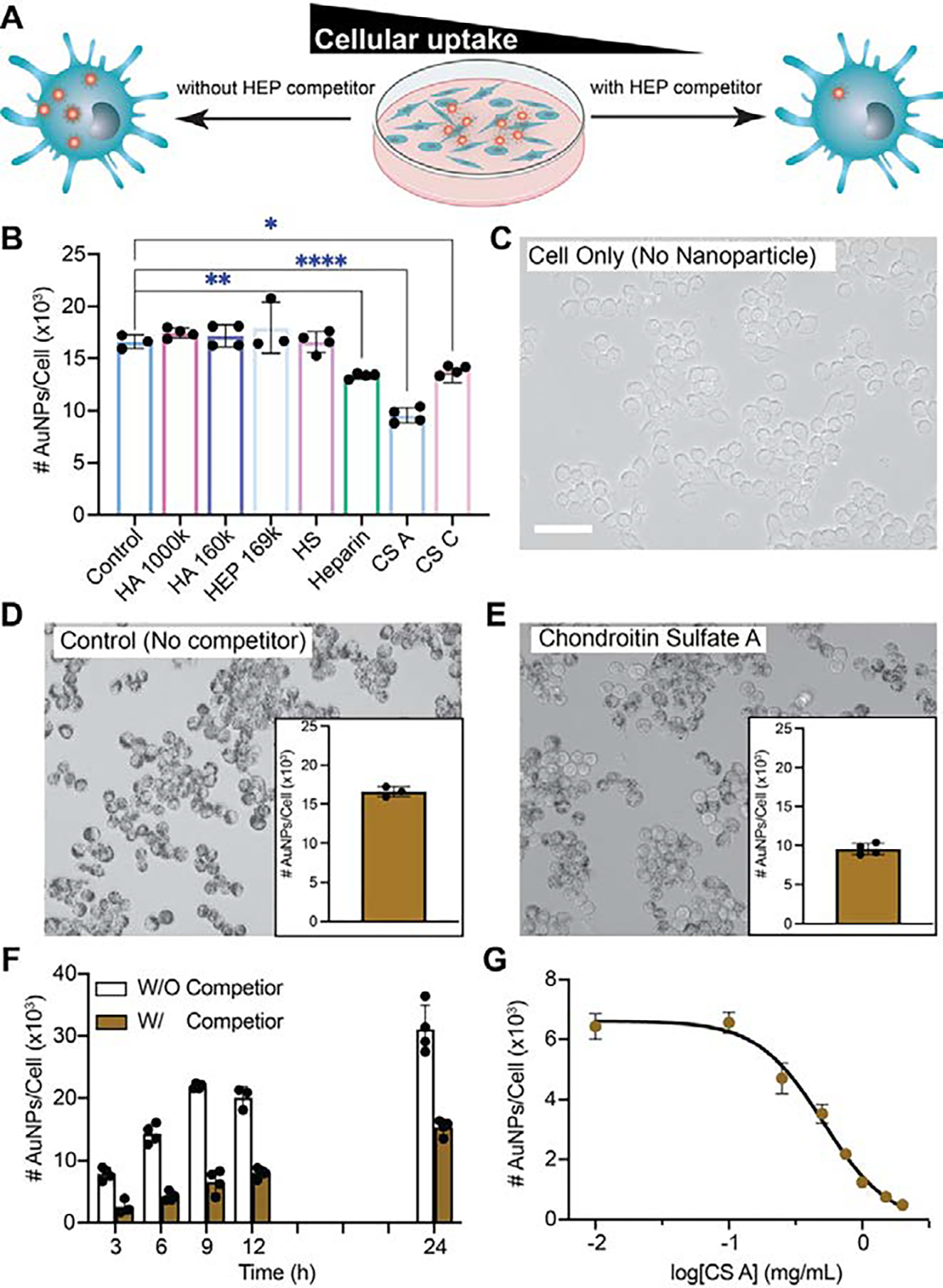
We used heparosan (HEP) polysaccharides for controlling nanoparticle delivery to innate immune cells. Our results show that HEP-coated nanoparticles were endocytosed in a time-dependent manner by innate immune cells via both clathrin-mediated and macropinocytosis pathways. Upon endocytosis, we observed HEP-coated nanoparticles in intracellular vesicles and the cytoplasm, demonstrating the potential for nanoparticle escape from intracellular vesicles. Competition with other glycosaminoglycan types inhibited the endocytosis of HEP-coated nanoparticles only partially. We further found that nanoparticle uptake into innate immune cells can be controlled by more than 3 orders of magnitude via systematically varying the HEP surface density. Our results suggest a substantial potential for HEP-coated nanoparticles to target innate immune cells for efficient intracellular delivery, including into the cytoplasm. This HEP nanoparticle surface engineering technology may be broadly used to develop efficient nanoscale devices for drug and gene delivery as well as possibly for gene editing and immuno-engineering applications.
我们使用硫酸乙酰肝素(HEP)多糖来控制纳米颗粒递送到先天免疫细胞。我们的结果表明,HEP 涂层的纳米颗粒通过网格蛋白介导和胞吞作用途径被先天免疫细胞以时间依赖的方式内吞。内吞后,我们观察到 HEP 涂层的纳米颗粒在细胞内囊泡和细胞质中,表明纳米颗粒有从细胞内囊泡逃逸的潜力。与其他糖胺聚糖类型的竞争仅部分抑制了 HEP 涂层纳米颗粒的内吞作用。我们进一步发现,通过系统地改变 HEP 表面密度,可以将先天免疫细胞对纳米颗粒的摄取控制在超过 3 个数量级。我们的结果表明,HEP 涂层纳米颗粒有很大的潜力作为先天免疫细胞的靶向载体,实现有效的细胞内递药,包括进入细胞质。这种 HEP 纳米颗粒表面工程技术可能广泛用于开发高效的纳米级药物和基因传递装置,以及可能用于基因编辑和免疫工程应用。