Public Health and Epidemiological Studies Group, Cardiovascular Foundation of Colombia, Floridablanca, Colombia.
Research Group and Development of Nursing Knowledge (GIDCEN-FCV), Research Center, Cardiovascular Foundation of Colombia, Floridablanca, Santander, Colombia.
Glob Heart. 2022 Aug 24;17(1):59. doi: 10.5334/gh.1150. eCollection 2022.
Chagas disease (CD) is a neglected tropical disease, endemic in Latin America, but due to migration and environmental changes it has become a global public health issue.
To assess the global prevalence and disability-adjusted life years due to CD using findings from the Global Burden of Disease Study 2019.
The Global Burden of Disease data was obtained from the Global Burden of Disease Collaborative Network; results were provided by the Institute for Health Metrics and Evaluation. The prevalence and disability-adjusted life-years (DALYs) were described at a global, regional, and national level, including data from 1990 to 2019.
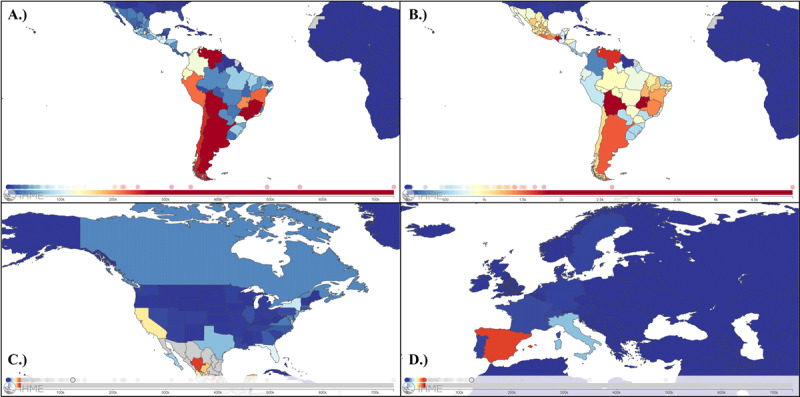
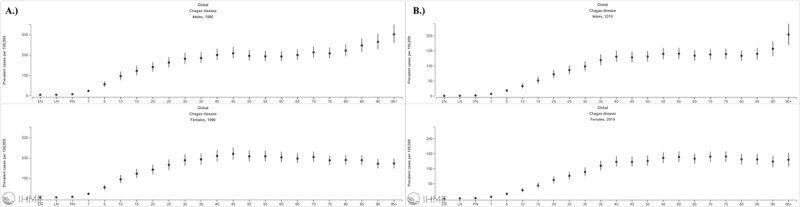
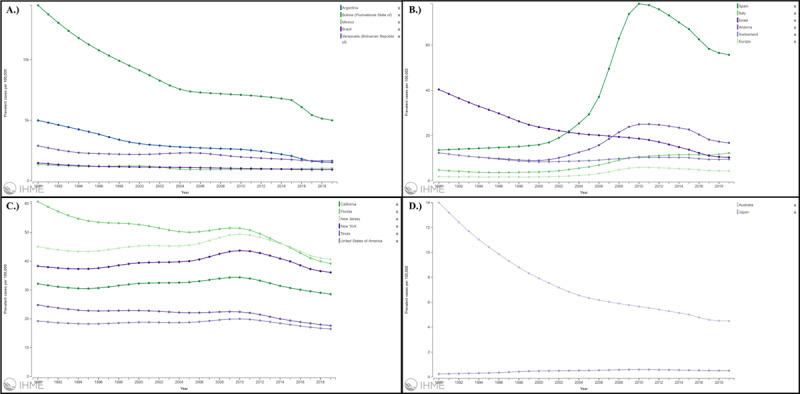
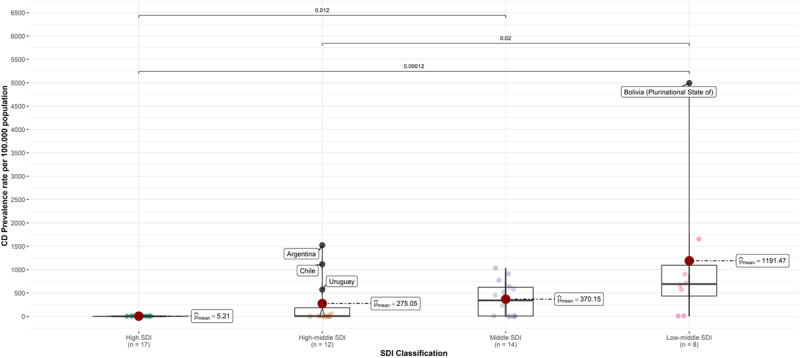
Globally, CD prevalence decreased by 11.3% during the study period, from 7,292,889 cases estimated in 1990 to 6,469,283 in 2019. Moreover, the global DALY rate of CD decreased by 23.7% during the evaluated period, from 360,872 in 1990 to 275,377 in 2019. In addition, significant differences in the burden by sex, being men the most affected, age, with the elderly having the highest burden of the disease, and sociodemographic index (SDI), with countries with the lowest SDI values having the highest prevalence of the disease, were observed. Finally, the prevalence trends have followed different patterns according to the region, with a sustained decrease in Latin America, compared to an increasing trend in North America and Europe until 2010.
The global burden of CD has changed in recent decades, with a sustained decline in the number of cases. Although the majority of cases remain concentrated in Latin America, the increase observed in countries in North America and Europe highlights the importance of screening at-risk populations and raising awareness of this neglected tropical disease.
恰加斯病(CD)是一种被忽视的热带病,流行于拉丁美洲,但由于移民和环境变化,它已成为全球公共卫生问题。
利用 2019 年全球疾病负担研究的结果,评估 CD 的全球患病率和残疾调整生命年。
全球疾病负担数据来自全球疾病负担合作网络;结果由健康计量与评估研究所提供。在全球、区域和国家层面描述了患病率和残疾调整生命年(DALYs),包括 1990 年至 2019 年的数据。
在研究期间,全球 CD 患病率下降了 11.3%,从 1990 年估计的 7292889 例降至 2019 年的 6469283 例。此外,在评估期间,CD 的全球 DALY 率下降了 23.7%,从 1990 年的 360872 例降至 2019 年的 275377 例。此外,还观察到了按性别、年龄和社会人口指数(SDI)划分的负担差异,男性受影响最大,老年人的疾病负担最高,SDI 值最低的国家的疾病患病率最高。最后,根据地区,患病率趋势呈现出不同的模式,与拉丁美洲持续下降相比,北美和欧洲呈上升趋势,直到 2010 年。
近几十年来,CD 的全球负担发生了变化,病例数量持续下降。尽管大多数病例仍集中在拉丁美洲,但在北美和欧洲观察到的病例增加,突显了对高危人群进行筛查和提高对这种被忽视的热带病认识的重要性。