Islam Moinul, Reza Md Tanzim, Kaosar Mohammed, Parvez Mohammad Zavid
Department of Computer Science and Engineering, Brac University, Dhaka, Bangladesh.
Discipline of Information Technology, Media and Communication, Murdoch University, Perth, Australia.
Neural Process Lett. 2022 Aug 28:1-31. doi: 10.1007/s11063-022-11014-1.
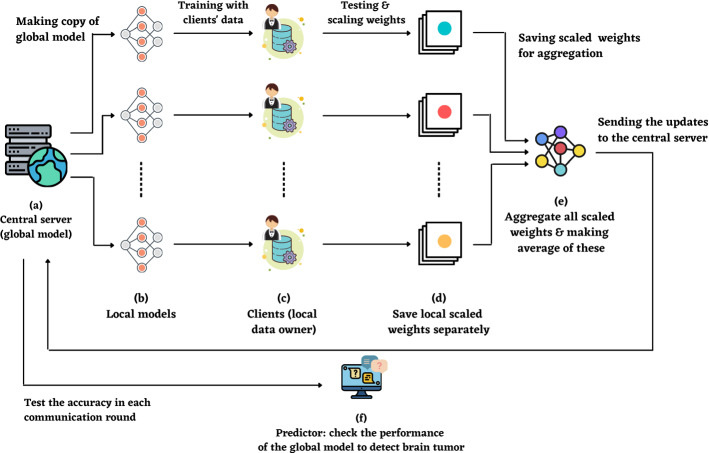
Medical institutions often revoke data access due to the privacy concern of patients. Federated Learning (FL) is a collaborative learning paradigm that can generate an unbiased global model based on collecting updates from local models trained by client's data while keeping the local data private. This study aims to address the centralized data collection issue through the application of FL on brain tumor identification from MRI images. At first, several CNN models were trained using the MRI data and the best three performing CNN models were selected to form different variants of ensemble classifiers. Afterward, the FL model was constructed using the ensemble architecture. It was trained using model weights from the local model without sharing the client's data (MRI images) using the FL approach. Experimental results show only a slight decline in the performance of the FL approach as it achieved 91.05% accuracy compared to the 96.68% accuracy of the base ensemble model. Additionally, same approach was taken for another slightly larger dataset to prove the scalability of the method. This study shows that the FL approach can achieve privacy-protected tumor classification from MRI images without compromising much accuracy compared to the traditional deep learning approach.
医疗机构常常出于对患者隐私的担忧而撤销数据访问权限。联邦学习(FL)是一种协作式学习范式,它能够在保持本地数据私密的同时,基于收集客户端数据训练的本地模型的更新来生成无偏差的全局模型。本研究旨在通过将联邦学习应用于从MRI图像中识别脑肿瘤来解决集中式数据收集问题。首先,使用MRI数据训练了几个卷积神经网络(CNN)模型,并选择性能最佳的三个CNN模型来形成不同变体的集成分类器。之后,使用集成架构构建了联邦学习模型。它使用来自本地模型的模型权重进行训练,而不使用联邦学习方法共享客户端数据(MRI图像)。实验结果表明,与基础集成模型96.68%的准确率相比,联邦学习方法的性能仅略有下降,达到了91.05%的准确率。此外,对另一个稍大的数据集采用了相同的方法来证明该方法的可扩展性。本研究表明,与传统深度学习方法相比,联邦学习方法能够在不损失太多准确率的情况下实现对MRI图像的隐私保护肿瘤分类。