Tougas Hailee, Chan Steven, Shahrvini Tara, Gonzalez Alvaro, Chun Reyes Ruth, Burke Parish Michelle, Yellowlees Peter
Department of Psychiatry and Behavioral Sciences, University of California, Davis, Sacramento, CA, United States.
Department of Psychiatry and Behavioral Sciences, Stanford University School of Medicine, Stanford, CA, United States.
JMIR Ment Health. 2022 Sep 6;9(9):e39556. doi: 10.2196/39556.
Patients with limited English proficiency frequently receive substandard health care. Asynchronous telepsychiatry (ATP) has been established as a clinically valid method for psychiatric assessments. The addition of automated speech recognition (ASR) and automated machine translation (AMT) technologies to asynchronous telepsychiatry may be a viable artificial intelligence (AI)-language interpretation option.
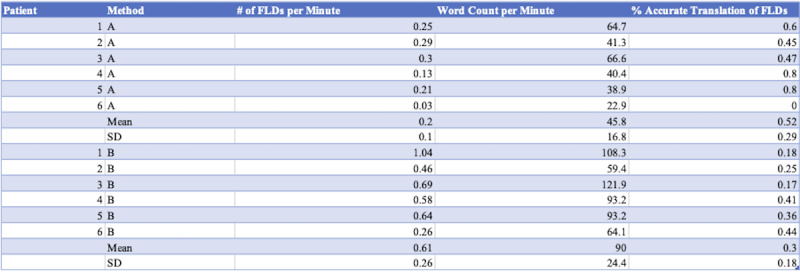
This project measures the frequency and accuracy of the translation of figurative language devices (FLDs) and patient word count per minute, in a subset of psychiatric interviews from a larger trial, as an approximation to patient speech complexity and quantity in clinical encounters that require interpretation.
A total of 6 patients were selected from the original trial, where they had undergone 2 assessments, once by an English-speaking psychiatrist through a Spanish-speaking human interpreter and once in Spanish by a trained mental health interviewer-researcher with AI interpretation. 3 (50%) of the 6 selected patients were interviewed via videoconferencing because of the COVID-19 pandemic. Interview transcripts were created by automated speech recognition with manual corrections for transcriptional accuracy and assessment for translational accuracy of FLDs.
AI-interpreted interviews were found to have a significant increase in the use of FLDs and patient word count per minute. Both human and AI-interpreted FLDs were frequently translated inaccurately, however FLD translation may be more accurate on videoconferencing.
AI interpretation is currently not sufficiently accurate for use in clinical settings. However, this study suggests that alternatives to human interpretation are needed to circumvent modifications to patients' speech. While AI interpretation technologies are being further developed, using videoconferencing for human interpreting may be more accurate than in-person interpreting.
ClinicalTrials.gov NCT03538860; https://clinicaltrials.gov/ct2/show/NCT03538860.
英语水平有限的患者经常接受不合格的医疗服务。异步远程精神病学(ATP)已被确立为一种有效的精神病学评估临床方法。在异步远程精神病学中添加自动语音识别(ASR)和自动机器翻译(AMT)技术可能是一种可行的人工智能(AI)语言口译选项。
本项目在一项更大规模试验的一部分精神病学访谈中,测量比喻性语言手段(FLD)翻译的频率和准确性以及患者每分钟的单词数量,以此作为临床会诊中患者言语复杂性和数量的近似值,这些临床会诊需要口译。
从原始试验中总共选取了6名患者,他们接受了两次评估,一次是由会说英语的精神科医生通过会说西班牙语的人工口译员进行,另一次是由经过培训的心理健康访谈研究人员使用AI口译以西班牙语进行。由于新冠疫情,6名选定患者中有3名(50%)通过视频会议进行访谈。访谈记录通过自动语音识别生成,并进行人工校正以确保转录准确性,并评估FLD的翻译准确性。
发现使用AI口译的访谈中FLD的使用和患者每分钟的单词数量显著增加。人工和AI口译的FLD翻译经常不准确,不过在视频会议中FLD翻译可能更准确。
目前AI口译在临床环境中的准确性还不够。然而,本研究表明需要人工口译的替代方案来避免对患者言语的修改。在进一步开发AI口译技术的同时,使用视频会议进行人工口译可能比面对面口译更准确。
ClinicalTrials.gov NCT03538860;https://clinicaltrials.gov/ct2/show/NCT03538860