Zhao Huangxuan, Ke Ziwen, Yang Fan, Li Ke, Chen Ningbo, Song Liang, Zheng Chuansheng, Liang Dong, Liu Chengbo
Research Laboratory for Biomedical Optics and Molecular Imaging CAS Key Laboratory of Health Informatics Shenzhen Institutes of Advanced Technology Chinese Academy of Sciences Shenzhen 518055 China.
Department of Radiology Union Hospital Tongji Medical College Huazhong University of Science and Technology Wuhan 430022 China.
Adv Sci (Weinh). 2020 Dec 21;8(3):2003097. doi: 10.1002/advs.202003097. eCollection 2021 Feb.
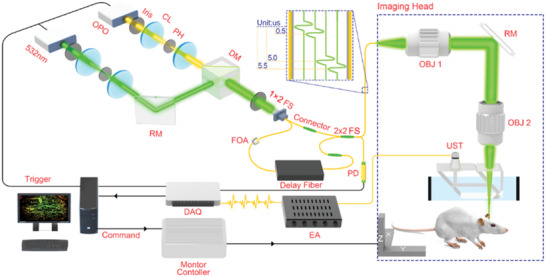
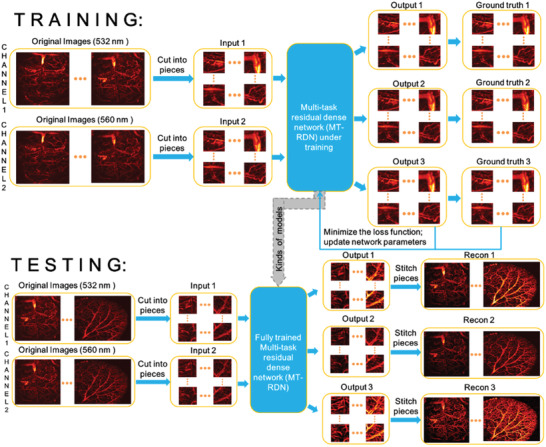
Optical-resolution photoacoustic microscopy (OR-PAM) is an excellent modality for in vivo biomedical imaging as it noninvasively provides high-resolution morphologic and functional information without the need for exogenous contrast agents. However, the high excitation laser dosage, limited imaging speed, and imperfect image quality still hinder the use of OR-PAM in clinical applications. The laser dosage, imaging speed, and image quality are mutually restrained by each other, and thus far, no methods have been proposed to resolve this challenge. Here, a deep learning method called the multitask residual dense network is proposed to overcome this challenge. This method utilizes an innovative strategy of integrating multisupervised learning, dual-channel sample collection, and a reasonable weight distribution. The proposed deep learning method is combined with an application-targeted modified OR-PAM system. Superior images under ultralow laser dosage (32-fold reduced dosage) are obtained for the first time in this study. Using this new technique, a high-quality, high-speed OR-PAM system that meets clinical requirements is now conceivable.
光学分辨率光声显微镜(OR-PAM)是一种用于体内生物医学成像的优秀模态,因为它无需外源性造影剂就能无创地提供高分辨率的形态学和功能信息。然而,高激发激光剂量、有限的成像速度和不完美的图像质量仍然阻碍了OR-PAM在临床应用中的使用。激光剂量、成像速度和图像质量相互制约,迄今为止,尚未提出解决这一挑战的方法。在此,提出了一种名为多任务残差密集网络的深度学习方法来克服这一挑战。该方法采用了一种创新策略,即整合多监督学习、双通道样本采集和合理的权重分配。所提出的深度学习方法与一个针对应用的改进型OR-PAM系统相结合。在本研究中首次在超低激光剂量(剂量降低32倍)下获得了 superior images 。使用这项新技术,现在可以设想出一个满足临床要求的高质量、高速OR-PAM系统。