From the Departments of Bioengineering (E.M.M.) and Radiology (A.H.), University of California, San Diego, 9300 Campus Point Dr, MC 0841, San Diego, CA 92037-0841; and GE Healthcare, Menlo Park, Calif (N.B.).
Radiology. 2020 Jun;295(3):552-561. doi: 10.1148/radiol.2020192173. Epub 2020 Apr 14.
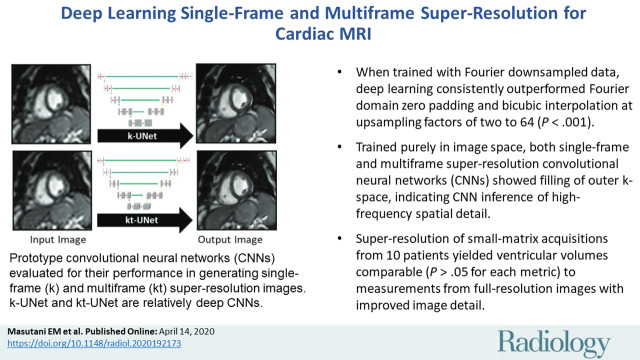
Background Cardiac MRI is limited by long acquisition times, yet faster acquisition of smaller-matrix images reduces spatial detail. Deep learning (DL) might enable both faster acquisition and higher spatial detail via super-resolution. Purpose To explore the feasibility of using DL to enhance spatial detail from small-matrix MRI acquisitions and evaluate its performance against that of conventional image upscaling methods. Materials and Methods Short-axis cine cardiac MRI examinations performed between January 2012 and December 2018 at one institution were retrospectively collected for algorithm development and testing. Convolutional neural networks (CNNs), a form of DL, were trained to perform super resolution in image space by using synthetically generated low-resolution data. There were 70%, 20%, and 10% of examinations allocated to training, validation, and test sets, respectively. CNNs were compared against bicubic interpolation and Fourier-based zero padding by calculating the structural similarity index (SSIM) between high-resolution ground truth and each upscaling method. Means and standard deviations of the SSIM were reported, and statistical significance was determined by using the Wilcoxon signed-rank test. For evaluation of clinical performance, left ventricular volumes were measured, and statistical significance was determined by using the paired Student test. Results For CNN training and retrospective analysis, 400 MRI scans from 367 patients (mean age, 48 years ± 18; 214 men) were included. All CNNs outperformed zero padding and bicubic interpolation at upsampling factors from two to 64 ( < .001). CNNs outperformed zero padding on more than 99.2% of slices (9828 of 9907). In addition, 10 patients (mean age, 51 years ± 22; seven men) were prospectively recruited for super-resolution MRI. Super-resolved low-resolution images yielded left ventricular volumes comparable to those from full-resolution images ( > .05), and super-resolved full-resolution images appeared to further enhance anatomic detail. Conclusion Deep learning outperformed conventional upscaling methods and recovered high-frequency spatial information. Although training was performed only on short-axis cardiac MRI examinations, the proposed strategy appeared to improve quality in other imaging planes. © RSNA, 2020
背景 心脏 MRI 受到采集时间长的限制,然而,更小矩阵图像的更快采集会降低空间细节。深度学习(DL)可能通过超分辨率同时实现更快的采集和更高的空间细节。目的 探索使用 DL 从小矩阵 MRI 采集增强空间细节的可行性,并评估其性能与传统图像放大方法的比较。材料和方法 回顾性收集了 2012 年 1 月至 2018 年 12 月在一家机构进行的短轴电影心脏 MRI 检查,用于算法开发和测试。卷积神经网络(CNN),一种 DL 形式,通过使用合成生成的低分辨率数据在图像空间中进行超分辨率训练。分别有 70%、20%和 10%的检查分配到训练、验证和测试集。通过计算高分辨率地面真实值和每种上采样方法之间的结构相似性指数(SSIM),将 CNN 与双三次插值和基于傅里叶的零填充进行比较。报告了 SSIM 的平均值和标准差,并通过使用 Wilcoxon 符号秩检验确定统计学意义。为了评估临床性能,测量了左心室容积,并通过使用配对学生 t 检验确定统计学意义。结果 对于 CNN 训练和回顾性分析,包括 367 名患者(平均年龄,48 岁±18;214 名男性)的 400 次 MRI 扫描。所有 CNN 在 2 到 64 倍的上采样因子上都优于零填充和双三次插值(<.001)。CNN 在超过 99.2%的切片上优于零填充(9907 个中的 9828 个)。此外,还前瞻性地招募了 10 名患者(平均年龄,51 岁±22;7 名男性)进行超分辨率 MRI。超分辨率低分辨率图像产生的左心室容积与全分辨率图像相当(>.05),而超分辨率全分辨率图像似乎进一步增强了解剖细节。结论 DL 优于传统的上采样方法,可以恢复高频空间信息。尽管仅在短轴心脏 MRI 检查上进行了训练,但所提出的策略似乎改善了其他成像平面的质量。©RSNA,2020