Muhammad Abdul Kadar Nellysha Namela, Ahmad Fairus, Teoh Seong Lin, Yahaya Mohamad Fairuz
Department of Anatomy, Faculty of Medicine, Universiti Kebangsaan Malaysia Medical Centre, Cheras, Kuala Lumpur 56000, Malaysia.
Department of Biomedical Sciences and Therapeutics, Faculty of Medicine and Health Sciences, Universiti Malaysia Sabah, Kota Kinabalu 88400, Malaysia.
Antioxidants (Basel). 2022 Oct 31;11(11):2154. doi: 10.3390/antiox11112154.
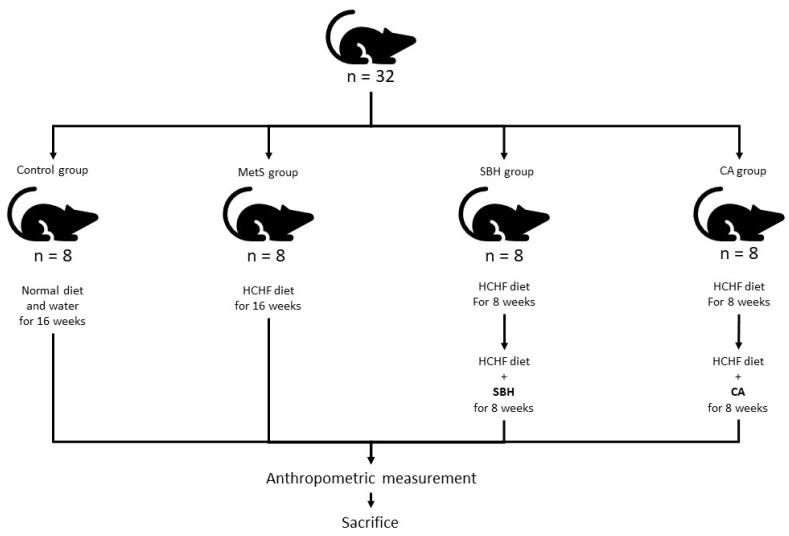
There is mounting evidence that metabolic syndrome (MetS) contributes to the development of neurodegenerative disorders such as Alzheimer’s disease. Honey, which has been used for generations, is high in antioxidants and has been demonstrated to benefit the brain and mental health by reducing oxidative stress and boosting cognitive outcomes. Honey from the stingless bees of Heterotrigona itama has been found to have higher phenolic content compared to other types of honeys. The aim of this study is to investigate the effects of stingless bee honey (SBH) supplementation and to compare it with a pure form of antioxidant, caffeic acid (CA), on MetS parameters and inflammatory markers in the brains of MetS-induced rats. A total of 32 male Wistar rats were divided equally into groups of control, high-carbohydrate high-fructose (HCHF) diet (MetS), HCHF + SBH supplemented (1 g/kg) (SBH), and HCHF + CA supplemented (10 mg/kg) (CA) groups. The total duration for SBH and CA supplementation was eight weeks. The HCHF diet was found to promote hypertension, hyperglycemia, and hypertriglyceridemia, and to increase brain TNF-α levels. Supplementation with SBH and CA significantly reversed (p < 0.05) the hyperglycemic and hypertensive effects of the HCHF diet. Although both supplemented groups showed no significant changes to serum HDL or TG, SBH significantly reduced (p < 0.05) brain TNF-α levels and increased (p < 0.05) brain BDNF levels. Immunohistochemistry investigations of neurogenesis (EdU) and apoptosis (TUNEL) on the cornu Ammonis 1 (CA1) and dentate gyrus (DG) areas of the hippocampus showed no changes with SBH and CA supplementation compared to the control. These findings suggest that SBH and CA have the potential to mitigate HCHF-induced MetS effects and possess neuroprotective abilities.
越来越多的证据表明,代谢综合征(MetS)会促使神经退行性疾病如阿尔茨海默病的发展。蜂蜜世代以来都被人们使用,富含抗氧化剂,并且已被证明通过减轻氧化应激和改善认知结果对大脑和心理健康有益。已发现来自黑大蜜蜂的蜂蜜与其他类型的蜂蜜相比,酚类含量更高。本研究的目的是调查补充无刺蜂蜂蜜(SBH)的效果,并将其与纯形式的抗氧化剂咖啡酸(CA)对MetS诱导大鼠大脑中的MetS参数和炎症标志物的影响进行比较。总共32只雄性Wistar大鼠被平均分为对照组、高碳水化合物高果糖(HCHF)饮食(MetS)组、补充HCHF + SBH(1 g/kg)(SBH)组和补充HCHF + CA(10 mg/kg)(CA)组。SBH和CA补充的总时长为八周。发现HCHF饮食会导致高血压、高血糖和高甘油三酯血症,并增加大脑肿瘤坏死因子-α(TNF-α)水平。补充SBH和CA显著逆转了(p < 0.05)HCHF饮食的高血糖和高血压作用。虽然两个补充组的血清高密度脂蛋白(HDL)或甘油三酯(TG)均无显著变化,但SBH显著降低了(p < 0.05)大脑TNF-α水平并增加了(p < 0.05)大脑脑源性神经营养因子(BDNF)水平。对海马体的海马1区(CA1)和齿状回(DG)区域进行神经发生(EdU)和细胞凋亡(TUNEL)的免疫组织化学研究表明,与对照组相比,补充SBH和CA后没有变化。这些发现表明,SBH和CA有减轻HCHF诱导的MetS效应的潜力,并具有神经保护能力。