Alqahtani Ali, Zahoor Mirza Mumtaz, Nasrullah Rimsha, Fareed Aqil, Cheema Ahmad Afzaal, Shahrose Abdullah, Irfan Muhammad, Alqhatani Abdulmajeed, Alsulami Abdulaziz A, Zaffar Maryam, Rahman Saifur
Department of Networks and Communications Engineering, College of Computer Science and Information Systems, Najran University, Najran 61441, Saudi Arabia.
Faculty of Computer Sciences, Ibadat International University, Islamabad 44000, Pakistan.
Life (Basel). 2022 Oct 26;12(11):1709. doi: 10.3390/life12111709.
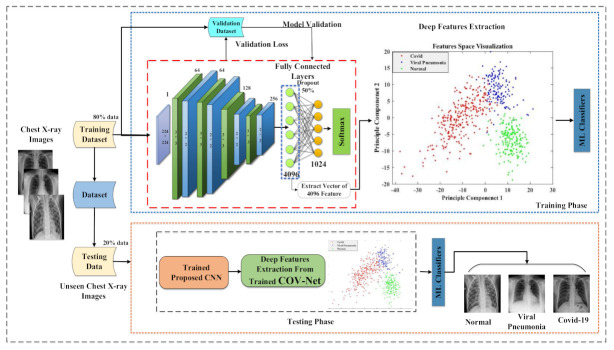
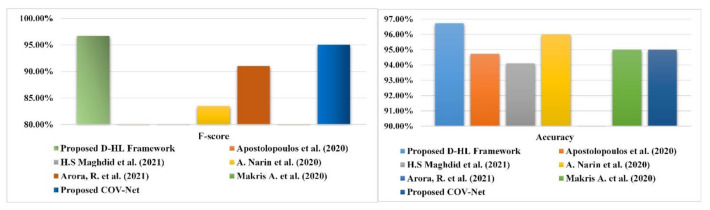
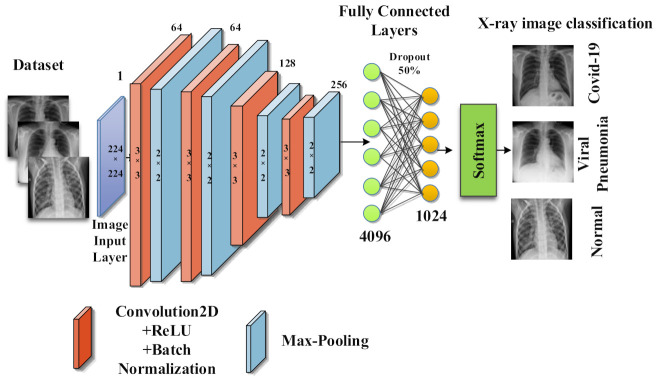
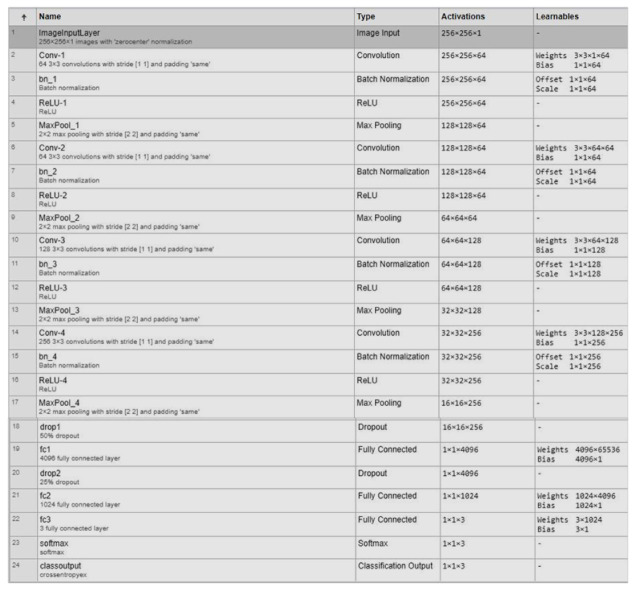
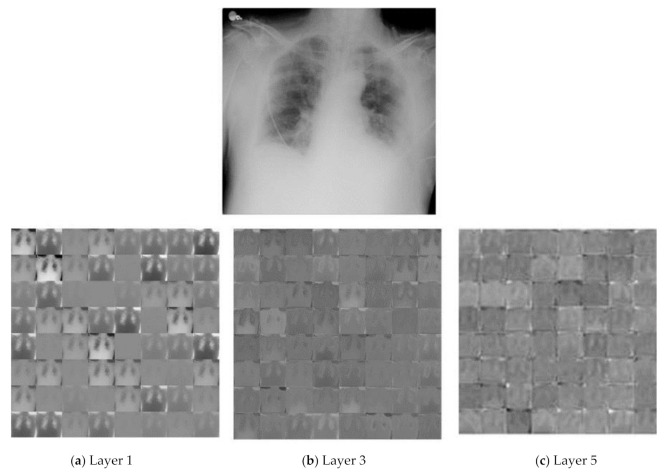
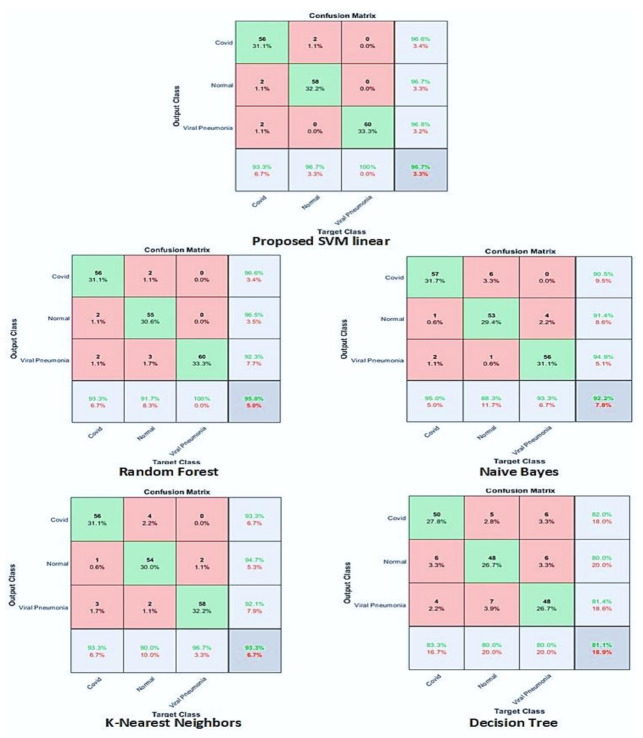
Early detection of abnormalities in chest X-rays is essential for COVID-19 diagnosis and analysis. It can be effective for controlling pandemic spread by contact tracing, as well as for effective treatment of COVID-19 infection. In the proposed work, we presented a deep hybrid learning-based framework for the detection of COVID-19 using chest X-ray images. We developed a novel computationally light and optimized deep Convolutional Neural Networks (CNNs) based framework for chest X-ray analysis. We proposed a new COV-Net to learn COVID-specific patterns from chest X-rays and employed several machine learning classifiers to enhance the discrimination power of the presented framework. Systematic exploitation of max-pooling operations facilitates the proposed COV-Net in learning the boundaries of infected patterns in chest X-rays and helps for multi-class classification of two diverse infection types along with normal images. The proposed framework has been evaluated on a publicly available benchmark dataset containing X-ray images of coronavirus-infected, pneumonia-infected, and normal patients. The empirical performance of the proposed method with developed COV-Net and support vector machine is compared with the state-of-the-art deep models which show that the proposed deep hybrid learning-based method achieves 96.69% recall, 96.72% precision, 96.73% accuracy, and 96.71% F-score. For multi-class classification and binary classification of COVID-19 and pneumonia, the proposed model achieved 99.21% recall, 99.22% precision, 99.21% F-score, and 99.23% accuracy.
早期检测胸部X光片中的异常对于新冠病毒病(COVID-19)的诊断和分析至关重要。它对于通过接触者追踪来控制疫情传播以及有效治疗COVID-19感染都具有成效。在本研究中,我们提出了一种基于深度混合学习的框架,用于使用胸部X光图像检测COVID-19。我们开发了一种新颖的、计算量小且经过优化的基于深度卷积神经网络(CNN)的框架用于胸部X光分析。我们提出了一种新的COV-Net,以从胸部X光片中学习COVID-19特有的模式,并采用了几种机器学习分类器来增强所提出框架的辨别能力。对最大池化操作的系统利用有助于所提出的COV-Net学习胸部X光片中感染模式的边界,并有助于对两种不同感染类型以及正常图像进行多类别分类。所提出的框架已在一个公开可用的基准数据集上进行了评估,该数据集包含冠状病毒感染、肺炎感染和正常患者的X光图像。将所提出方法与已开发的COV-Net和支持向量机的实证性能与当前最先进的深度模型进行了比较,结果表明所提出的基于深度混合学习的方法实现了96.69%的召回率、96.72%的精确率、96.73%的准确率和96.71%的F值。对于COVID-19和肺炎的多类别分类和二分类,所提出的模型实现了99.21%的召回率、99.22%的精确率、99.21%的F值和99.23%的准确率。