Department of Neurology, Massachusetts General Hospital, Brigham and Women's Hospital, Boston, Massachusetts, USA.
Division of Sleep Medicine, Harvard Medical School, Boston, Massachusetts, USA.
Clin Transl Med. 2022 Dec;12(12):e1131. doi: 10.1002/ctm2.1131.
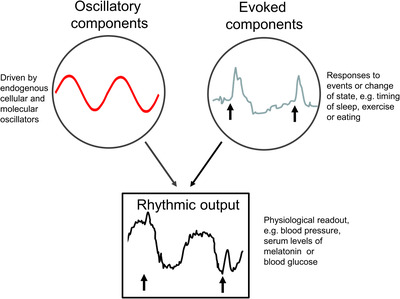
Daily rhythms are observed in humans and almost all other organisms. Most of these observed rhythms reflect both underlying endogenous circadian rhythms and evoked responses from behaviours such as sleep/wake, eating/fasting, rest/activity, posture changes and exercise. For many research and clinical purposes, it is important to understand the contribution of the endogenous circadian component to these observed rhythms.
The goal of this manuscript is to provide guidance on best practices in measuring metrics of endogenous circadian rhythms in humans and promote the inclusion of circadian rhythms assessments in studies of health and disease. Circadian rhythms affect all aspects of physiology. By specifying minimal experimental conditions for studies, we aim to improve the quality, reliability and interpretability of research into circadian and daily (i.e., time-of-day) rhythms and facilitate the interpretation of clinical and translational findings within the context of human circadian rhythms. We describe protocols, variables and analyses commonly used for studying human daily rhythms, including how to assess the relative contributions of the endogenous circadian system and other daily patterns in behaviours or the environment. We conclude with recommendations for protocols, variables, analyses, definitions and examples of circadian terminology.
Although circadian rhythms and daily effects on health outcomes can be challenging to distinguish in practice, this distinction may be important in many clinical settings. Identifying and targeting the appropriate underlying (patho)physiology is a medical goal. This review provides methods for identifying circadian effects to aid in the interpretation of published work and the inclusion of circadian factors in clinical research and practice.
人类和几乎所有其他生物都存在日常节律。这些观察到的节律大多反映了内在的内源性昼夜节律以及睡眠/觉醒、进食/禁食、休息/活动、姿势变化和运动等行为的诱发反应。出于许多研究和临床目的,了解这些观察到的节律中内源性昼夜节律成分的贡献非常重要。
本文的目的是提供测量人类内源性昼夜节律指标的最佳实践指南,并促进在健康和疾病研究中纳入昼夜节律评估。昼夜节律影响生理的各个方面。通过为研究指定最小的实验条件,我们旨在提高昼夜节律和日常(即一天中的时间)节律研究的质量、可靠性和可解释性,并有助于在人类昼夜节律的背景下解释临床和转化研究的发现。我们描述了常用于研究人类日常节律的方案、变量和分析方法,包括如何评估内源性生物钟系统和行为或环境中的其他日常模式的相对贡献。最后,我们提出了有关方案、变量、分析、定义和昼夜术语示例的建议。
尽管在实践中区分昼夜节律和对健康结果的日常影响可能具有挑战性,但在许多临床环境中,这种区分可能很重要。确定和针对适当的潜在(病理)生理学是医学目标。本综述提供了识别昼夜影响的方法,以帮助解释已发表的工作,并将昼夜因素纳入临床研究和实践中。