Kidney Research Center, Tabriz University of Medical Sciences, Tabriz, Iran.
Research Center for Pharmaceutical Nanotechnology, Biomedicine Institute, Tabriz University of Medical Sciences, Tabriz, Iran.
Nanotheranostics. 2023 Jan 1;7(1):61-69. doi: 10.7150/ntno.78611. eCollection 2023.
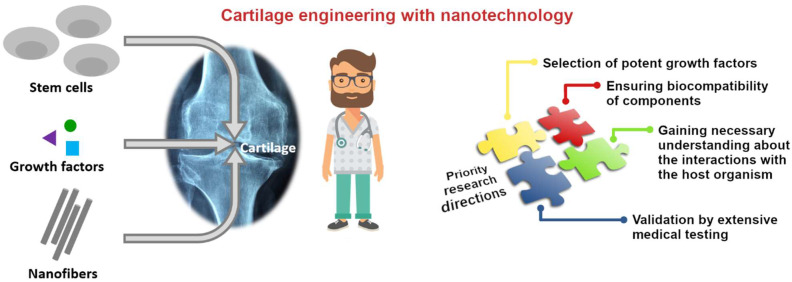
Articular cartilage has a low self-repair capacity due to the lack of vessels and nerves. In recent times, nanofiber scaffolds have been widely used for this purpose. The optimum nanofiber scaffold should stimulate new tissue's growth and mimic the articular cartilage nature. Furthermore, the characteristics of the scaffold should match those of the cellular matrix components of the native tissue to best merge with the target tissue. Therefore, selective modification of prefabricated scaffolds based on the structure of the repaired tissues is commonly conducted to promote restoring the tissue. A thorough analysis is required to find out the architectural features of scaffolds that are essential to make the treatment successful. The current review aims to target this challenge. The article highlights different optimization approaches of nanofibrous scaffolds for improved cartilage tissue engineering. In this context, the influence of the architecture of nanoscaffolds on performance is discussed in detail. Finally, based on the gathered information, a future outlook is provided to catalyze development in this promising field.
关节软骨由于缺乏血管和神经,自我修复能力较低。最近,纳米纤维支架被广泛用于这一目的。最佳的纳米纤维支架应能刺激新组织的生长,并模拟关节软骨的特性。此外,支架的特性应与天然组织的细胞基质成分相匹配,以使其与目标组织最佳融合。因此,通常对预制支架进行基于修复组织结构的选择性修饰,以促进组织的恢复。需要进行彻底的分析以找出对治疗成功至关重要的支架的建筑特征。本文旨在针对这一挑战进行综述。本文重点介绍了用于改善软骨组织工程的纳米纤维支架的不同优化方法。在这方面,详细讨论了纳米支架结构对性能的影响。最后,根据收集到的信息,提供了未来展望,以促进这一有前途的领域的发展。