Jo Yong-Yeon, Kwon Joon-Myoung, Jeon Ki-Hyun, Cho Yong-Hyeon, Shin Jae-Hyun, Lee Yoon-Ji, Jung Min-Seung, Ban Jang-Hyeon, Kim Kyung-Hee, Lee Soo Youn, Park Jinsik, Oh Byung-Hee
Department of Medical Research, Medical AI, 163, Yangjaecheon-ro, Gangnam-gu, Seoul, 06302, Republic of Korea.
Department of artificial intelligence and big data research, Sejong Medical Research Institute, 28, Hohyeon-ro 489beon-gil, Bucheon-si, Gyeonggi-do, 14754, Republic of Korea.
Eur Heart J Digit Health. 2021 Feb 9;2(2):290-298. doi: 10.1093/ehjdh/ztab025. eCollection 2021 Jun.
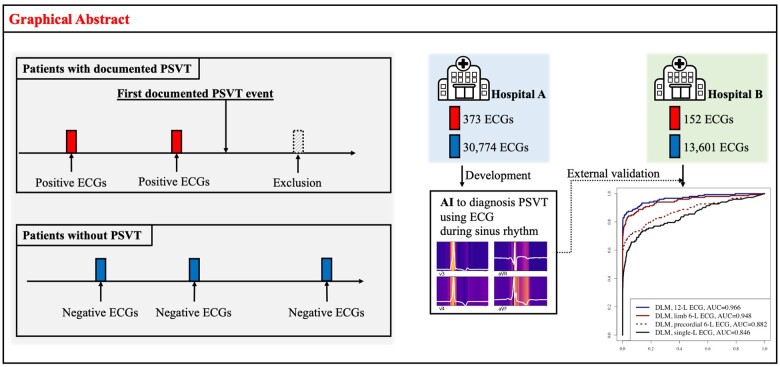
Paroxysmal supraventricular tachycardia (PSVT) is not detected owing to its paroxysmal nature, but it is associated with the risk of cardiovascular disease and worsens the patient quality of life. A deep learning model (DLM) was developed and validated to identify patients with PSVT during normal sinus rhythm in this multicentre retrospective study.
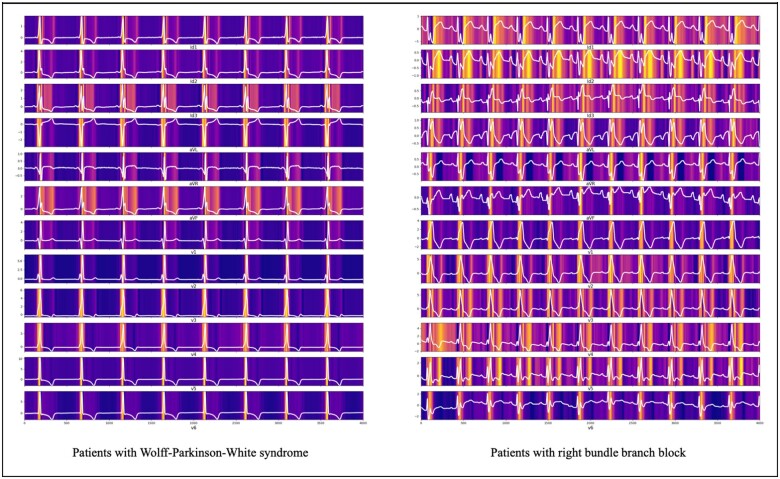
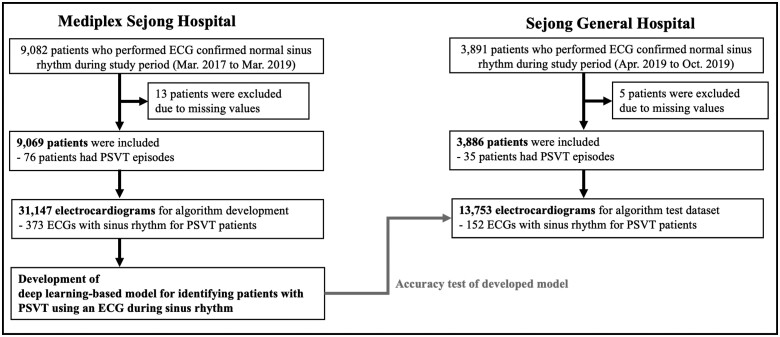
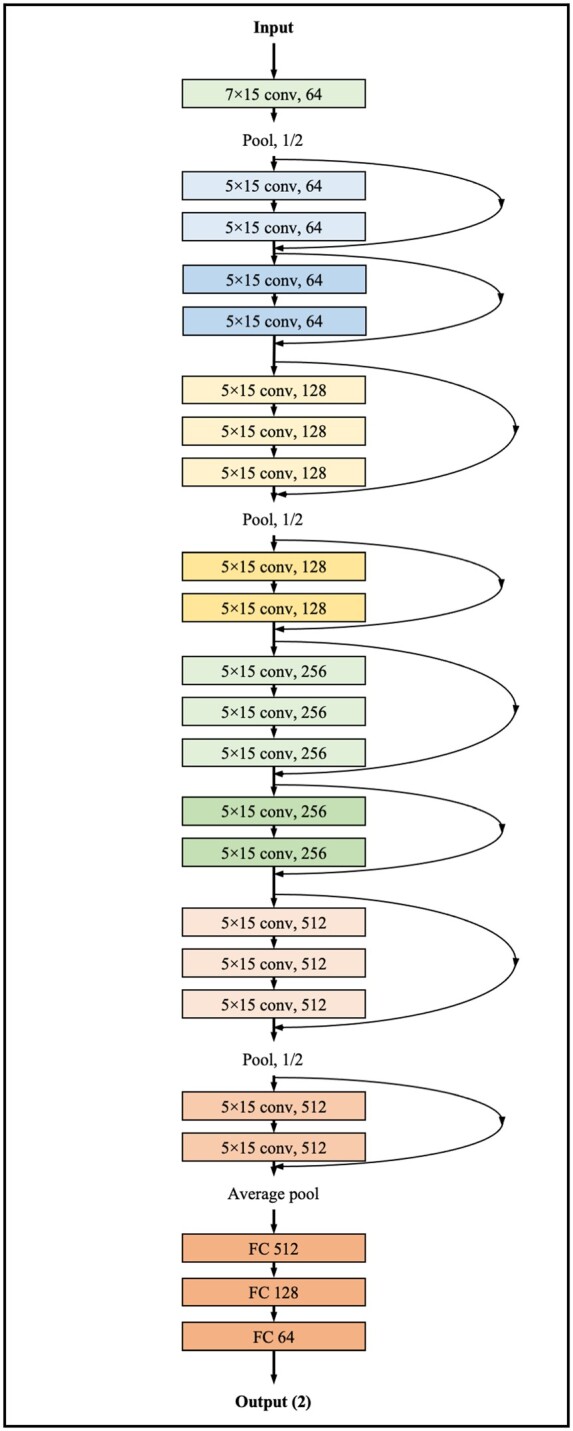
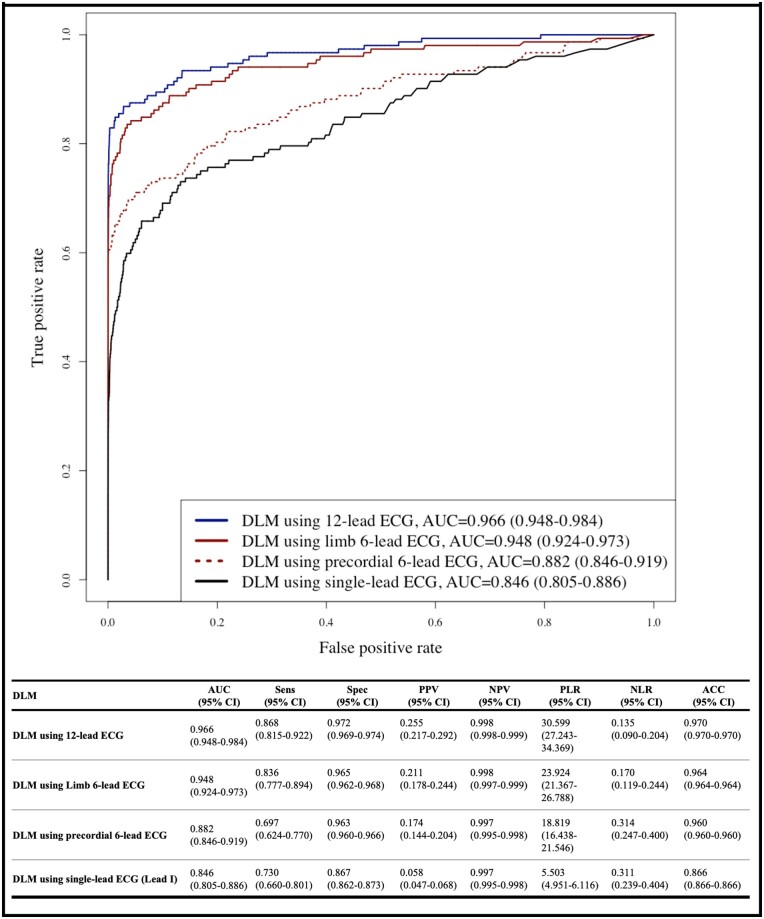
This study included 12 955 patients with normal sinus rhythm, confirmed by a cardiologist. A DLM was developed using 31 147 electrocardiograms (ECGs) of 9069 patients from one hospital. We conducted an accuracy test with 13 753 ECGs of 3886 patients from another hospital. The DLM was developed based on residual neural network. Digitally stored ECG were used as predictor variables and the outcome of the study was ability of the DLM to identify patients with PSVT using an ECG during sinus rhythm. We employed a sensitivity map method to identify an ECG region that had a significant effect on developing PSVT. During accuracy test, the area under the receiver operating characteristic curve of a DLM using a 12-lead ECG for identifying PSVT patients during sinus rhythm was 0.966 (0.948-0.984). The accuracy, sensitivity, specificity, positive predictive value, and negative predictive value of DLM were 0.970, 0.868, 0.972, 0.255, and 0.998, respectively. The DLM showed delta wave and QT interval were important to identify the PSVT.
The proposed DLM demonstrated a high performance in identifying PSVT during normal sinus rhythm. Thus, it can be used as a rapid, inexpensive, point-of-care means of identifying PSVT in patients.
阵发性室上性心动过速(PSVT)因其发作性特点难以被检测到,但它与心血管疾病风险相关,会降低患者生活质量。在这项多中心回顾性研究中,开发并验证了一种深度学习模型(DLM),用于识别窦性心律正常时的PSVT患者。
本研究纳入了12955例经心脏病专家确认窦性心律正常的患者。使用来自一家医院的9069例患者的31147份心电图(ECG)开发了DLM。我们用来自另一家医院的3886例患者的13753份ECG进行了准确性测试。DLM基于残差神经网络开发。将数字存储的ECG用作预测变量,研究结果是DLM使用窦性心律时的ECG识别PSVT患者的能力。我们采用敏感性映射方法来识别对PSVT发生有显著影响的ECG区域。在准确性测试中,使用12导联ECG识别窦性心律时PSVT患者的DLM的受试者工作特征曲线下面积为0.966(0.948 - 0.984)。DLM的准确性、敏感性、特异性、阳性预测值和阴性预测值分别为0.970、0.868、0.972、0.255和0.998。DLM显示δ波和QT间期对识别PSVT很重要。
所提出的DLM在识别窦性心律正常时的PSVT方面表现出高性能。因此,它可作为一种快速、廉价的即时护理手段来识别患者中的PSVT。