Biomedical Image Analysis Group, Department of Computing, Imperial College London, London, United Kingdom.
Institute of Signal Processing and System Theory, University of Stuttgart, Stuttgart, Germany.
Invest Radiol. 2023 May 1;58(5):346-354. doi: 10.1097/RLI.0000000000000941. Epub 2022 Dec 16.
The UK Biobank (UKBB) and German National Cohort (NAKO) are among the largest cohort studies, capturing a wide range of health-related data from the general population, including comprehensive magnetic resonance imaging (MRI) examinations. The purpose of this study was to demonstrate how MRI data from these large-scale studies can be jointly analyzed and to derive comprehensive quantitative image-based phenotypes across the general adult population.
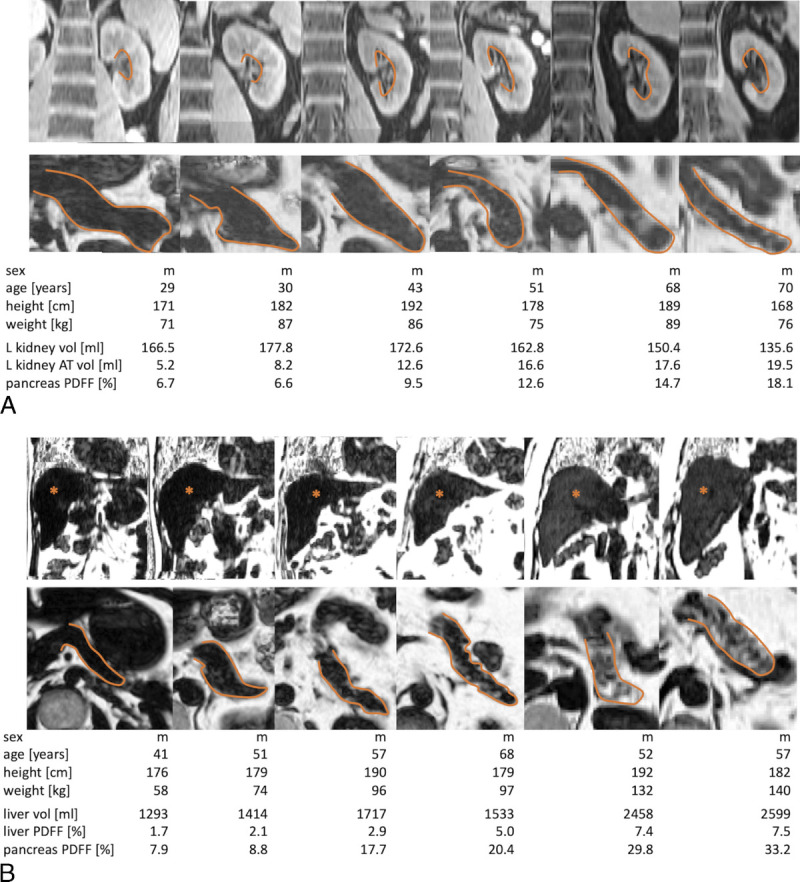
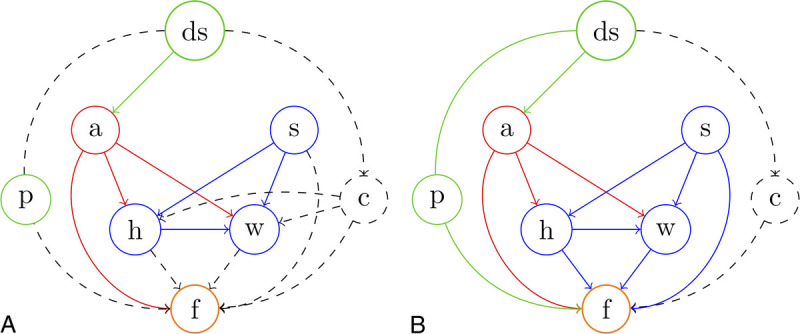
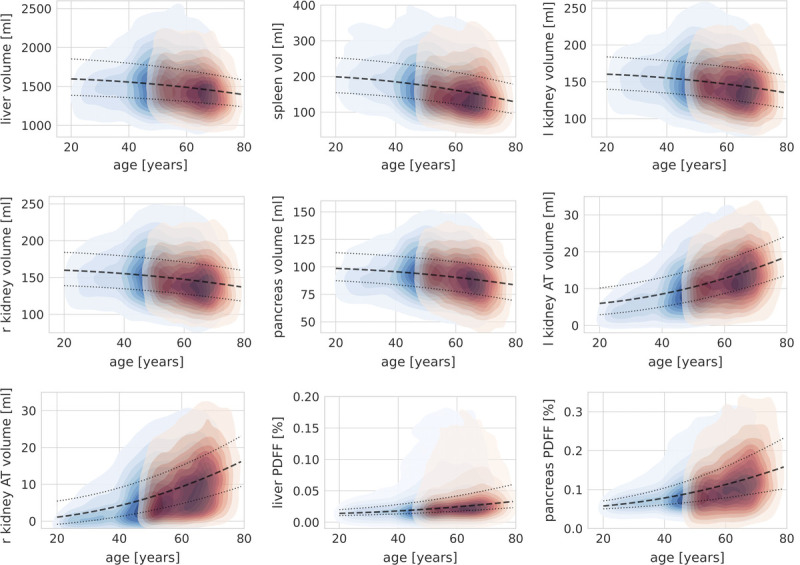
Image-derived features of abdominal organs (volumes of liver, spleen, kidneys, and pancreas; volumes of kidney hilum adipose tissue; and fat fractions of liver and pancreas) were extracted from T1-weighted Dixon MRI data of 17,996 participants of UKBB and NAKO based on quality-controlled deep learning generated organ segmentations. To enable valid cross-study analysis, we first analyzed the data generating process using methods of causal discovery. We subsequently harmonized data from UKBB and NAKO using the ComBat approach for batch effect correction. We finally performed quantile regression on harmonized data across studies providing quantitative models for the variation of image-derived features stratified for sex and dependent on age, height, and weight.
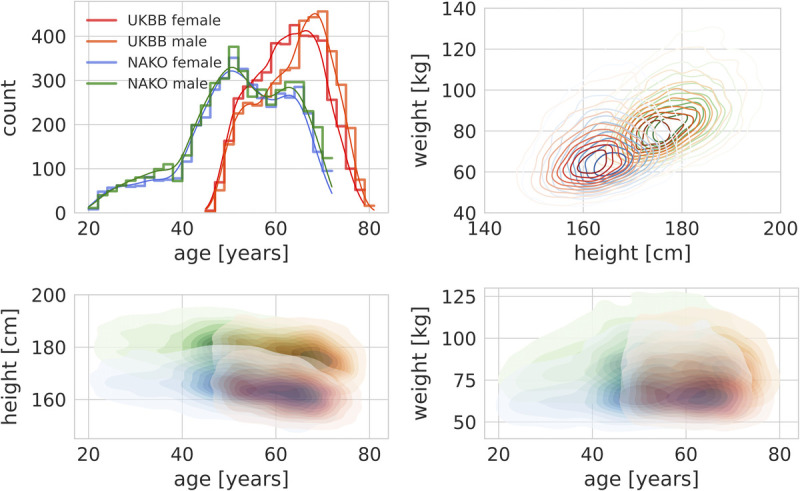
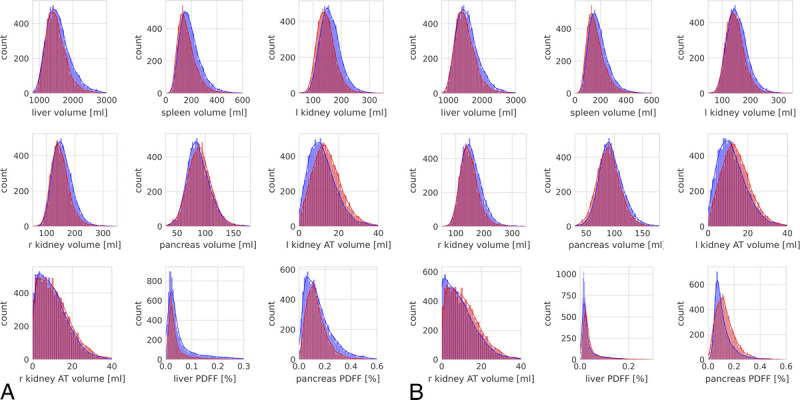
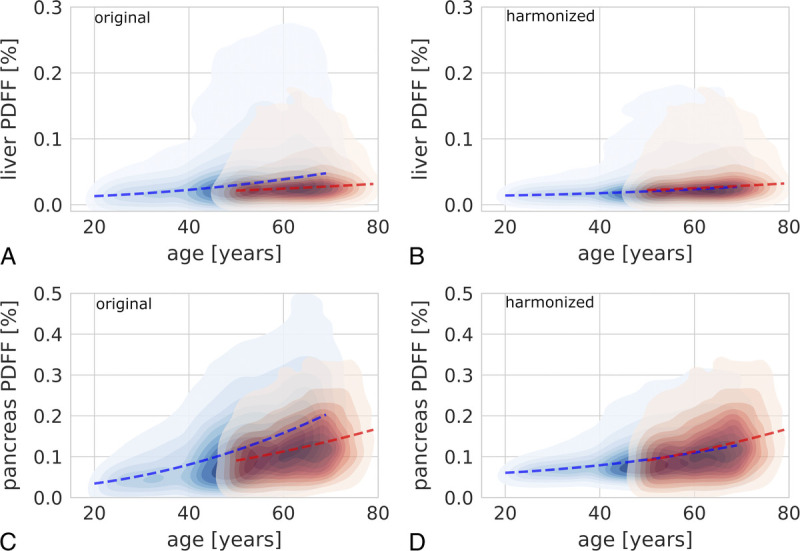
Data from 8791 UKBB participants (49.9% female; age, 63 ± 7.5 years) and 9205 NAKO participants (49.1% female, age: 51.8 ± 11.4 years) were analyzed. Analysis of the data generating process revealed direct effects of age, sex, height, weight, and the data source (UKBB vs NAKO) on image-derived features. Correction of data source-related effects resulted in markedly improved alignment of image-derived features between UKBB and NAKO. Cross-study analysis on harmonized data revealed comprehensive quantitative models for the phenotypic variation of abdominal organs across the general adult population.
Cross-study analysis of MRI data from UKBB and NAKO as proposed in this work can be helpful for future joint data analyses across cohorts linking genetic, environmental, and behavioral risk factors to MRI-derived phenotypes and provide reference values for clinical diagnostics.
英国生物银行(UKBB)和德国国家队列研究(NAKO)是最大的队列研究之一,从一般人群中收集了广泛的与健康相关的数据,包括全面的磁共振成像(MRI)检查。本研究的目的是展示如何联合分析这些大规模研究的 MRI 数据,并在一般成年人群中得出全面的基于定量图像的表型。
根据基于质量控制的深度学习生成的器官分割,从 UKBB 和 NAKO 的 17996 名参与者的 T1 加权 Dixon MRI 数据中提取腹部器官的图像衍生特征(肝脏、脾脏、肾脏和胰腺的体积;肾脏门脂肪组织的体积;以及肝脏和胰腺的脂肪分数)。为了能够进行有效的跨研究分析,我们首先使用因果发现方法分析了数据生成过程。然后,我们使用 ComBat 方法对 UKBB 和 NAKO 的数据进行了协方差校正。最后,我们对跨研究的协调数据进行了分位数回归,为性别分层的图像衍生特征的变化提供了定量模型,并依赖于年龄、身高和体重。
分析了 8791 名 UKBB 参与者(49.9%为女性;年龄为 63 ± 7.5 岁)和 9205 名 NAKO 参与者(49.1%为女性,年龄为 51.8 ± 11.4 岁)的数据。对数据生成过程的分析表明,年龄、性别、身高、体重和数据源(UKBB 与 NAKO)对图像衍生特征有直接影响。校正数据源相关影响后,UKBB 和 NAKO 之间的图像衍生特征明显更加一致。对协调数据的跨研究分析揭示了一般成年人群中腹部器官表型变化的全面定量模型。
本研究中提出的 UKBB 和 NAKO 的 MRI 数据的跨研究分析有助于未来对与遗传、环境和行为风险因素相关的 MRI 衍生表型进行联合队列分析,并为临床诊断提供参考值。