São Carlos Institute of Chemistry, University of São Paulo, Av. Trabalhador São Carlense, 400 Parque Arnold Schimidt, São Carlos, SP, 13566-590, Brazil.
Anal Bioanal Chem. 2023 Jul;415(18):3879-3895. doi: 10.1007/s00216-023-04578-x. Epub 2023 Feb 9.
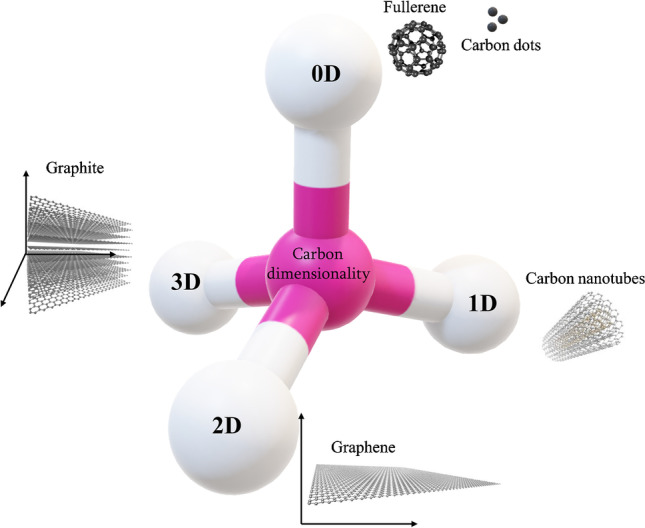
Since the last decade, carbon nanomaterials have had a notable impact on different fields such as bioimaging, drug delivery, artificial tissue engineering, and biosensors. This is due to their good compatibility toward a wide range of chemical to biological molecules, low toxicity, and tunable properties. Especially for biosensor technology, the characteristic features of each dimensionality of carbon-based materials may influence the performance and viability of their use. Surface area, porous network, hybridization, functionalization, synthesis route, the combination of dimensionalities, purity levels, and the mechanisms underlying carbon nanomaterial interactions influence their applications in bioanalytical chemistry. Efforts are being made to fully understand how nanomaterials can influence biological interactions, to develop commercially viable biosensors, and to gain knowledge on the biomolecular processes associated with carbon. Here, we present a comprehensive review highlighting the characteristic features of the dimensionality of carbon-based materials in biosensing.
自上个十年以来,碳纳米材料在生物成像、药物输送、人工组织工程和生物传感器等不同领域产生了显著影响。这是由于它们对广泛的化学和生物分子具有良好的兼容性、低毒性和可调的性质。特别是对于生物传感器技术,基于碳的材料的每个维度的特征可能会影响其使用的性能和可行性。表面积、多孔网络、杂化、功能化、合成路线、维度的组合、纯度水平以及碳纳米材料相互作用的机制都会影响它们在生物分析化学中的应用。人们正在努力充分了解纳米材料如何影响生物相互作用,开发商业上可行的生物传感器,并获得与碳相关的生物分子过程的知识。在这里,我们提出了一个全面的综述,强调了基于碳的材料维度在生物传感中的特征。