Chowdhury Kona, Ahmad Rahnuma, Sinha Susmita, Dutta Siddhartha, Haque Mainul
Pediatrics, Gonoshasthaya Samaj Vittik Medical College, Dhaka, BGD.
Physiology, Medical College for Women and Hospital, Dhaka, BGD.
Cureus. 2023 Feb 18;15(2):e35154. doi: 10.7759/cureus.35154. eCollection 2023 Feb.
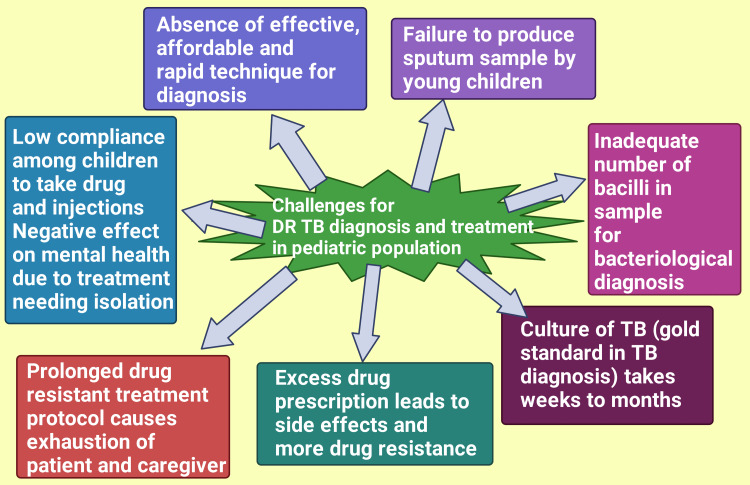
Drug-resistant tuberculosis (DR-TB) has continued to be a global health cataclysm. It is an arduous condition to tackle but is curable with the proper choice of drug and adherence to the drug therapy. WHO has introduced newer drugs with all-oral shorter regimens, but the COVID-19 pandemic has disrupted the achievements and raised the severity. The COVID-19 controlling mechanism is based on social distancing, using face masks, personal protective equipment, medical glove, head shoe cover, face shield, goggles, hand hygiene, and many more. Around the globe, national and international health authorities impose lockdown and movement control orders to ensure social distancing and prevent transmission of COVID-19 infection. Therefore, WHO proposed a TB control program impaired during a pandemic. Children, the most vulnerable group, suffer more from the drug-resistant form and act as the storehouse of future fatal cases. It has dire effects on physical health and hampers their mental health and academic career. Treatment of drug-resistant cases has more success stories in children than adults, but enrollment for treatment has been persistently low in this age group. Despite that, drug-resistant childhood tuberculosis has been neglected, and proper surveillance has not yet been achieved. Insufficient reporting, lack of appropriate screening tools for children, less accessibility to the treatment facility, inadequate awareness, and reduced funding for TB have worsened the situation. All these have resulted in jeopardizing our dream to terminate this deadly condition. So, it is high time to focus on this issue to achieve our Sustainable Development Goals (SDGs), the goal of ending TB by 2030, as planned by WHO. This review explores childhood TB's current position and areas to improve. This review utilized electronic-based data searched through PubMed, Google Scholar, Google Search Engine, Science Direct, and Embase.
耐多药结核病(DR-TB)仍然是一场全球健康灾难。这是一种难以应对的疾病,但通过正确选择药物并坚持药物治疗是可以治愈的。世界卫生组织(WHO)已经推出了采用全口服短程治疗方案的新型药物,但新冠疫情扰乱了所取得的成果并加剧了严峻程度。新冠疫情的防控机制基于社交距离、佩戴口罩、使用个人防护装备、医用手套、头鞋套、面罩、护目镜、手部卫生等等。在全球范围内,国家和国际卫生当局实施封锁和行动控制令,以确保社交距离并防止新冠病毒感染的传播。因此,WHO提出了一项在疫情期间受到影响的结核病控制计划。儿童是最脆弱的群体,更容易感染耐药型结核病,并且是未来致命病例的储存库。这对他们的身体健康产生了可怕的影响,还阻碍了他们的心理健康和学业。耐药病例的治疗在儿童中比在成人中更有成功案例,但该年龄组的治疗登记率一直很低。尽管如此,儿童耐药结核病一直被忽视,尚未实现适当的监测。报告不足、缺乏适合儿童的筛查工具、治疗机构可及性较低、认识不足以及结核病资金减少,使情况更加恶化。所有这些都导致我们终结这种致命疾病的梦想受到威胁。所以,现在是时候关注这个问题,以实现我们的可持续发展目标(SDGs),即按照WHO的计划在2030年终结结核病的目标。本综述探讨了儿童结核病的现状以及需要改进的领域。本综述利用了通过PubMed、谷歌学术、谷歌搜索引擎、科学Direct和Embase搜索的电子数据。