Bounegru Alexandra Virginia, Apetrei Constantin
Department of Chemistry, Physics and the Environment, Faculty of Sciences and the Environment, "Dunărea de Jos" University of Galați, 47 Domnească Street, 800008 Galați, Romania.
Nanomaterials (Basel). 2023 Feb 17;13(4):760. doi: 10.3390/nano13040760.
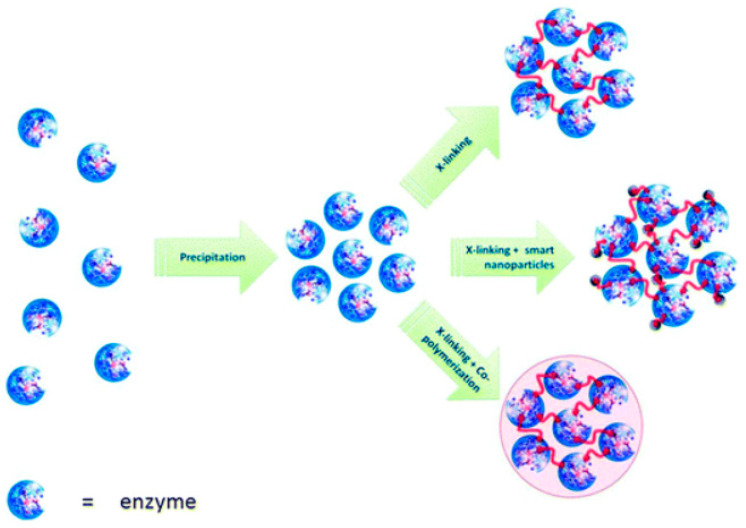
The development of enzyme biosensors has successfully overcome various challenges such as enzyme instability, loss of enzyme activity or long response time. In the electroanalytical field, tyrosinase is used to develop biosensors that exploit its ability to catalyze the oxidation of numerous types of phenolic compounds with antioxidant and neurotransmitter roles. This review critically examines the main tyrosinase immobilization techniques for the development of sensitive electrochemical biosensors. Immobilization strategies are mainly classified according to the degree of reversibility/irreversibility of enzyme binding to the support material. Each tyrosinase immobilization method has advantages and limitations, and its selection depends mainly on the type of support electrode, electrode-modifying nanomaterials, cross-linking agent or surfactants used. Tyrosinase immobilization by cross-linking is characterized by very frequent use with outstanding performance of the developed biosensors. Additionally, research in recent years has focused on new immobilization strategies involving cross-linking, such as cross-linked enzyme aggregates (CLEAs) and magnetic cross-linked enzyme aggregates (mCLEAs). Therefore, it can be considered that cross-linking immobilization is the most feasible and economical approach, also providing the possibility of selecting the reagents used and the order of the immobilization steps, which favor the enhancement of biosensor performance characteristics.
酶生物传感器的发展已成功克服了各种挑战,如酶的不稳定性、酶活性丧失或响应时间长等问题。在电分析领域,酪氨酸酶被用于开发生物传感器,利用其催化多种具有抗氧化和神经递质作用的酚类化合物氧化的能力。本文综述了用于开发灵敏电化学生物传感器的主要酪氨酸酶固定化技术。固定化策略主要根据酶与载体材料结合的可逆/不可逆程度进行分类。每种酪氨酸酶固定化方法都有其优缺点,其选择主要取决于所使用的载体电极类型、电极修饰纳米材料、交联剂或表面活性剂。通过交联固定酪氨酸酶的特点是在已开发的生物传感器中使用非常频繁且性能优异。此外,近年来的研究集中在涉及交联的新固定化策略上,如交联酶聚集体(CLEAs)和磁性交联酶聚集体(mCLEAs)。因此,可以认为交联固定化是最可行和经济的方法,同时也提供了选择所用试剂和固定化步骤顺序的可能性,这有利于提高生物传感器的性能特征。