Zhou Lu, Wen Yuefeng, Zhang Guoqian, Wang Linjing, Wu Shuyu, Zhang Shuxu
Department of Radiation Oncology, Affiliated Cancer Hospital and Institute of Guangzhou Medical University, Guangzhou, China.
J Oncol. 2023 Feb 18;2023:5328927. doi: 10.1155/2023/5328927. eCollection 2023.
The study aims to establish and validate an effective CT-based radiation pneumonitis (RP) prediction model using the multiomics method of radiomics and EQD2-based dosiomics.
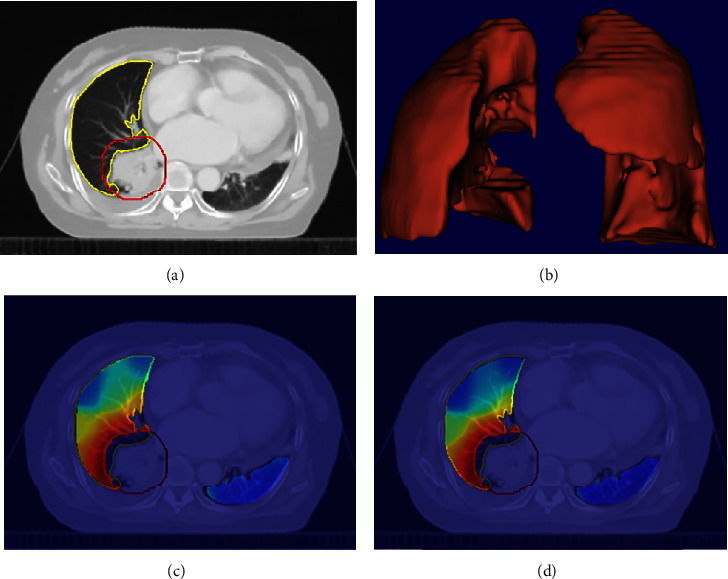
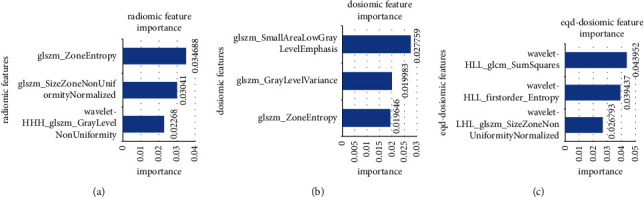
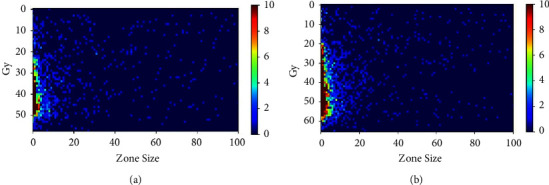
The study performed a retrospective analysis on 91 nonsmall cell lung cancer patients who received radiotherapy from 2019 to 2021 in our hospital. The patients with RP grade ≥1 were labeled as 1, and those with RP grade < 1 were labeled as 0. The whole lung excluding clinical target volume (lung-CTV) was used as the region of interest (ROI). The radiomic and dosiomic features were extracted from the lung-CTV area's image and dose distribution. Besides, the equivalent dose of the 2 Gy fractionated radiation (EQD) model was used to convert the physical dose to the isoeffect dose, and then, the EQD2-based dosiomic (eqd-dosiomic) features were extracted from the isoeffect dose distribution. Four machine learning (ML) models, including DVH, radiomics combined with DVH (radio + DVH), radiomics combined with dosiomics (radio + dose), and radiomics combined with eqd-dosiomics (radio + eqdose), were established to construct the prediction model via eleven different classifiers. The fivefold cross-validation was used to complete the classification experiment. The area under the curve (AUC) of the receiver operating characteristics (ROC), accuracy, precision, recall, and F1-score were calculated to assess the performance level of the prediction models.
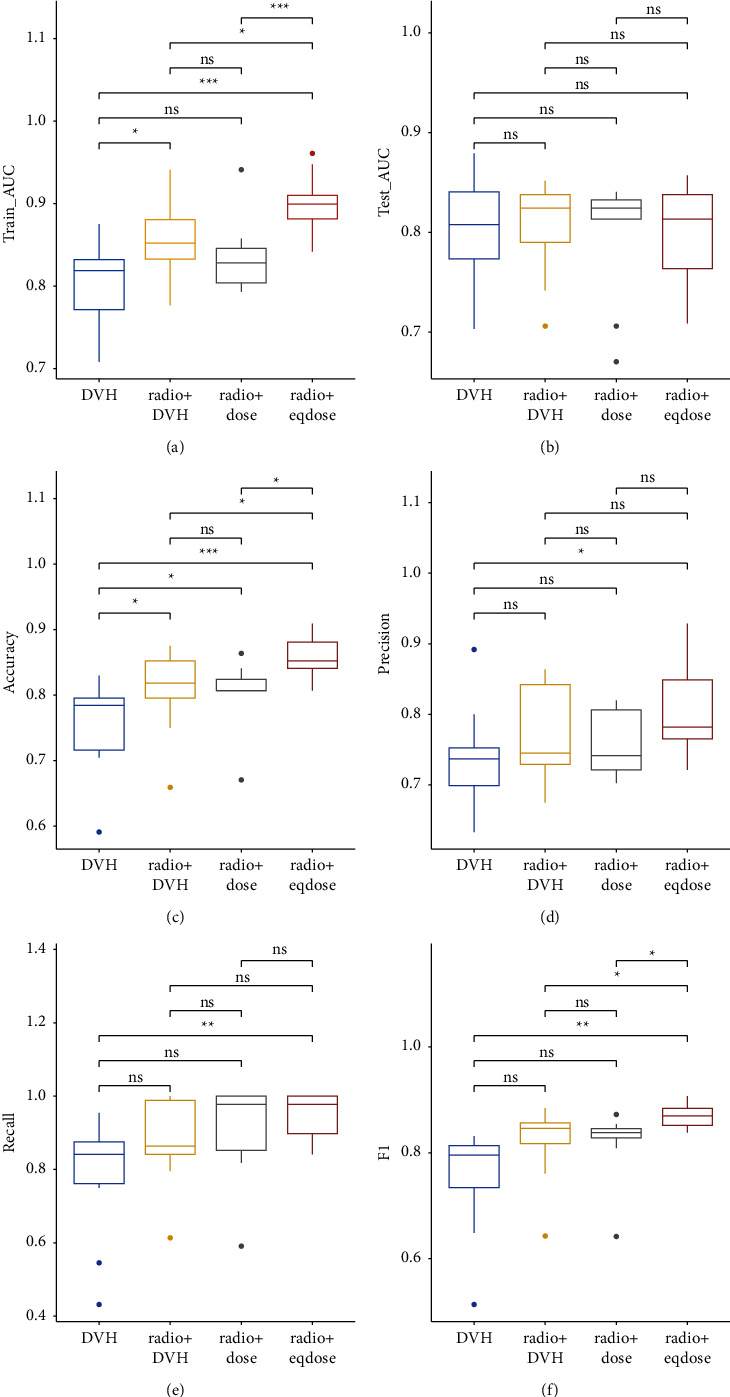
Compared with the DVH, radio + DVH, and radio + dose model, the value of the training AUC, accuracy, and F1-score of radio + eqdose was higher, and the difference was statistically significant ( < 0.05). Besides, the average value of the precision and recall of radio + eqdose was higher, but the difference was not statistically significant ( > 0.05).
The performance of using the ML-based multiomics method of radiomics and eqd-dosiomics to predict RP is more efficient and effective.
本研究旨在利用基于多组学的放射组学和基于等效剂量2(EQD2)的剂量组学方法,建立并验证一种有效的基于CT的放射性肺炎(RP)预测模型。
本研究对2019年至2021年在我院接受放疗的91例非小细胞肺癌患者进行回顾性分析。RP分级≥1级的患者标记为1,RP分级<1级的患者标记为0。将排除临床靶区体积(肺-CTV)后的全肺作为感兴趣区(ROI)。从肺-CTV区域的图像和剂量分布中提取放射组学和剂量组学特征。此外,使用2 Gy分割照射的等效剂量(EQD)模型将物理剂量转换为等效生物效应剂量,然后从等效生物效应剂量分布中提取基于EQD2的剂量组学(eqd-剂量组学)特征。建立了四个机器学习(ML)模型,包括剂量体积直方图(DVH)、放射组学联合DVH(放射组学+DVH)、放射组学联合剂量组学(放射组学+剂量)和放射组学联合eqd-剂量组学(放射组学+等效剂量),通过11种不同的分类器构建预测模型。采用五折交叉验证完成分类实验。计算受试者工作特征曲线(ROC)下面积(AUC)、准确率、精确率、召回率和F1分数,以评估预测模型的性能水平。
与DVH、放射组学+DVH和放射组学+剂量模型相比,放射组学+等效剂量的训练AUC、准确率和F1分数值更高,差异有统计学意义(<0.05)。此外,放射组学+等效剂量的精确率和召回率平均值更高,但差异无统计学意义(>0.05)。
基于ML的放射组学和eqd-剂量组学多组学方法预测RP的性能更高效。