Division of Gastroenterology and Hepatology, NHC Key Laboratory of Digestive Disease, Ministry of Health, Renji Hospital, School of Medicine, Shanghai Jiao Tong University, Shanghai Institute of Digestive Disease, Shanghai, 200125, China.
State Key Laboratory of Cancer Biology and National Clinical Research Center for Digestive Diseases, Xijing Hospital of Digestive Diseases, Fourth Military Medical University, Xi'an, 710032, Shaanxi Province, China.
BMC Public Health. 2023 Mar 29;23(1):582. doi: 10.1186/s12889-023-15272-z.
For effective preventive strategies against GORD (gastro-esophageal reflux disease), we assessed the GORD burden from 1990 to 2019.
The burden of GORD between 1990 and 2019 was evaluated globally, regionally, and nationally. Using ASIR (age-standardized incidence), ASYLDs (age-standardized years lived with disabilitys), we compared them to the GBD world population per 100,000. The estimates were based on 95% uncertainty intervals (UIs). The AAPC (average annual percent change) in incidence, YLDs, along with prevalence rates with associated 95% CIs were estimated.
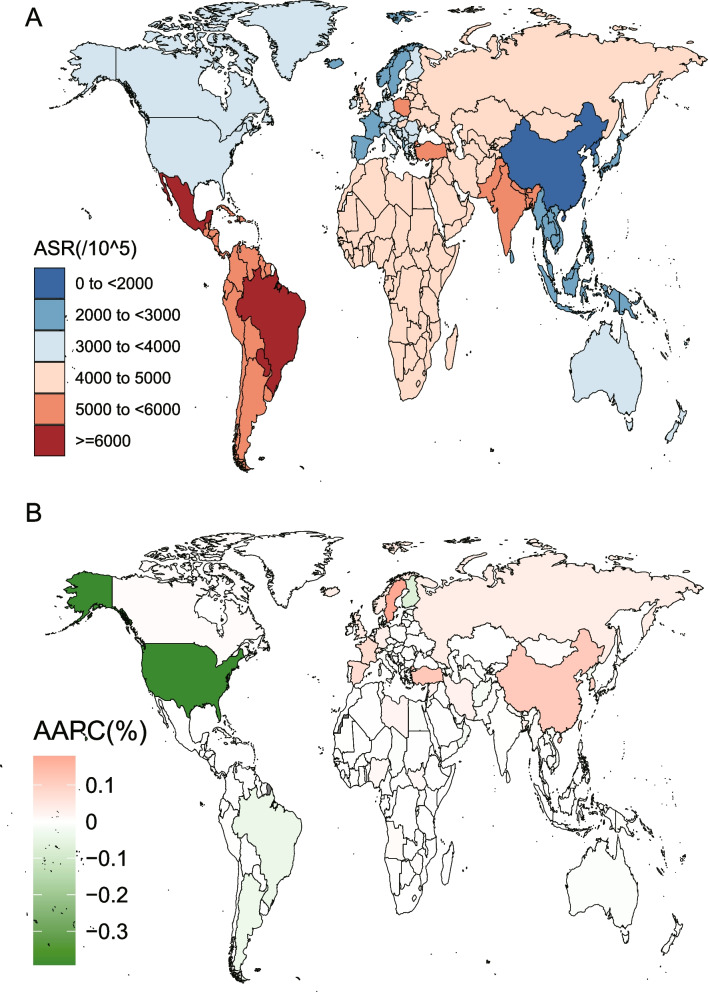
Data to estimate the burden of GORD are scarce till now. The global ASIR of GORD in 2019 was 3792.79 per 100,000, an increase AAPC of 0.112% from 1990. The prevalence of GORD increased with a AAPC of 0.096% to 9574.45 per 100,000. Global ASYLDs in 2019 was 73.63, an increase AAPC of 0.105% from 1990. The GORD burden varies greatly depending on the development level and geographical location. USA demonstrated the most obvious decreasing trend in burden of GORD, while Sweden had an increasing trend. That the increase in GORD YLDs was mediated primarily by the growth and aging of population, was revealed by decomposition analyses. There was an inverse relationship between SDI (socio-demographic index) and GORD-burden. Frontier analyses revealed significant scope of improvement in the status of development at all levels.
GORD is a public health challenge, especially in Latin America. Some SDI quintiles had declining rates, while some countries experienced increased rates. Thus, resources should be allocated for preventative measures based on country-specific estimates.
为了制定有效的胃食管反流病(GORD)预防策略,我们评估了 1990 年至 2019 年期间 GORD 的负担。
我们在全球、地区和国家层面评估了 1990 年至 2019 年 GORD 的负担。使用年龄标准化发病率(ASIR)和年龄标准化残疾生存年数(ASYLDs),我们将其与全球每 10 万人的 GBD 人口进行了比较。这些估计是基于 95%的不确定性区间(UI)。我们还估计了发病率、残疾生存年数(YLDs)以及患病率的平均年变化百分比(AAPC),并提供了相关的 95%置信区间(CI)。
目前为止,用于评估 GORD 负担的数据还很有限。2019 年全球 GORD 的 ASIR 为每 10 万人 3792.79 例,1990 年至 2019 年的 AAPC 增加了 0.112%。GORD 的患病率呈上升趋势,AAPC 为 0.096%,达到每 10 万人 9574.45 例。2019 年全球 ASYLDs 为 73.63,1990 年至 2019 年的 AAPC 增加了 0.105%。GORD 负担因发展水平和地理位置的不同而有很大差异。美国在 GORD 负担方面表现出最明显的下降趋势,而瑞典则呈上升趋势。分解分析表明,GORD YLDs 的增加主要是由人口增长和老龄化导致的。社会人口指数(SDI)与 GORD 负担呈负相关。前沿分析显示,各级发展水平都有显著的改善空间。
GORD 是一个公共卫生挑战,尤其是在拉丁美洲。一些 SDI 五分位数的发病率呈下降趋势,而一些国家的发病率呈上升趋势。因此,应根据具体国情评估结果,为预防措施分配资源。