Afshar Majid, Adelaine Sabrina, Resnik Felice, Mundt Marlon P, Long John, Leaf Margaret, Ampian Theodore, Wills Graham J, Schnapp Benjamin, Chao Michael, Brown Randy, Joyce Cara, Sharma Brihat, Dligach Dmitriy, Burnside Elizabeth S, Mahoney Jane, Churpek Matthew M, Patterson Brian W, Liao Frank
University of Wisconsin - Madison, Madison, WI, United States.
Loyola University Chicago, Chicago, IL, United States.
JMIR Med Inform. 2023 Apr 20;11:e44977. doi: 10.2196/44977.
The clinical narrative in electronic health records (EHRs) carries valuable information for predictive analytics; however, its free-text form is difficult to mine and analyze for clinical decision support (CDS). Large-scale clinical natural language processing (NLP) pipelines have focused on data warehouse applications for retrospective research efforts. There remains a paucity of evidence for implementing NLP pipelines at the bedside for health care delivery.
We aimed to detail a hospital-wide, operational pipeline to implement a real-time NLP-driven CDS tool and describe a protocol for an implementation framework with a user-centered design of the CDS tool.
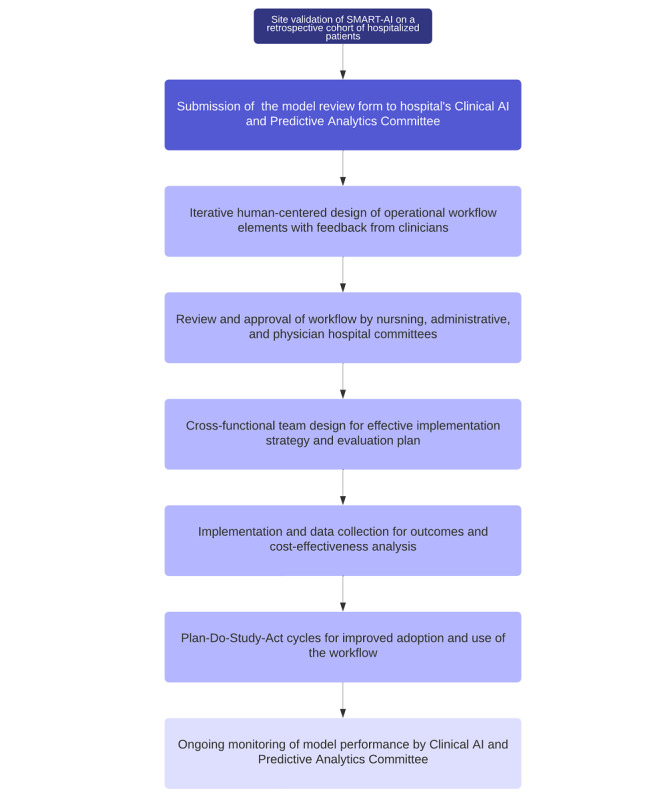
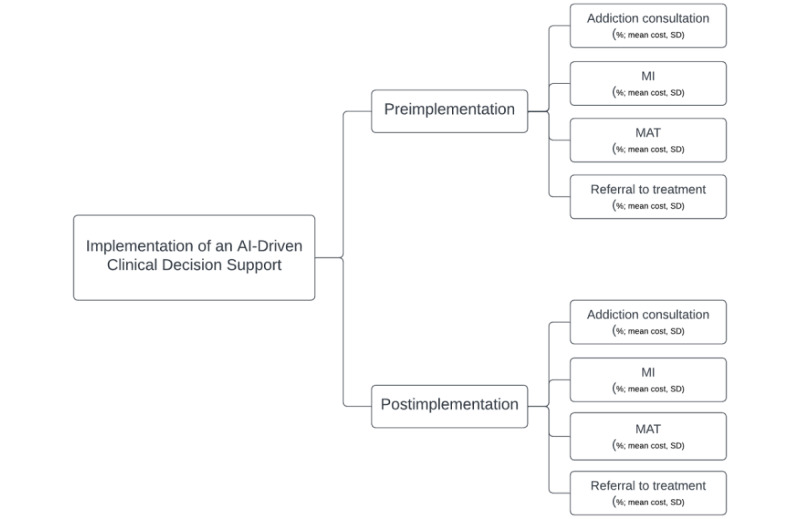
The pipeline integrated a previously trained open-source convolutional neural network model for screening opioid misuse that leveraged EHR notes mapped to standardized medical vocabularies in the Unified Medical Language System. A sample of 100 adult encounters were reviewed by a physician informaticist for silent testing of the deep learning algorithm before deployment. An end user interview survey was developed to examine the user acceptability of a best practice alert (BPA) to provide the screening results with recommendations. The planned implementation also included a human-centered design with user feedback on the BPA, an implementation framework with cost-effectiveness, and a noninferiority patient outcome analysis plan.
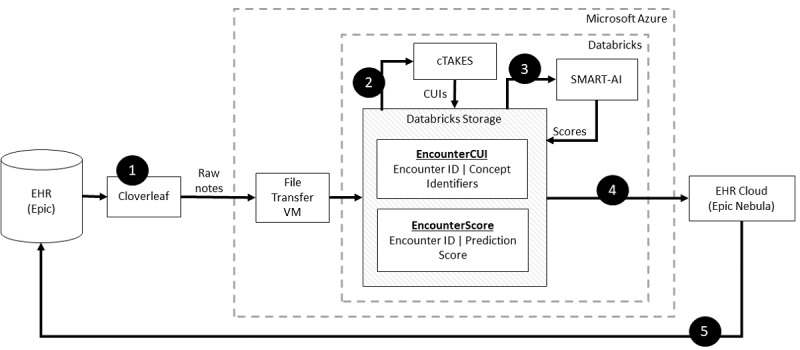
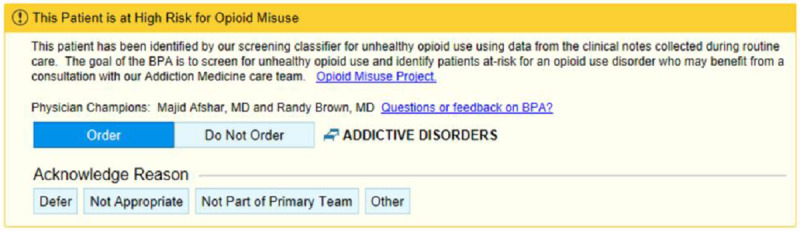
The pipeline was a reproducible workflow with a shared pseudocode for a cloud service to ingest, process, and store clinical notes as Health Level 7 messages from a major EHR vendor in an elastic cloud computing environment. Feature engineering of the notes used an open-source NLP engine, and the features were fed into the deep learning algorithm, with the results returned as a BPA in the EHR. On-site silent testing of the deep learning algorithm demonstrated a sensitivity of 93% (95% CI 66%-99%) and specificity of 92% (95% CI 84%-96%), similar to published validation studies. Before deployment, approvals were received across hospital committees for inpatient operations. Five interviews were conducted; they informed the development of an educational flyer and further modified the BPA to exclude certain patients and allow the refusal of recommendations. The longest delay in pipeline development was because of cybersecurity approvals, especially because of the exchange of protected health information between the Microsoft (Microsoft Corp) and Epic (Epic Systems Corp) cloud vendors. In silent testing, the resultant pipeline provided a BPA to the bedside within minutes of a provider entering a note in the EHR.
The components of the real-time NLP pipeline were detailed with open-source tools and pseudocode for other health systems to benchmark. The deployment of medical artificial intelligence systems in routine clinical care presents an important yet unfulfilled opportunity, and our protocol aimed to close the gap in the implementation of artificial intelligence-driven CDS.
ClinicalTrials.gov NCT05745480; https://www.clinicaltrials.gov/ct2/show/NCT05745480.
电子健康记录(EHR)中的临床叙述包含对预测分析有价值的信息;然而,其自由文本形式难以挖掘和分析以用于临床决策支持(CDS)。大规模临床自然语言处理(NLP)管道主要专注于数据仓库应用以进行回顾性研究。在床边实施NLP管道以提供医疗服务方面,证据仍然匮乏。
我们旨在详细介绍一个全院范围的操作管道,以实施一个由NLP驱动的实时CDS工具,并描述一个具有以用户为中心设计的CDS工具的实施框架协议。
该管道集成了一个先前训练的开源卷积神经网络模型,用于筛查阿片类药物滥用,该模型利用映射到统一医学语言系统中标准化医学词汇的EHR记录。在部署前,一名医师信息专家对100例成人病例进行了抽样审查,以对深度学习算法进行静默测试。开发了一项终端用户访谈调查,以检查最佳实践警报(BPA)的用户可接受性,该警报用于提供带有建议的筛查结果。计划实施还包括以用户为中心的设计,收集用户对BPA的反馈,一个具有成本效益的实施框架,以及一项非劣效性患者结局分析计划。
该管道是一个可重复的工作流程,带有用于云服务的共享伪代码,以便在弹性云计算环境中摄取、处理和存储来自主要EHR供应商的作为健康级别7消息的临床记录。记录的特征工程使用了一个开源NLP引擎,这些特征被输入到深度学习算法中,结果在EHR中作为BPA返回。深度学习算法的现场静默测试显示敏感性为93%(95%CI 66%-99%),特异性为92%(95%CI 84%-96%),与已发表的验证研究相似。在部署前,该项目获得了医院各委员会对住院手术的批准。进行了五次访谈;这些访谈为一份教育传单的制定提供了信息,并进一步修改了BPA以排除某些患者并允许拒绝建议。管道开发中最长的延迟是由于网络安全审批,特别是因为微软(Microsoft Corp)和Epic(Epic Systems Corp)云供应商之间受保护健康信息的交换。在静默测试中,生成的管道在提供者在EHR中输入记录后的几分钟内就将BPA提供到了床边。
实时NLP管道的组件通过开源工具和伪代码进行了详细说明,可供其他卫生系统作为基准。在常规临床护理中部署医学人工智能系统是一个重要但尚未实现的机会,我们的协议旨在弥合人工智能驱动的CDS实施方面的差距。
ClinicalTrials.gov NCT05745480;https://www.clinicaltrials.gov/ct2/show/NCT05745480