Yue Ke, Chen Junyu, Li Yingqiu, Kai Lei
School of Life Sciences, Jiangsu Normal University, Xuzhou 22116, China.
Comput Struct Biotechnol J. 2023 May 4;21:2899-2908. doi: 10.1016/j.csbj.2023.05.003. eCollection 2023.
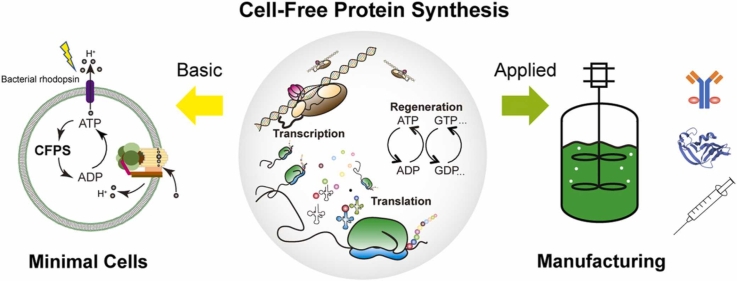
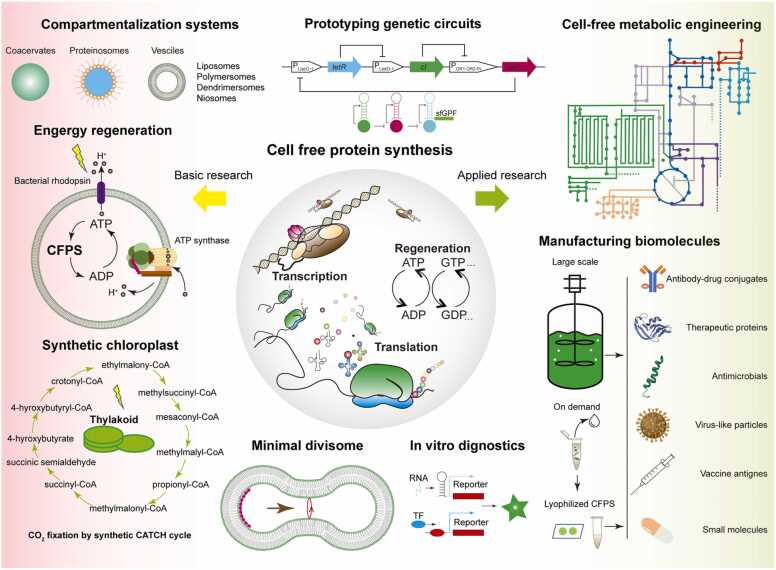
The rapid development of synthetic biology has enabled the production of compounds with revolutionary improvements in biotechnology. DNA manipulation tools have expedited the engineering of cellular systems for this purpose. Nonetheless, the inherent constraints of cellular systems persist, imposing an upper limit on mass and energy conversion efficiencies. Cell-free protein synthesis (CFPS) has demonstrated its potential to overcome these inherent constraints and has been instrumental in the further advancement of synthetic biology. Via the removal of the cell membranes and redundant parts of cells, CFPS has provided flexibility in directly dissecting and manipulating the Central Dogma with rapid feedback. This mini-review summarizes recent achievements of the CFPS technique and its application to a wide range of synthetic biology projects, such as minimal cell assembly, metabolic engineering, and recombinant protein production for therapeutics, as well as biosensor development for in vitro diagnostics. In addition, current challenges and future perspectives in developing a generalized cell-free synthetic biology are outlined.
合成生物学的迅速发展使得能够生产出在生物技术方面有革命性改进的化合物。为此,DNA操作工具加快了细胞系统的工程改造。尽管如此,细胞系统的固有局限性依然存在,对质量和能量转换效率设置了上限。无细胞蛋白质合成(CFPS)已展现出克服这些固有局限性的潜力,并在合成生物学的进一步发展中发挥了重要作用。通过去除细胞膜和细胞的冗余部分,CFPS在直接剖析和操纵中心法则并获得快速反馈方面提供了灵活性。本综述总结了CFPS技术的近期成果及其在广泛的合成生物学项目中的应用,如最小细胞组装、代谢工程、用于治疗的重组蛋白生产以及用于体外诊断的生物传感器开发。此外,还概述了发展通用无细胞合成生物学目前面临的挑战和未来前景。