Department of Otolaryngology-Head and Neck Surgery, University of California San Francisco, San Francisco, CA 94117
Department of Radiology and Biomedical Imaging, University of California San Francisco, San Francisco, CA 94117.
eNeuro. 2023 Jun 6;10(6). doi: 10.1523/ENEURO.0056-23.2023. Print 2023 Jun.
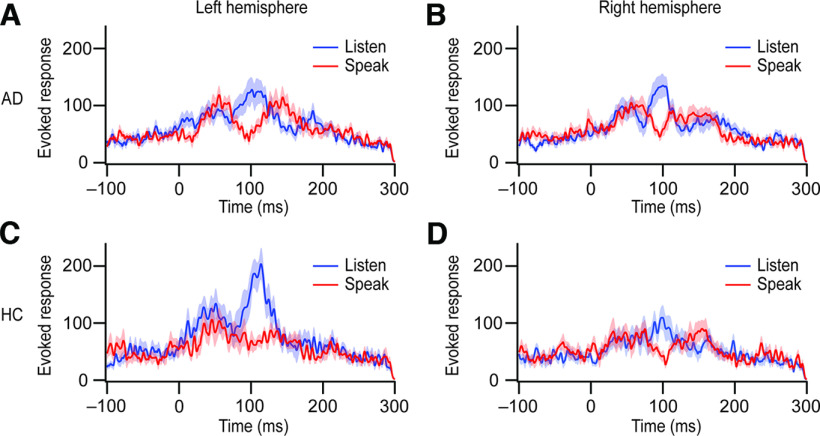
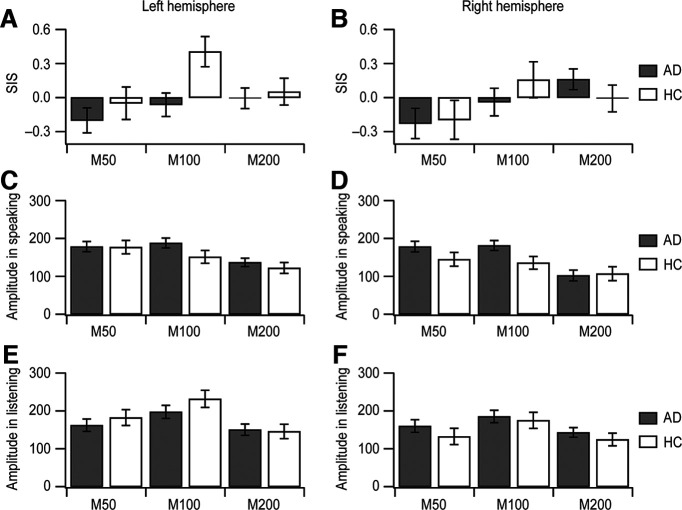
Alzheimer's disease (AD) is a neurodegenerative disease involving cognitive impairment and abnormalities in speech and language. Here, we examine how AD affects the fidelity of auditory feedback predictions during speaking. We focus on the phenomenon of speaking-induced suppression (SIS), the auditory cortical responses' suppression during auditory feedback processing. SIS is determined by subtracting the magnitude of auditory cortical responses during speaking from listening to playback of the same speech. Our state feedback control (SFC) model of speech motor control explains SIS as arising from the onset of auditory feedback matching a prediction of that feedback onset during speaking, a prediction that is absent during passive listening to playback of the auditory feedback. Our model hypothesizes that the auditory cortical response to auditory feedback reflects the mismatch with the prediction: small during speaking, large during listening, with the difference being SIS. Normally, during speaking, auditory feedback matches its predictions, then SIS will be large. Any reductions in SIS will indicate inaccuracy in auditory feedback prediction not matching the actual feedback. We investigated SIS in AD patients [=20; mean (SD) age, 60.77 (10.04); female (%), 55.00] and healthy controls [=12; mean (SD) age, 63.68 (6.07); female (%), 83.33] through magnetoencephalography (MEG)-based functional imaging. We found a significant reduction in SIS at ∼100 ms in AD patients compared with healthy controls (linear mixed effects model, = 6.849, =0.011). The results suggest that AD patients generate inaccurate auditory feedback predictions, contributing to abnormalities in AD speech.
阿尔茨海默病(AD)是一种神经退行性疾病,涉及认知障碍和言语异常。在这里,我们研究 AD 如何影响说话时听觉反馈预测的准确性。我们专注于说话诱导抑制(SIS)现象,即听觉皮层反应在听觉反馈处理期间的抑制。SIS 通过从聆听相同语音的回放中减去说话期间听觉皮层反应的幅度来确定。我们的言语运动控制状态反馈控制(SFC)模型将 SIS 解释为源自听觉反馈开始与说话时该反馈开始的预测匹配,而在被动聆听回放的听觉反馈时则没有该预测。我们的模型假设听觉皮层对听觉反馈的反应反映了与预测的不匹配:在说话期间较小,在聆听期间较大,差异即为 SIS。通常,在说话期间,听觉反馈与预测匹配,然后 SIS 将很大。SIS 的任何减少都表明听觉反馈预测不准确,与实际反馈不匹配。我们通过基于脑磁图(MEG)的功能成像研究了 AD 患者[=20;平均(SD)年龄,60.77(10.04);女性(%),55.00]和健康对照[=12;平均(SD)年龄,63.68(6.07);女性(%),83.33]中的 SIS。我们发现与健康对照组相比,AD 患者在约 100 ms 时 SIS 显着降低(线性混合效应模型,= 6.849,= 0.011)。结果表明,AD 患者产生不准确的听觉反馈预测,导致 AD 言语异常。