Department Otorhinolaryngology, Head and Neck Surgery, The Second Affiliated Hospital of Anhui Medical University, Hefei, Anhui, China.
Department Otorhinolaryngology, Head and Neck Surgery, Wuhu Hospital, East China Normal University (The Second People's Hospital of Wuhu), Wuhu, Anhui, China.
Front Endocrinol (Lausanne). 2023 Jun 22;14:1216718. doi: 10.3389/fendo.2023.1216718. eCollection 2023.
Data from the National Health and Nutrition Examination Survey (NHANES) were used to assess the association between the triglyceride-glucose (TyG) index and hearing impairment (HI).
We used eight survey cycles from NHANES 2001-2012 and 2015-2018 to conduct this cross-sectional study. HI was designed as an dependent variable, and the TyG index was selected as an exposure factor (independent variable). The correlation between the two variables was assessed using multiple logistic regression. In order to assess whether there was a non-linear relationship between the TyG index and HI, the TyG index was distributed and a test for trend was conducted (P for trend), followed by smooth curve fitting (penalized spline) and generalized additive model (GAM) regression. We also performed a subgroup analysis to identify sensitive groups whose responses were clearly associated with independent variables.
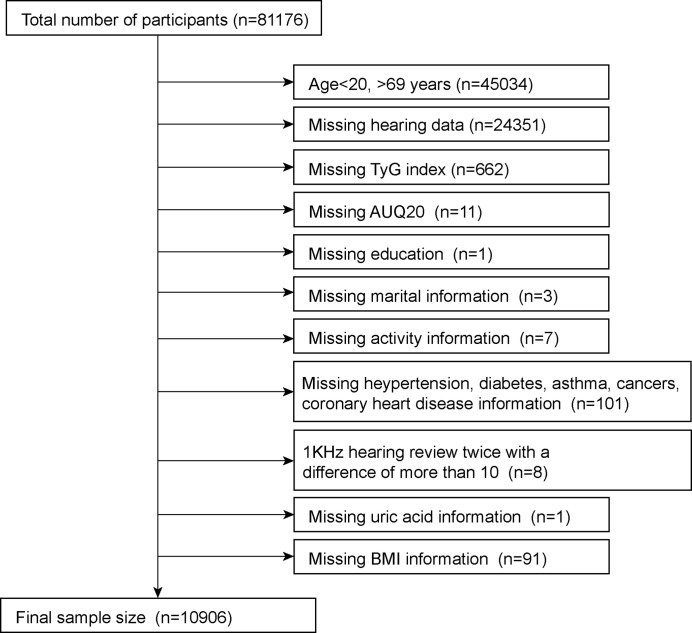
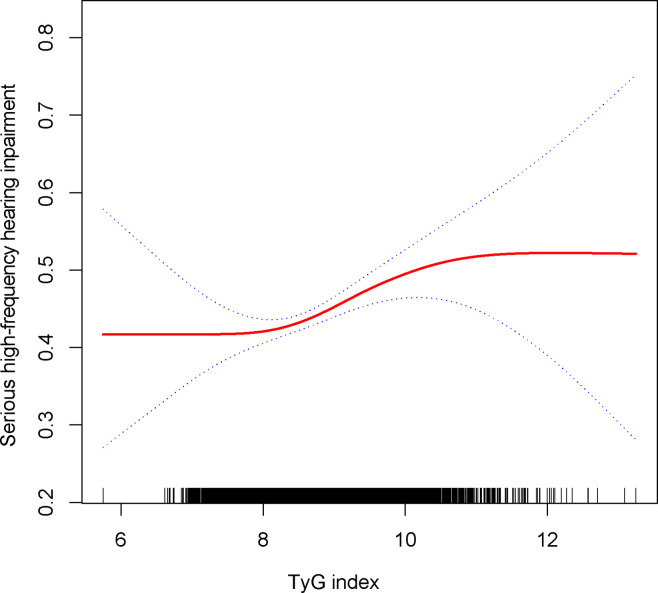
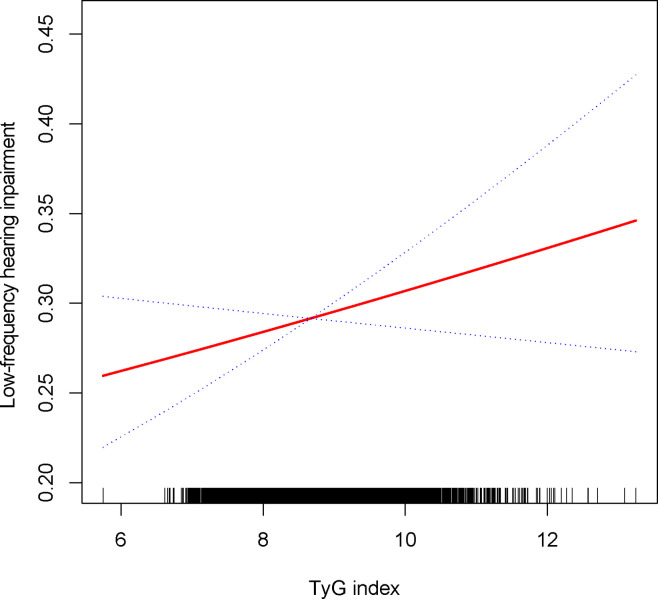
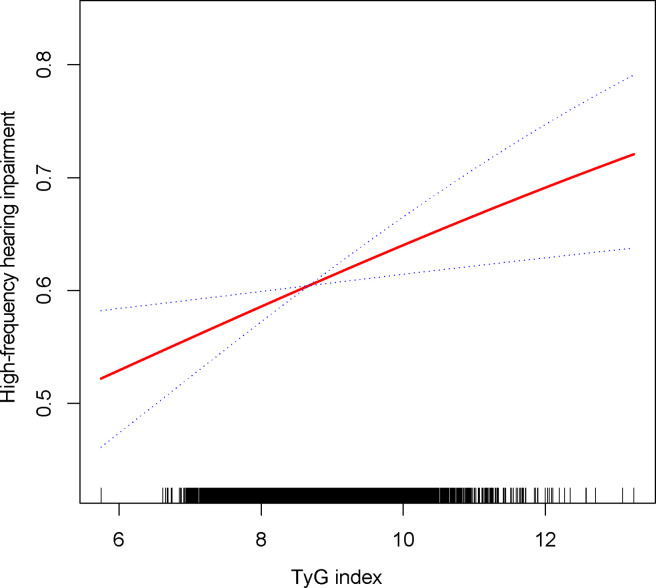
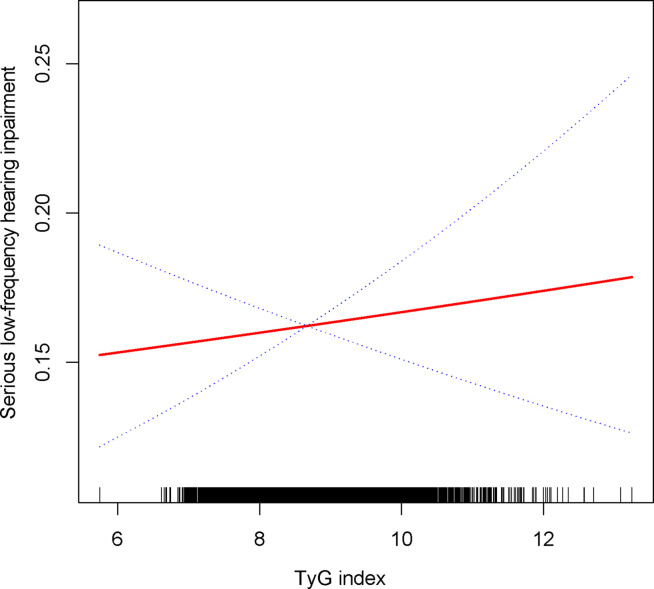
10,906 participants were finally included in the study, and those with a higher TyG index had a higher frequency of hearing impairment. There was a linear positive correlation between the TyG index and HI. For the low-frequency HI, however, this positive correlation was not statistically significant (OR = 1.05, 95% CI: 0.98, 1.14); however, it was more stable for the high-frequency HI (OR = 1.12, 95% CI: 1.03, 1.22). Additionally, as the TyG index increased, this positive association increased as well (P for trend = 0.05). The HPTA test showed a positive association with more severe HI (simultaneous) as the independent variable increased (OR = 1.14, 95% CI: 1.05-1.24), and this association was even more significant with increasing severity (P for trend 0.05). According to the subgroup analysis, the positive association between TyG index and high-frequency HI was more significant in females, 40-69 years old, without hypertension or diabetes, and when strict high-frequency HI was significant in males, females, 40-69 years old, with hypertension and diabetes.
Participants with a higher TyG index may have a higher risk of HI. TyG index and HI risk showed a linear relationship, which became even more significant when HPTA was included.
利用国家健康与营养调查(NHANES)的数据评估甘油三酯-葡萄糖(TyG)指数与听力障碍(HI)之间的关系。
本横断面研究使用了 NHANES 2001-2012 年和 2015-2018 年的 8 个调查周期的数据。将 HI 设计为因变量,TyG 指数为暴露因素(自变量)。使用多因素逻辑回归评估两个变量之间的相关性。为了评估 TyG 指数与 HI 之间是否存在非线性关系,对 TyG 指数进行分布并进行趋势检验(P 趋势),然后进行平滑曲线拟合(惩罚样条)和广义相加模型(GAM)回归。我们还进行了亚组分析,以确定与自变量反应明显相关的敏感组。
最终纳入研究的 10906 名参与者中,TyG 指数较高者听力障碍的发生率较高。TyG 指数与 HI 呈线性正相关。然而,对于低频 HI,这种正相关不具有统计学意义(OR=1.05,95%CI:0.98,1.14);然而,对于高频 HI,这种正相关更为稳定(OR=1.12,95%CI:1.03,1.22)。此外,随着 TyG 指数的增加,这种正相关也随之增加(P 趋势=0.05)。HPTA 检验显示,随着独立变量的增加,与更严重 HI(同时)呈正相关(OR=1.14,95%CI:1.05-1.24),且随着严重程度的增加,这种相关性更为显著(P 趋势 0.05)。根据亚组分析,在女性、40-69 岁、无高血压或糖尿病的人群中,TyG 指数与高频 HI 之间的正相关更为显著;而在男性、女性、40-69 岁、有高血压或糖尿病的人群中,严格的高频 HI 更显著。
TyG 指数较高的参与者可能有更高的 HI 风险。TyG 指数与 HI 风险呈线性关系,当纳入 HPTA 时,这种关系更为显著。