Civzele Anna, Stipniece-Jekimova Alise Anna, Mezule Linda
Water Research and Environmental Biotechnology Laboratory, Water Systems and Biotechnology Institute, Faculty of Civil Engineering, Riga Technical University, LV-1048 Riga, Latvia.
J Fungi (Basel). 2023 Jul 24;9(7):780. doi: 10.3390/jof9070780.
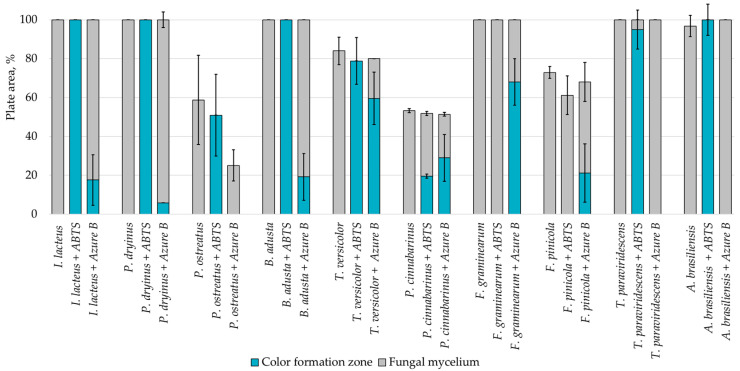
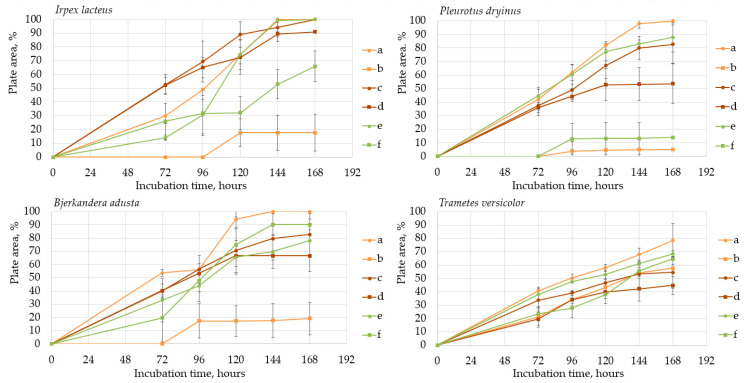
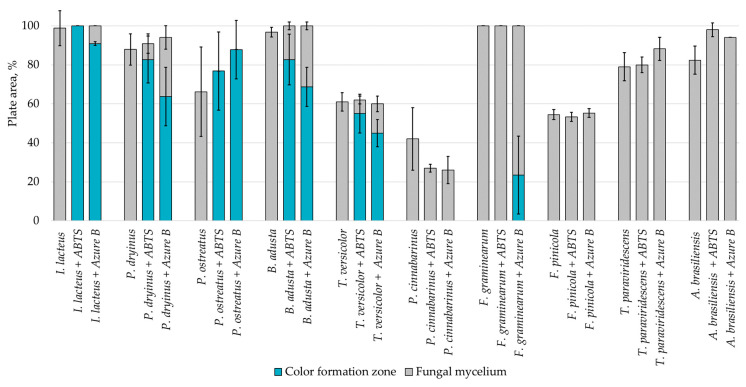
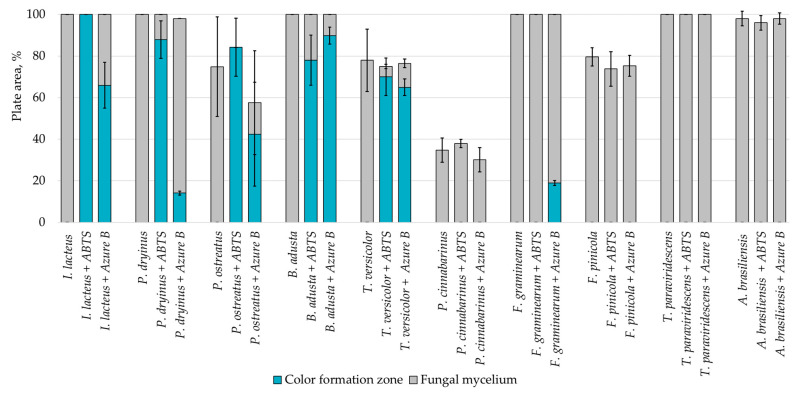
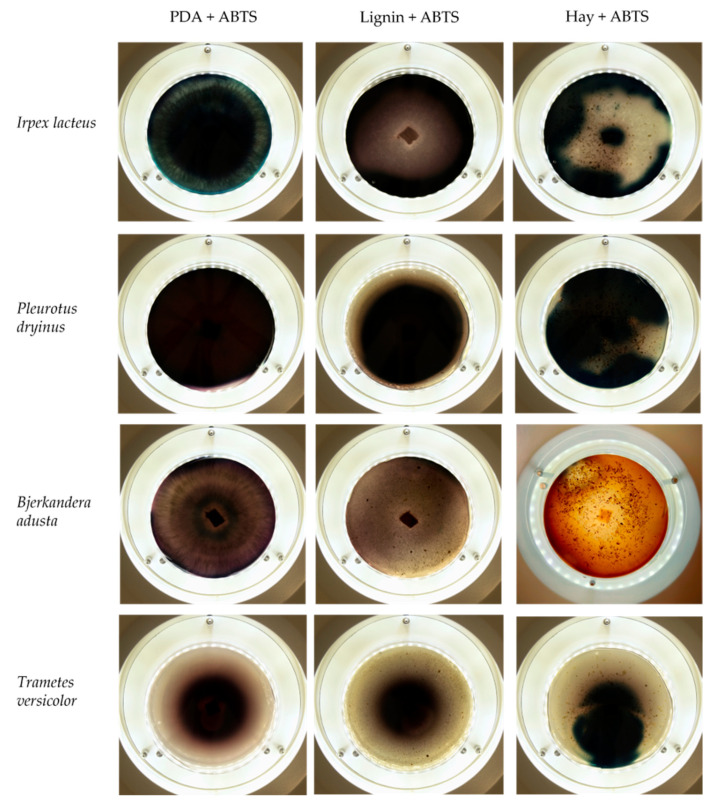
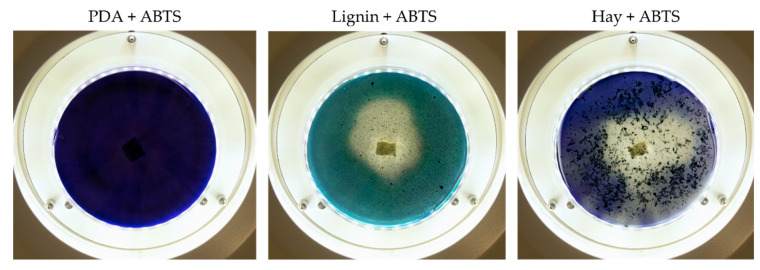
Lignocellulosic biomass is a significant source of sustainable fuel and high-value chemical production. However, due to the complex cross-linked three-dimensional network structure, lignin is highly rigid to degradation. In natural environments, the degradation is performed by wood-rotting fungi. The process is slow, and thus, the use of lignin degradation by fungi has not been regarded as a feasible technology in the industrial lignocellulose treatment. Fungi produce a wide variety of ligninolytic enzymes that can be directly introduced in industrial processing of lignocellulose. Within this study, screening of ligninolytic enzyme production using decolorization of ABTS and Azure B dyes was performed for 10 fungal strains with potentially high enzyme production abilities. In addition to standard screening methods, media containing lignin and hay biomass as carbon sources were used to determine the change in enzyme production depending on the substrate. All selected fungi demonstrated the ability to adapt to a carbon source limitation; however, four strains indicated the ability to secrete ligninolytic enzymes in all experimental conditions-, , , and -respectively displayed a 100%, 82.7%, 82.7%, and 55% oxidation of ABTS on lignin-containing media and 100%, 87.9%, 78%, and 70% oxidation of ABTS on hay-containing media after 168 h of incubation. As a result, the most potent strains of fungi were selected to produce lignocellulose-degrading enzymes and to demonstrate their potential application in biological lignocellulose pretreatment.
木质纤维素生物质是可持续燃料和高价值化学品生产的重要来源。然而,由于其复杂的交联三维网络结构,木质素极难降解。在自然环境中,木质素的降解由木腐真菌完成。但这个过程很缓慢,因此,利用真菌降解木质素在工业木质纤维素处理中尚未被视为可行技术。真菌能产生多种木质素分解酶,可直接应用于木质纤维素的工业加工。在本研究中,使用ABTS和天青B染料脱色法对10株具有潜在高产酶能力的真菌菌株进行了木质素分解酶产生情况的筛选。除了标准筛选方法外,还使用了以木质素和干草生物质为碳源的培养基来测定酶产量随底物的变化。所有选定的真菌都表现出适应碳源限制的能力;然而,有4株菌株显示出在所有实验条件下都能分泌木质素分解酶——菌株、、和分别在含木质素培养基上对ABTS的氧化率为100%、82.7%、82.7%和55%,在含干草培养基上孵育168小时后对ABTS的氧化率为100%、87.9%、78%和70%。结果,选出了最具潜力的真菌菌株来生产木质纤维素降解酶,并展示它们在生物木质纤维素预处理中的潜在应用。