Li Qi, Li Chengsi, Ye Qinghua, Gu Qihui, Wu Shi, Zhang Youxiong, Wei Xianhu, Xue Liang, Chen Moutong, Zeng Haiyan, Zhang Jumei, Wu Qingping
Key Laboratory of Agricultural Microbiomics and Precision Application (MARA), Guangdong Provincial Key Laboratory of Microbial Safety and Health, State Key Laboratory of Applied Microbiology Southern China, Institute of Microbiology, Guangdong Academy of Sciences, 510070, PR China.
Curr Res Food Sci. 2023 Jul 24;7:100554. doi: 10.1016/j.crfs.2023.100554. eCollection 2023.
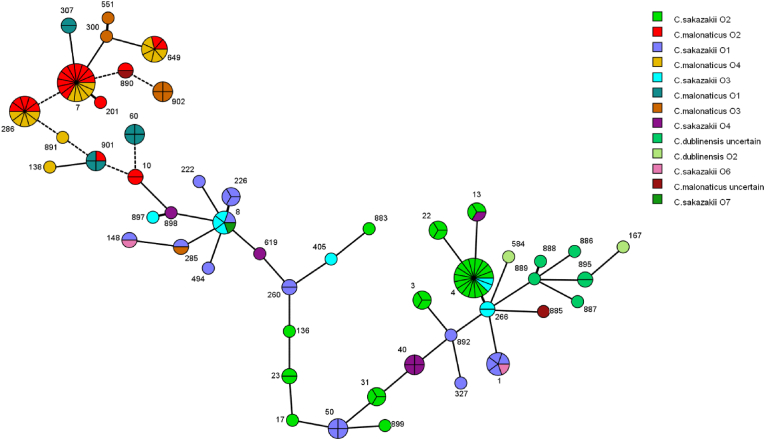
This study explored the prevalence of spp. in wet rice and flour products from Guangdong province, China, the molecular characteristics and antimicrobial susceptibility profiles of the isolates were identified. Among 249 samples, 100 (40.16%) were positive for spp., including 77 wet rice and 23 wet flour products. Eleven serotypes were characterized among 136 isolates with O2 (n = 32) predominating. Forty-nine MLST patterns were assigned, 15 of which were new. ST4 (n = 17) was the dominant ST, which is previously reported to have caused three deaths; followed by ST7 (n = 15), which is connected to adult infections. All strains presented susceptibility to ampicillin/sulbactam, imipenem, aztreonam and trimethoprim/sulfamethoxazole. The isolates showed maximum resistance to cephalothin, and the resistance and intermediate rates were 91.91% and 3.68%, each. Two strains, croM234A1 and croM283-1, displayed resistance to three antibiotics. High contamination level and predominant number of pathogenic STs of in wet rice and flour products implied a potential risk to public healthiness. This survey could provide comprehensive information for establishing more targeted control methods for spp.
本研究探讨了中国广东省大米和面粉制品中某菌属的流行情况,鉴定了分离株的分子特征和抗菌药敏谱。在249份样品中,100份(40.16%)某菌属呈阳性,包括77份大米制品和23份面粉制品。在136株分离株中鉴定出11种血清型,其中O2型(n = 32)占主导。确定了49种多位点序列分型模式,其中15种为新发现的模式。ST4型(n = 17)是主要的序列型,此前曾报道该型导致3人死亡;其次是ST7型(n = 15),与成人感染有关。所有菌株对氨苄西林/舒巴坦、亚胺培南、氨曲南和甲氧苄啶/磺胺甲恶唑均敏感。分离株对头孢噻吩耐药性最高,耐药率和中介率分别为91.91%和3.68%。两株菌croM234A1和croM283 - 1对三种抗生素耐药。大米和面粉制品中某菌属的高污染水平和主要致病序列型数量表明对公众健康存在潜在风险。本次调查可为建立更具针对性的某菌属控制方法提供全面信息。