Department of Nutritional Sciences, Faculty of Health and Medical Sciences, University of Surrey, Guildford, GU2 7XH, UK.
Institute for Global Food Security, School of Biological Sciences, Queens University Belfast, Northern Ireland, UK.
Br J Nutr. 2024 Jan 28;131(2):265-275. doi: 10.1017/S0007114523001873. Epub 2023 Aug 25.
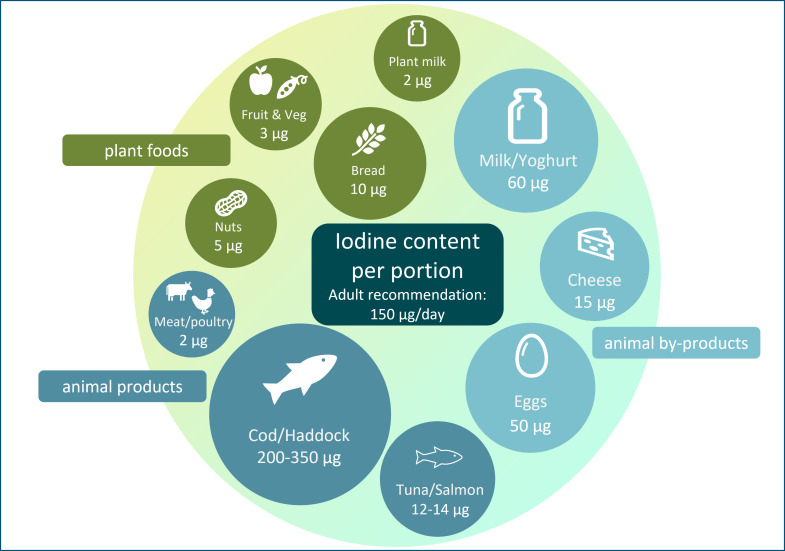
An increasing number of food-based recommendations promote a plant-based diet to address health concerns and environmental sustainability in global food systems. As the main sources of iodine in many countries are fish, eggs and dairy products, it is unclear whether plant-based diets, such as the EAT-Lancet reference diet, would provide sufficient iodine. This is important as iodine, through the thyroid hormones, is required for growth and brain development; adequate iodine intake is especially important before, and during, pregnancy. In this narrative review, we evaluated the current literature and estimated iodine provision from the EAT-Lancet reference diet. There is evidence that those following a strict plant-based diet, such as vegans, cannot reach the recommended iodine intake from food alone and are reliant on iodine supplements. Using the EAT-Lancet reference diet intake recommendations in combination with iodine values from UK food tables, we calculated that the diet would provide 128 μg/d (85 % of the adult recommendation of 150 μg/d and 51–64 % of the pregnancy recommendation of 200–250 μg/d). However, if milk is replaced with unfortified plant-based alternatives, total iodine provision would be just 54 μg/d (34 % and 22–27 % of the recommendations for adults and pregnancy, respectively). Plant-based dietary recommendations might place consumers at risk of iodine deficiency in countries without a fortification programme and where animal products provide the majority of iodine intake, such as the UK and Norway. It is essential that those following a predominantly plant-based diet are given appropriate dietary advice to ensure adequate iodine intake.
越来越多的基于食物的建议提倡植物性饮食,以解决全球食品系统中的健康问题和环境可持续性。由于许多国家的碘主要来源是鱼类、鸡蛋和奶制品,因此尚不清楚植物性饮食(如 EAT-Lancet 参考饮食)是否能提供足够的碘。这很重要,因为碘通过甲状腺激素,是生长和大脑发育所必需的;在怀孕前和怀孕期间,足够的碘摄入尤其重要。在本叙述性评论中,我们评估了目前的文献,并估计了 EAT-Lancet 参考饮食中碘的供应情况。有证据表明,那些遵循严格植物性饮食的人,如素食主义者,无法仅从食物中获得推荐的碘摄入量,而依赖于碘补充剂。我们使用 EAT-Lancet 参考饮食摄入建议,并结合英国食物表中的碘值,计算出该饮食将提供 128 μg/d(成人推荐量 150 μg/d 的 85%,孕妇推荐量 200-250 μg/d 的 51-64%)。然而,如果用未强化的植物性替代品代替牛奶,总碘供应将只有 54 μg/d(成人和孕妇推荐量的 34%和 22-27%)。在没有强化计划且动物产品提供大部分碘摄入的国家,如英国和挪威,植物性饮食建议可能会使消费者面临碘缺乏的风险。对于那些主要食用植物性饮食的人,必须给予适当的饮食建议,以确保足够的碘摄入。